A Brain Implant Entered the Insurance System
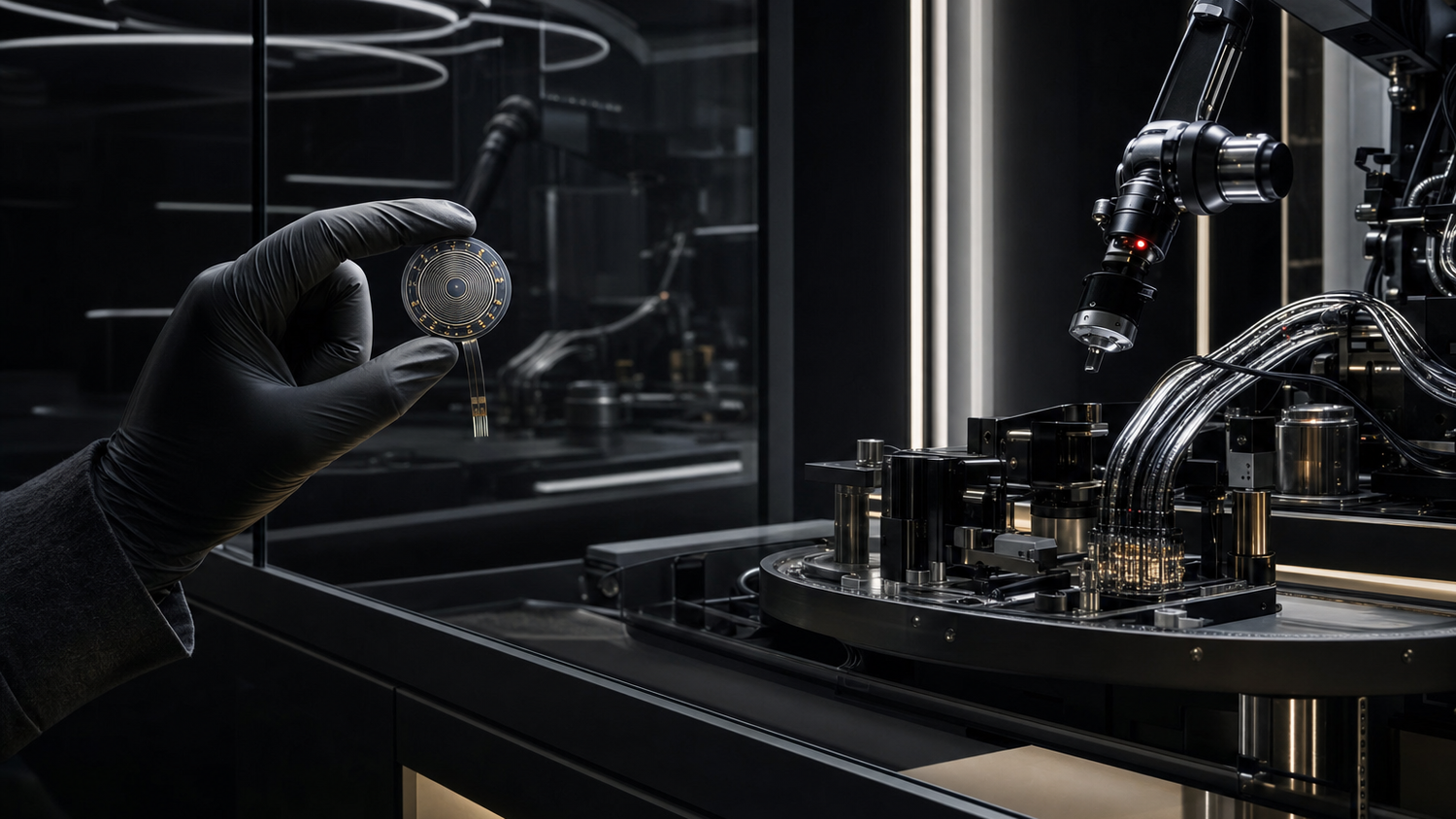
For ten years after a traffic accident, a patient in Shanghai could not close his hand around a cup. Rehabilitation had reached its limit. On July 13, 2026, surgeons at Huashan Hospital placed a coin-sized brain-computer interface on the surface of his brain. The system recorded neural signals associated with intended movement. A connected device could then help translate that intention into hand motion.
The operation matters for reasons that extend beyond the implant. South China Morning Post reported that the NEO device had received approval from China’s National Medical Products Administration on March 13. Four months later, it had moved through production, hospital introduction, patient screening, a commercial procedure and reported inclusion in local commercial health insurance. A medical technology had crossed several institutional borders in one season.
Practical takeaway. The decisive neurotechnology race now runs through regulators, hospitals and insurers as well as laboratories. Clearance establishes a lawful route to market; prescription, payment, clinical follow-up and neural-data stewardship determine whether that route becomes durable care.
The four-month institutional chain
Brain-computer interfaces have spent decades producing remarkable demonstrations. A person imagines a movement; electrodes detect a pattern; software translates the signal; a cursor, robotic arm or assistive device responds. Each stage can be scientifically impressive while the whole system remains confined to a research protocol.
The Shanghai sequence reached a different category. According to the July 15 SCMP report, NEO became commercially prescribable after its March 13 approval. Huashan Hospital performed the first reported commercial operation on July 13. The account says the procedure produced stable epidural signals and that the patient was recovering with stable vital signs. Those are early perioperative observations, not proof of durable functional benefit. They still mark a handoff from experimental access to a commercial clinical pathway.
That handoff distributes responsibility. The manufacturer must produce a consistent device. The hospital must select patients, perform surgery and manage follow-up. The regulator must define the approved use and watch the device after market entry. An insurer that finances treatment must decide eligibility and payment. The patient lives with the consequences of every one of those choices.
A device on the brain’s surface
NEO is described as an invasive brain-computer interface because implantation requires surgery. Its electrodes sit epidurally, on the outer surface of the brain without penetrating brain tissue. That physical design differs from systems that insert electrode threads into tissue. The distinction can affect signal resolution, surgical risk, tissue response and long-term stability. Public reporting does not yet support a clean winner across those dimensions.
The approved use is also narrower than the futuristic label “brain chip” suggests. The system is intended to assist hand movement for people with paralysis associated with spinal cord or neck injury. In the reported case, neural signals are translated into support for hand motion. The humane measure is plain: reaching, grasping and drinking independently. Grand claims about cognitive enhancement or direct thought transfer do not belong in this case.
A narrow indication is a form of governance. It tells clinicians and patients what the regulator has actually assessed. It also gives post-market monitoring a defined starting point. Expansion to stroke rehabilitation or other uses would require its own clinical and regulatory record.
Insurance turns innovation into allocation
Clearance permits a product to enter the market. Reimbursement determines how far it can travel. Reporting from Shanghai says NEO was added to local commercial health insurance within four months of approval. City News Service identified Huhuibao, Shanghai’s supplementary insurance scheme, while SCMP used the more cautious formulation “local commercial health insurance.” The exact benefit terms, exclusions and patient contribution deserve primary-document confirmation before anyone treats the reported inclusion as universal coverage.
Even with that caveat, the reimbursement move changes the governance problem. An insurer needs a covered indication, a price, an eligible population and a way to judge claims. A hospital needs capacity to implant and support the device. Patients need continuity if the manufacturer updates the software, changes hardware or exits the market. Health systems eventually need comparative outcomes: function gained, complications, durability, rehabilitation burden and quality of life.
This is where neurotechnology meets health economics. A spectacular procedure can reach a few patients through trials or private payment. A reimbursable procedure creates an allocation system. It turns questions of access, benefit and opportunity cost into institutional choices.
Neural data enters ordinary administration
The implant also creates an unusual data relationship. Neural signals are health data, but they can reveal intention and patterns of behavior at a level that feels closely tied to personhood. A clinical system may process raw signals, inferred commands, calibration data, device logs and rehabilitation outcomes. Different actors can hold different layers: patient, hospital, device maker, software provider and insurer.
UNESCO’s member states adopted the Recommendation on the Ethics of Neurotechnology by consensus in November 2025. The instrument addresses mental privacy, autonomy, identity, non-discrimination and access. Shanghai’s commercial case gives those principles an operational setting. Consent must remain meaningful over time. Cybersecurity must cover the implant and its connected components. A person should not lose essential functionality because a service contract, software version or corporate owner changes.
The comparison with ordinary medical devices is useful and incomplete. Pacemakers and cochlear implants already depend on software, clinical support and long-term manufacturer stewardship. A brain-computer interface adds a more intimate signal stream and a machine-learning layer that may adapt to the patient. Earlier Quentir analysis on AI accuracy claims showed why performance statements need their conditions attached. For an implanted interface, those conditions include the patient population, task, training period, assistance device and duration of follow-up.
The global race has more than one finish line
Public discussion often frames neurotechnology as China versus Neuralink. That shorthand misses the institutional contest. The United States has deep research capacity, established device regulation and active human trials. China has now shown a reported route linking national clearance, a leading hospital, commercial surgery and insurance inclusion. Other jurisdictions may move more slowly while imposing different requirements for clinical proof, data protection, reimbursement or liability.
Speed can reveal capacity without proving superiority. A four-month transition says that manufacturing, clinical sites and financing were prepared to move together. It does not establish long-term safety, functional durability or comparative effectiveness. Those questions require years of follow-up and public reporting. The first operation is the beginning of the post-market story.
How Quentir Reads It
The important unit is the institutional chain: device design, approved indication, surgical capacity, rehabilitation, payment, data stewardship and post-market accountability. Each link can fail independently. A technically successful implant can remain inaccessible. A reimbursed implant can produce uneven outcomes. A strong clinical program can still leave patients exposed to software abandonment or unclear neural-data rights.
That chain also explains why neurotechnology belongs beside AI governance, medical-device law, insurance design and competition policy. The device maker may control proprietary hardware and decoding software. Hospitals accumulate specialized skill. Insurers shape demand through coverage. Regulators decide how much new proof is needed when an adaptive component changes. Market power can settle around the interface long before a broad public debate catches up.
Quentir’s Signature Report format is built for this kind of cross-domain issue, adding fixed scope, an executive summary, a dated source spine, refresh triggers and an internal-use license. This free analysis follows one commercial transition and stops well short of a paid edition’s comparative jurisdictional and product assessment.
The next revealing date will not be another launch announcement. It will be the first credible follow-up showing who received the device, what function persisted, which complications occurred and how coverage worked in practice. A cup lifted independently months after surgery would carry more meaning than any global-race headline.
Sources: South China Morning Post, “China completes world’s first commercial brain-computer interface implant”, published July 15, 2026; South China Morning Post, “In a first, China’s Neuracle wins approval for implantable brain-computer interface”, March 13, 2026; City News Service, “A World First Medical Breakthrough in Shanghai”, July 15, 2026; UNESCO, Recommendation on the Ethics of Neurotechnology, adopted November 2025. Public-source snapshot: July 16, 2026.
Published intelligence, built to inform your own decisions. Published: July 16, 2026.