
Can a quantum computer stay calibrated long enough to matter?
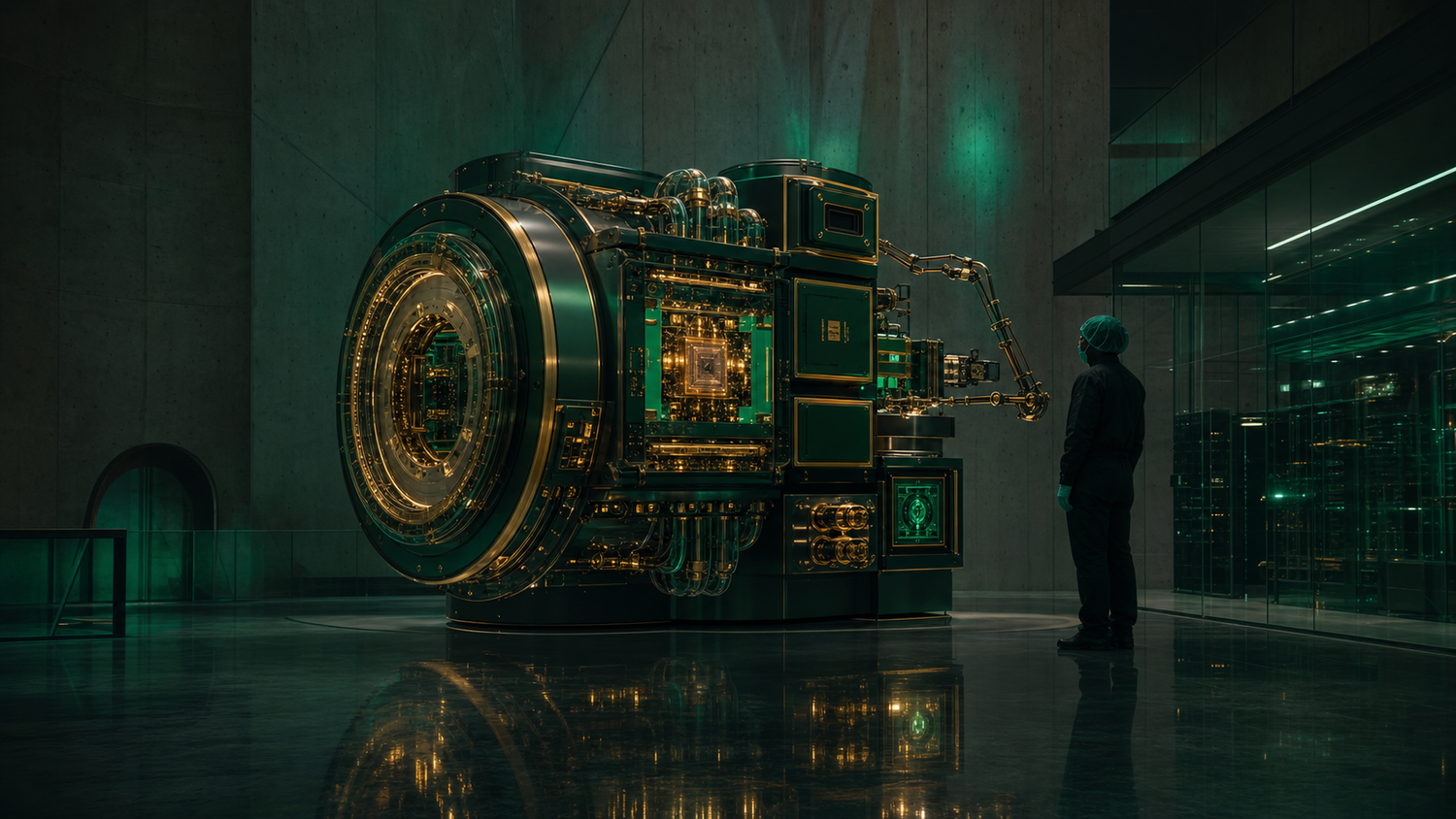
A factory that has to stop every few minutes is not a factory yet. It may contain brilliant machinery, expensive sensors and a capable control room, but if the line must be halted whenever heat, vibration or drift enters the system, the output remains experimental. That is a useful way to read the 8 July 2026 Nature paper, “Reinforcement learning control of quantum error correction”. Its subject sounds technical. Its governance meaning is plain: a quantum computer becomes socially consequential when it can keep running.
The paper’s central constraint is calibration. Quantum computers are analogue machines trying to behave digitally enough to support reliable computation. Quantum error correction turns fragile physical errors into repeated “error” or “no error” signals that a decoder can use. That only works while the physical gate error rate stays below the relevant threshold. Real hardware drifts. Traditional calibration can restore performance, but the familiar method is blunt: stop the error-correction process, recalibrate the system, and start again.
Practical takeaway. The post-quantum clock is not only a qubit-count question. If quantum-control systems learn to keep error-corrected machines stable during computation, runtime becomes a concrete signal for security migration, procurement diligence and public trust.
A deep read of the runtime bottleneck
The Nature result targets the stop-start problem directly. The authors repurpose the error-detection events produced inside quantum error correction as a learning signal for an artificial-intelligence controller. Instead of treating syndrome data only as a way to infer corrections to the logical state, the system also uses those events to steer physical control parameters while computation continues. The important phrase in the paper is “continuously maintaining” performance amid non-stationarity. That is an engineering sentence with legal and commercial consequences.
The consequence is runtime. The paper notes that useful future algorithms may require continuous execution times on the order of days or months. It cites resource-estimate work on factoring 2048-bit RSA integers with fewer than one million noisy qubits. That does not mean a cryptographically relevant quantum computer has arrived. It means the path to one may depend less on one theatrical leap in hardware scale and more on the unglamorous ability to keep a machine below threshold without pulling it off the track.
Why this matters for encrypted life
Long-running computation maps onto long-lived secrets. The public debate often describes post-quantum risk as a future “Q-Day”. That shorthand is too theatrical. The more serious problem is that medical records, financial credentials, identity systems, government communications and industrial designs can remain sensitive for decades. An adversary does not need today’s quantum computer to read tomorrow’s data if it can collect ciphertext now and wait for the control layer to mature.
This is where the human stake enters. Post-quantum migration can sound like a bank-infrastructure chore or a standards exercise. It is also about whether families can trust that health histories, payment identities, pension records, private correspondence and public-service files will not become readable because institutions treated cryptographic migration as optional until the demonstration was undeniable. The Nature paper is not a policy document. It still speaks to policy because it changes what competent timing analysis should watch.
The architecture signals are moving in the same direction
The day’s other quantum sources point to the same substrate question. ETH Zurich researchers, reported on 9 July 2026 by The Quantum Insider, demonstrated a superconducting architecture with mechanical resonators as quantum working memory, separating processing from storage in a way modeled on classical computers. The group implemented the Quantum Fourier Transform and a period-finding algorithm. That does not make the device commercially ready. It does show why memory, density and storage lifetime now belong in the same conversation as gates and qubit counts.
Control hardware is also becoming a standards story. The 9 July synthesis flagged HiSEP-Q 2, a RISC-V vector control engine reported as addressing 128 qubits in one instruction, with a 2.52× program speedup and an 80 ns halt-resume path after mid-circuit measurement. Its own limits matter: deep sequential circuits do not vectorize neatly. But the RISC-V connection is a warning that quantum control may become a portable industrial layer, not a vendor-private laboratory artifact. Once control planes standardize, procurement, export, assurance and liability questions follow.
Standards arrive before the machine is finished
Europe’s QKD work shows the opposite direction of travel. A 7 July 2026 arXiv report tested real-time VPN traffic over ETSI GS QKD 014 key delivery using a LuxQuanta NOVA platform, carrying ETSI key identifiers in-band and encrypting IP traffic with AES-256-GCM. QKD and PQC are not substitutes in every architecture, and Quentir has been careful in earlier coverage such as the Department of War quantum-safe analysis to distinguish approved migration paths from technologies that a particular authority excludes. The QKD example still matters because it shows standards integration moving into field prototypes while fault-tolerant computation remains unfinished.
The institutional lesson is uncomfortable. Standards, pilots and contractual claims will mature while the physics remains contested. That is normal in infrastructure. Railways, aviation, electricity grids and medical devices all developed governance before every technical question was settled. Quantum will be no cleaner. The responsible posture is to separate what is ready for deployment, what is ready for monitoring, and what is only a research signal that changes the risk horizon.
The market may misread the signal
Investors like visible machines and public roadmaps. The more important signal may be maintenance: calibration, memory, cooling, readout, control, certification and software engineering. Semiconductor Engineering’s 9 July industry piece quoted QED-C executive director Celia Merzbacher on quantum as a likely accelerator layer, closer to GPUs added to high-performance computing than to a computer in every office closet. It also pointed to application-specific platforms for workloads that the military or drug companies are willing to pay for. That framing fits the day’s academic sources on quantum chemistry, nonlinear dynamics and protein-structure sampling.
The business risk is overclaim. A vendor can sell the story of a powerful future machine before it can prove stable runtime, calibrated control, reproducible outputs or secure integration. Recent Quentir coverage of AI accuracy claims becoming the product applies here by analogy: when capability is marketed ahead of verification, the claim itself becomes an object of governance. For quantum, the claim should be tested against runtime, not only against a glossy hardware number.
How Quentir Reads It
Quentir’s reading is that the control layer has become strategic. The most consequential movement on 9 July is not a new regulation. It is the narrowing distance between physical stability and cryptographic relevance. Better runtime does not prove that RSA will fall on a fixed date. It does make weak migration excuses less credible, especially for institutions holding records whose value outlives the systems that created them.
For readers tracking this as an archive problem, Quentir’s All-access membership is the relevant bridge: it keeps the connected record of public sources, executive summaries, refresh triggers and related Quentir analysis in one place, including the PQC, quantum-security and standards threads that a single free post can only sample. The free point here is narrower and urgent enough: add calibration and continuous runtime to the watchlist for post-quantum readiness.
The next credible warning may not be a bigger chip photograph. It may be a quieter sentence in a paper or system note: the machine stayed below threshold while the work continued. When that sentence becomes routine, the governance conversation will already be late.
Published intelligence, built to inform your own decisions. Published: 9 July 2026.
Sources: Nature, “Reinforcement learning control of quantum error correction” (8 July 2026); The Quantum Insider, “ETH Zurich Demonstrates Quantum Computer Architecture With Mechanical Working Memory” (9 July 2026); Semiconductor Engineering, “Where Does Quantum Computing Stand?” (9 July 2026); arXiv, “Real-Time VPN Traffic over ETSI GS QKD 014 Key Delivery with a LuxQuanta NOVA QKD Platform” (7 July 2026); Quentir public-source snapshot: 9 July 2026.
Published intelligence, built to inform your own decisions. Published: July 9, 2026.
Wondering where your own organization stands on the post-quantum transition? The Quantum Readiness Scanner turns one hour of self-assessment into a board-ready report within three business days.