
DOE's Quantum Computing Roadmap of 25 September 2026 Sets 50 to 100+ Logical Qubits for 2028: How the SCAC Report's Targets Compare With the Genesis Q Competition
What DOE released on 25 September 2026
The Department of Energy's Office of Science has published the report of its advisory committee's quantum subcommittee, SCAC Quantum Committee Report: A Pathway to an Integrated Quantum Future. The subcommittee, chaired by Anna Grassellino of Fermilab with Supratik Guha of the University of Chicago as vice chair, was asked for a roadmap toward scientifically useful, fault-tolerant quantum computing by 2028 and a long-term plan for a DOE Quantum Computing User Facility. DOE's announcement describes the goal as a scientifically relevant, error-corrected quantum computer by 2028.
Which numbers the report attaches to 2028
One figure in the 58-page report gives the 2028 column concrete values: roughly 50 to 100+ logical qubits, 104 to 105 hard logical operations, a full scientific calculation returned within 24 hours, and independent validation against experiment or classical limits. The text calls these illustrative performance ranges.
How the Genesis Q Competition turns the same numbers into milestones
Eight days earlier DOE opened the Genesis Q Competition. Its published sample agreement asks for circuits on at least 100 logical qubits, standardized across awardees and sized at roughly 104 to 105 hard operations, with the results checked by a DOE verification team at an evaluation date DOE currently anticipates in September 2028. This post compares advisory ranges with negotiated, independently verified milestones.
Commerce Finalized a $1 Billion CHIPS Award to IBM's Anderon on 16 September 2026 for a 300 mm Quantum Wafer Foundry in Albany; the Release Calls It Pure-Play, and Names No Customer Other Than IBM
What was finalized on 16 September 2026
Anderon LLC, the quantum foundry subsidiary IBM formed in May 2026, announced that its $1 billion CHIPS and Science Act award with the US Department of Commerce is final. The award funds research and development at a 300-millimeter wafer fab in Albany, New York; IBM contributes a further $1 billion in cash. The company says the first quantum wafers are already running through the line, for superconducting qubit arrays, quantum input/output signaling and readout signal chain components, with other modalities to follow. It is the largest single item in the $2.013 billion quantum portfolio Commerce announced through nine letters of intent on 21 May 2026.
The claim under test: pure-play
Both IBM releases call Anderon a pure-play quantum foundry. In the semiconductor industry that phrase has a precise meaning since TSMC's founding in 1987: a fab that sells manufacturing and sells no chips of its own, so that customers who compete with each other can trust it with their designs. Anderon is described only as an IBM company, the release quotes IBM Research's director on IBM's own roadmap as the need Anderon meets, and the May release says additional investors are expected as Anderon grows. Anderon's website promises that the manufacturing partner will never compete with a customer's products. No external customer is named in either release.
Why the distinction matters for public money
Commerce is funding two quantum foundries under different theories: Anderon for superconducting wafers, and GlobalFoundries' $375 million foundry for five modalities. Whether Anderon becomes a shared national quantum wafer manufacturing base for companies that compete with IBM is a question the public documents leave open; the first non-IBM wafer customer, and the terms that protect its designs, are not yet public.
The US-Taiwan Agreement on Reciprocal Trade Signed on 12 February 2026 Commits Taiwan's Government to No New Quantum, AI or Biotech Research Arrangements With Authorities of Countries of Concern
What Taiwan signed on 12 February 2026
The Agreement on Reciprocal Trade between the United States and Taiwan, concluded through the American Institute in Taiwan and the Taipei Economic and Cultural Representative Office, carries a Section 5 headed Economic and National Security. Article 5.2 aligns Taiwan's export controls with those in force in the United States, including the Foreign Direct Product Rule on semiconductors, and its ninth paragraph commits the Taiwan side to robust research security and to no new agreements, partnerships or similar arrangements for science and technology cooperation with authorities of countries of concern, especially in artificial intelligence, biotechnology and quantum computing. The agreement is signed; under Article 7.5 it enters into force the day after the last notification that internal procedures are complete, and the February USTR fact sheet says the Taiwan side will submit it to its legislature for review. Whether that notification has since been given is not stated in any USTR release this post could find.
What the University of Calgary paper adds
Carlo Dade and Alex Giordano of the School of Public Policy compared the 21 Agreements on Reciprocal Trade the United States had concluded by August 2026. They range from formal trade agreements to frameworks, memorandums and news releases, all executive arrangements with no congressional participation. Nearly every one contains provisions aimed at limiting China's role in the partner's economy; Malaysia agreed to mirror US export controls with equivalent restrictive effect, and Taiwan's Foreign Direct Product Rule alignment was matched by no other deal they reviewed.
Why it matters beyond Taiwan
A government commitment to enter no new research arrangements with authorities of countries of concern, quantum computing named among the fields, is carried by a trade arrangement that either side can terminate on six months' notice, with no export-control rule of that kind on the books. The Calgary paper, like The Logic, reads the clause as aimed at China; the text itself names no country. This post reads the clause, the eight paragraphs around it, and what the same template would mean for Canada, for Europe's research-security rules and for the physicists whose collaborations will be tested against it.
Rigetti and D-Wave Disclosed the Equity Terms on Their $100 Million CHIPS Quantum Awards: What the 4-8 September 2026 Agreements Say the Government Gets
What the three companies signed between 4 and 8 September 2026
Rigetti Computing and D-Wave Quantum both date their CHIPS and Science Act award agreements with the U.S. Department of Commerce to 4 September 2026. Rigetti entered the accompanying securities agreement on 8 September, with the share issuance expected the same day; D-Wave's filing states that it will enter its securities agreement and report issuance afterward. Both filings disclose a minority, non-controlling equity stake for Commerce as a condition of the award. Quantinuum announced finalization of its own $100 million CHIPS research award on 8 September; that release confirms the award and its manufacturing partners and discloses no equity, voting or issuance terms. All three sit inside a federal program of about $2 billion across nine companies announced in May 2026.
Why the instrument matters more than the amount
A grant closes when its milestones are audited. Stock does not close. Rigetti's agreement generally bars Commerce from voting the shares except on specified class-rights and business-combination matters, and D-Wave describes similarly narrow rights, so the department's leverage sits elsewhere: in transfer restrictions, registration rights, repurchase mechanics, intellectual property licenses, march-in rights and award remedies. The August 2025 Intel conversion is the ancestor of the mechanism and an imperfect precedent, because that stake is expressly passive, with no board seat and no governance or information rights.
Three public payments, three visibility regimes
Appropriated research money reports to Congress and federal equity reports through securities filings. A third payment is far harder to see: Cook County's Class 8 MICRO classification would cut the assessment rate on Chicago's South Works quantum campus from 25 percent to 10 percent for thirty years, an estimated $175 million reduction, subject to city and county review, with no community benefits agreement signed. This post reads the three instruments together, sets them beside the public auditing the science is already doing on itself, and asks what a public shareholder in quantum computing would need in order to know whether the position is working.
NEC Stopped Building Quantum Computers in March 2026, Twenty-Seven Years After Its Tsukuba Lab Made the First Superconducting Qubit
A 1999 result and a 2026 withdrawal, from the same company
NEC researchers at the Fundamental Research Laboratories in Tsukuba demonstrated the first coherent control of a superconducting qubit in a paper Nature received on 26 January 1999 and published on 29 April. That single-Cooper-pair box is the direct ancestor of the transmon circuits used at Google, IBM and Fujitsu. At the end of March 2026, NEC closed its own superconducting hardware program. Japanese outlets reported the shutdown between 4 and 7 September 2026, and NEC's press office declined to go beyond a line about continuing technical assessment.
What the 2022 Cabinet Office submission showed, and what NEC announced
On 6 December 2022 NEC filed a slide deck with Japan's Cabinet Office working group on practical quantum applications. Page 10 charts a four-qubit basic unit of superconducting parametrons scaling to 100 qubits and then past 1,000, for the quantum annealer. The hardware NEC went on to announce was an eight-qubit parametron annealing machine built with the National Institute of Advanced Industrial Science and Technology, offered to Tohoku University over the internet from June 2023. No public announcement of a 100-qubit NEC machine has been found.
Two European decisions from the same period point the other way
NEC judged the payback horizon too long. Days before the reporting appeared, the Novo Nordisk Foundation confirmed a 5,300-square-meter quantum chip plant for Copenhagen, and a European Commission official told a Parliament audience that the forthcoming EU Quantum Act "is not about budget." Three institutions, one question about how long to wait for quantum hardware to pay, three different answers.
Four Documents of 4 August to 3 September 2026 Name a Requirement Before Its Test Exists: G7 Post-Quantum Procurement, the NSCEB Implant Gap List, Quantum Sensing and the Ninth Circuit's Agent Ruling
Four documents issued between 4 August and 3 September 2026, read together in the week of 29 August to 4 September, each name a requirement their own sources cannot yet test
On 3 September 2026 the G7 Cybersecurity Working Group wrote public procurement into the transition to post-quantum cryptography, the same day a deployed-silicon preprint reported a class of ML-DSA defects that known-answer tests do not reach. On 2 September a United States congressional commission listed what the country lacks before an implantable brain-computer interface can reach a patient, with active reimbursement coverage on the list. On 27 and 28 August a quantum navigation supplier named the defense organizations it works with while a submission to the independent AUKUS Public Inquiry described quantum magnetic sensing as a threat to submarine stealth. And the Ninth Circuit's ruling of 4 August, attributing computer access to the user when an AI agent acts, met a research preview of 27 August in which agents operate laboratory pipettes.
The shape the four share, and where its cost lands
In each case the sources themselves identify a gap between the requirement and the capacity to meet or verify it: a conformance suite that a preprint shows cannot see a defect class, an approval in one jurisdiction with no coverage decision in another, adjacent sensing capabilities evaluated as a purchase by one office and as a threat by another, and an access ruling built on a record of screenshots where the laboratory example has none. The cost of the gap falls on whoever signs the document the requirement calls for. This long read sets the four side by side and draws one question per pillar for the people who will be asked to sign, with the founder's two War on the Rocks essays, on testing deployed systems and on a single accountable office at the National Security Council, holding the two ends of the answer for quantum governance.

Five Fault-Tolerance Preprints of 2 and 3 September 2026 Test the Assumptions Behind Low-Qubit Q-Day Estimates: Logical Gates on qLDPC Codes, Ion Crystals, GKP Lattices, Noisy Links and Decoders
Five research teams posted fault-tolerance preprints within two days, each on a different component of a protected computation
Between 2 and 3 September 2026 five preprints on fault-tolerant quantum computation appeared on arXiv from five research teams: two on computing with quantum low-density parity-check codes, and three on the encoding, the inter-module links and the decoding such a computation would need. Rahul Sahay, David Long and Vedika Khemani built a framework that puts logical Pauli, Clifford and non-Clifford gates on qLDPC codes in one homological language and used it to find constant-depth implementations of the full Clifford group on toric-code blocks and addressable CCZ gates in three dimensions. Tang, Duan and Wu showed how to run the nonlocal gates such codes need on a two-dimensional crystal of 512 ions without moving any of them, and simulated a logical error rate of one in a trillion. Hillmann, Eisert and Arzani lifted low-density lattice codes into the bosonic GKP setting. Schmidt and five co-authors halved the distillation distance needed for fault tolerance across modules joined by noisy Bell pairs. Liu, Zeng, Wu and Lao recovered discarded decoder samples to close up to 83 percent of the gap between practical and optimal decoding.
Where the gate count meets the migration calendar
A high-rate code stores many logical qubits in few physical ones; the open question has been what a gate on such a code costs. That cost is one of the quantities inside any estimate of when a cryptographically relevant attack on RSA or elliptic-curve keys becomes feasible. The Oratomic-led estimate of 30 March 2026 by Madelyn Cain and co-authors, 10,000 neutral-atom qubits for Shor's algorithm, rested in its authors' words on high-rate codes and efficient logical instruction sets, and Cloudflare cited that estimate among the developments behind its 7 April roadmap, which targets completion of its network migration in 2029. Mauritz Kop and Joseph Federici wrote in July that falling estimates make quantum readiness a present coordination problem with lead times of a decade or more, and these five papers are the week's work on the assumptions inside such estimates.
The question to put to any resource estimate
This post reads the five papers together and draws one diligence rule from them: a claim about how many physical qubits break an RSA or elliptic-curve key is only as good as the logical gate set it assumes, and that set is now being worked out paper by paper. Which of the five results a given estimate relies on is the question a committee can ask, and a reader of this site can check.

Quantinuum's C4-Helix Code on Helios, 2 September 2026: Two Logical Qubits in Twenty Ions, the Full Clifford Group, and What the Paper Says It Has Not Done
A twenty-qubit code carried two logical qubits, computed on them, and handed them to another code
On 2 September 2026 a Quantinuum team posted arXiv:2609.03194, reporting three experiments on the company's 98-qubit Helios trapped-ion processor with a [[20,2,6]] C4-Helix code: twenty physical qubits holding two logical qubits at distance six. Repeated error correction over twenty rounds gave a logical error of 4.6 × 10⁻⁵ per logical qubit per cycle, down from 2.1 × 10⁻⁴ for the smaller [[10,2,3]] code on the same machine. Randomized benchmarking of the complete Clifford group on the two logical qubits, with active correction between gates, gave 2.8 × 10⁻⁴ per two-qubit logical Clifford against 1.2 × 10⁻³ for unencoded ions. A chain-map CNOT into a 25-qubit distance-five surface code prepared a three-qubit GHZ state at a fidelity lower bound of 99.925 percent against 99.54 percent physical. None of the three figures relies on discarding failed runs; the Clifford and GHZ results beat their stated physical baselines, and the memory result improved on the smaller logical code.
What the authors say is still missing
The paper's discussion section states that no universal Clifford+T computation was implemented, that the non-Clifford resource states must be imported through the interface just demonstrated, and that the measured error rates sit around 10−4 where the early fault-tolerant regime the authors target begins at 10−6. Their simulations put that regime within reach once physical two-qubit infidelity improves by about an order of magnitude from the 7.9 × 10⁻⁴ reported in the Helios technical paper of 7 November 2025. Decoding for the memory experiment was done offline, and the confidence interval on the memory figure runs from 2.0 × 10⁻⁵ to 1.08 × 10⁻⁴.
The four numbers a proposal should carry
This post reads the result against the processor's own baseline and draws one diligence rule from it: a logical error rate is meaningful only beside the physical rate on the same machine, the physical qubits consumed per logical qubit, and the set of operations the code can perform while protected. This paper supplies all four and names what it has not done, which is the form a checkable error-correction claim takes.
An Author of D-Wave's 2025 Advantage Paper Simulated All Four of Its Graph Topologies Classically: What Roeland Wiersema Published on 1 September 2026, and the GPU Hours It Took
An author of the 2025 advantage paper published the classical answer
On 12 March 2025 D-Wave published quench dynamics of spin glasses run on an Advantage2 annealing processor in Science, and estimated in its announcement that the same simulation would have taken the Frontier supercomputer at Oak Ridge nearly a million years and more electricity than the world uses in a year. On 1 September 2026 Roeland Wiersema, the fifth of the sixty-two authors on that paper and now at the Flatiron Institute's Center for Computational Quantum Physics, published a classical simulation covering all four of the experiment's problem graphs.
What the new paper reports, and on which instances
Using time-dependent variational Monte Carlo with a path-factorized correlator state, Wiersema reports final two-spin correlation errors on par with the processor for the sizes where converged reference data exists, and a relative two-spin correlation error of about 7.6 percent against the processor's data on a 72-spin biclique instance, a topology tensor-network methods handle least well. He notes that no other variational method is known to produce a correct state at that scale. The technical content is three numerical repairs: parallel tempering for slow Markov chains, blurred sampling for high-variance estimators, and an importance-weighted adaptive integrator.
The price of the result, stated by its author
The paper prices itself. The simulations took hundreds of GPU hours where the processor returns the same correlations in seconds, the largest instances of the original experiment stay out of reach, and an entire instance class is left untouched. Wiersema writes that the findings sharpen the question of quantum advantage without settling it, and his acknowledgments thank two D-Wave scientists for discussions during the work. We read the sequence from the March 2024 preprint through two classical preprints in March 2025, a D-Wave-led evaluation in August 2025 and two papers in 2026, and what it leaves for anyone judging a vendor's performance claim.
ESA's QKDSat Photon Source Passed Space Qualification in Valencia on 1 September 2026, and the NCSC Will Not Accept QKD for UK Government Use
What DAS Photonics qualified in Valencia on 1 September 2026
ESA announced that DAS Photonics has completed qualification of the Engineering Qualification Model of the Faint Pulse Source, the optical source that generates the pulses QKDSat uses to distribute keys from orbit. The unit was qualified to European Cooperation for Space Standardisation requirements at the ESA-VSC testing facility in Valencia and handed to Redwire Europe. ESA describes it as the most advanced qualified faint pulse source with embedded security mechanisms in Europe for a satellite-based quantum key distribution system. QKDSat runs under the ARTES programme, with Honeywell Aerospace, Redwire Europe and DAS Photonics named as partners.
What Britain's NCSC says about QKD, and for whom
The National Cyber Security Centre's paper on quantum networking technologies, published on 5 August 2025 at version 1.0, states that the NCSC will not support the use of QKD for government or military applications, and that using a QKD system should not count towards assessments of data-in-transit security under its Cyber Assessment Framework. For other sectors it recommends that QKD should not be solely relied upon for generating and distributing keys. The objection is that QKD supplies a shared secret and no way to know who is at the other end. The NCSC's post-quantum migration timeline, published 20 March 2025, runs on standardised algorithms: discovery by 2028, highest-priority systems by 2031, everything by 2035.
Where the qualification chain and the accreditation chain part
Madrid's MadQCI network links 30 locations over more than 700 kilometres of fibre, including hospitals in the Vithas group and cryptography work with Banco Santander. Component-level security criteria for QKD modules exist. A published acceptance case for a complete satellite system carrying government traffic does not.
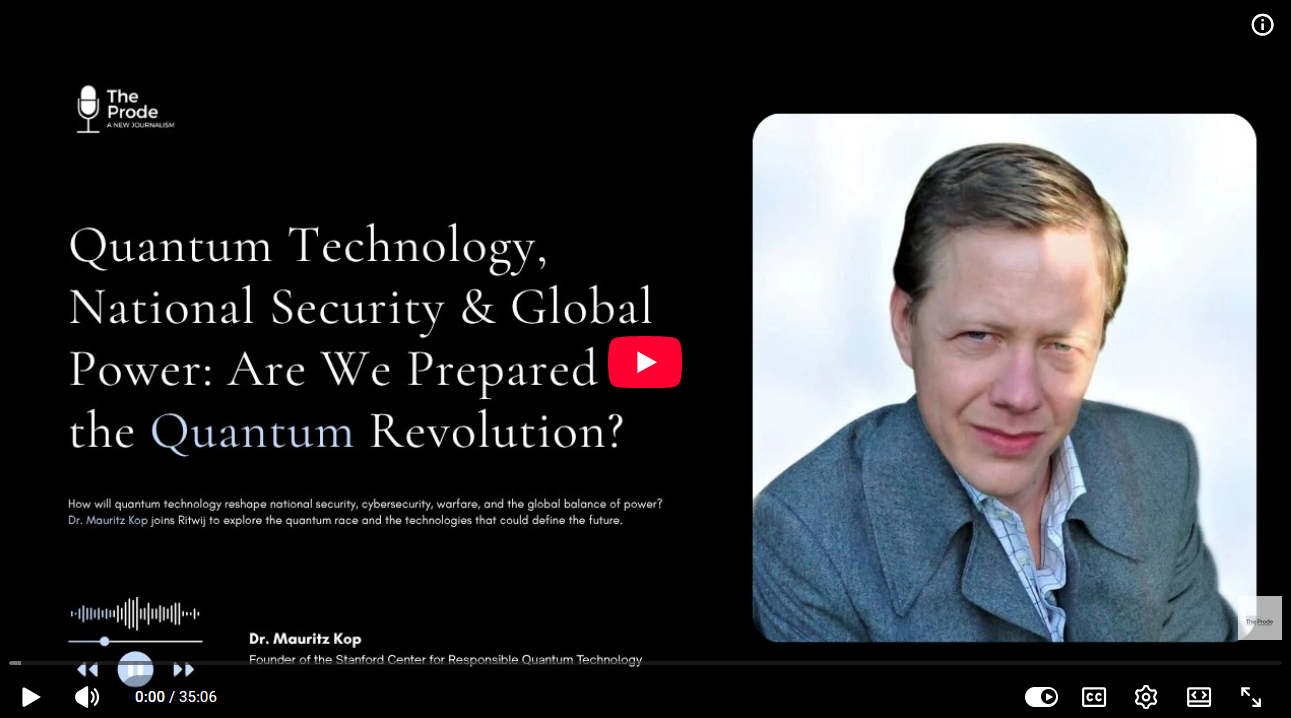
Prof. Mauritz Kop on The Prode: the Quantum Race, Q-Day Deadlines, and US National Security — the August 31, 2026 Interview
What Prof. Mauritz Kop told The Prode on August 31, 2026
The Prode, the independent interview platform founded by journalist Ritwij Raj, released its conversation with Prof. Mauritz Kop on the emerging quantum race and its implications for defense and national security. Kop, founder of the Stanford Center for Responsible Quantum Technology and of Quentir, answers six questions now facing the US national-security and technology-policy communities — from the timeline for a cryptographically relevant quantum computer to the shape of government-industry collaboration. The full video is embedded in this article.
Q-Day math and the deadlines that already exist
Nobody can date Q-Day, and Kop declines to invent one. What changed this March is the engineering target: two papers lowered the resource estimates for machines running Shor's algorithm — one neutral-atom architecture at 10,000 reconfigurable qubits, a Google-led estimate under 500,000 physical qubits for the P-256 curve. His planning instrument is Mosca's theorem, and his planning horizon is public: NIST's 2024 standards, NSA's January 2027 acquisition requirement and 2035 completion date, the June 2026 executive order with 2030 and 2031 milestones, and the UK and EU tracks toward 2035.
Harvest now, decrypt later — and the data that cannot be reissued
Adversaries can store ciphertext today and read it once hardware matures. Kop extends the harvest-now-decrypt-later problem to its sharpest case: a password can be changed, a genome cannot, and it carries information about your relatives as well as yourself. His prescription is anticipatory data stewardship — if future decryption is foreseeable, it belongs in today's duty of care.
Sensing, deterrence by denial, and the golden triangle
On quantum sensing, Kop ranks the public evidence: military value appears first in positioning, navigation, and timing when GPS is jammed, while ocean-transparency claims outrun public evidence. The deterrence logic he draws is denial — guaranteed navigation and timing, quantum-secure command and control, and communications that stay up under attack. And for the valley of death between research grant and purchase, his answer is the golden triangle of academia, policy, and industry: a real mission, a first paying customer, and a test an independent team can challenge — the program he carries forward from Stanford to CIGI, the US Air Force Academy, and Quentir.
Korea's Health Ministry Funded a Quantum Nanosensor for Cancer-Drug Heart Damage: the KRW 8 Billion ARPA-H RFP5 Award of 31 August 2026
What the Ministry of Health and Welfare selected on 31 August 2026
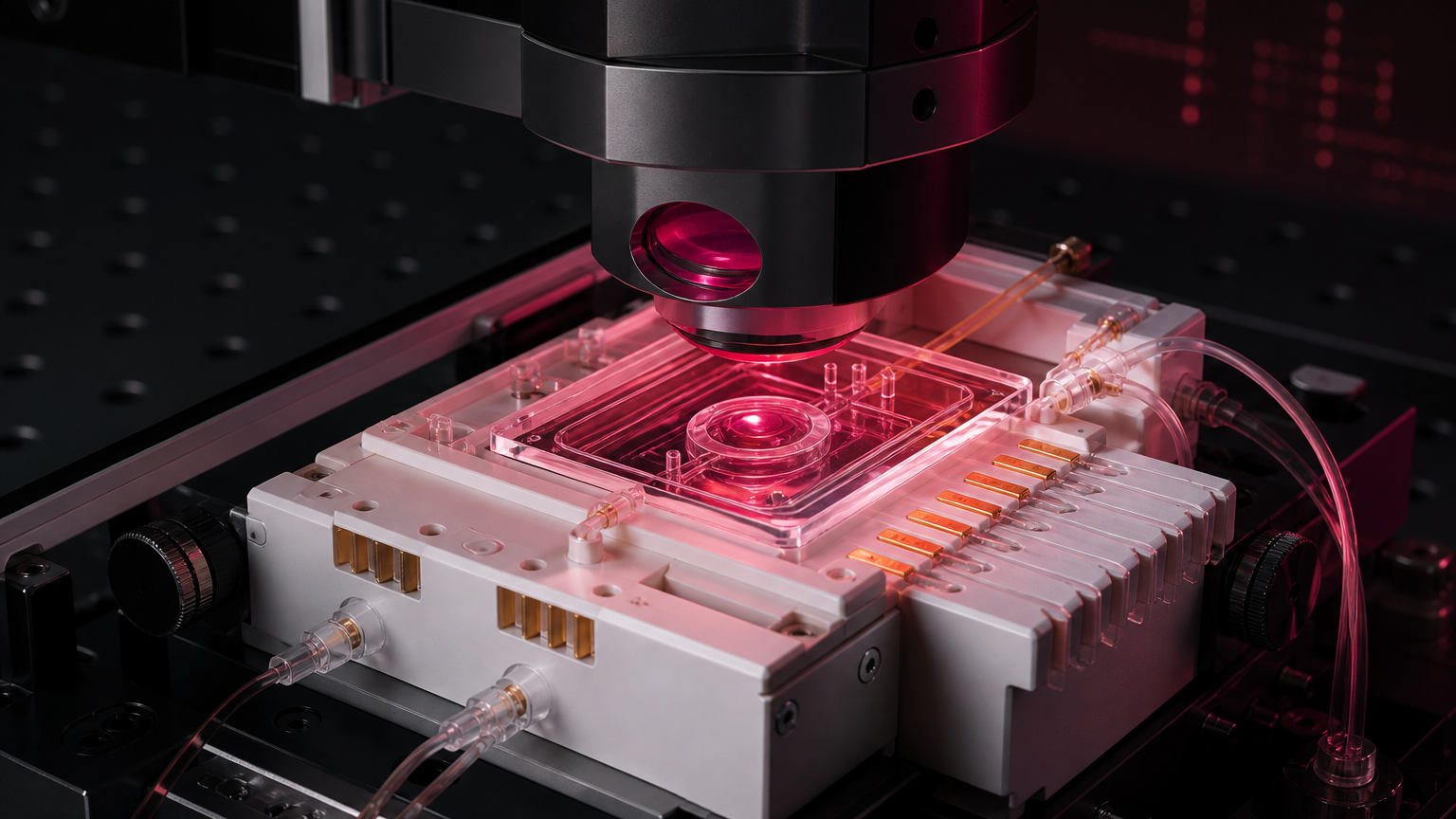
Korea's health ministry, working through the Korea Health Industry Development Institute and its K-Health Future Promotion Team, selected a consortium led by Kyung Hee University's Son Seok-kyun, a physicist, for RFP5 of the Korean ARPA-H project: quantum sensing-based ultra-high-sensitivity early diagnosis technology. The award is KRW 8 billion across four and a half years. RFP5 was one of nine challenges opened on 1 June 2026 for applications closing 1 July. The design fuses a biocompatible molecular quantum nanosensor with a cardiac organoid organ-on-a-chip, and the entry indication is anticancer-drug-induced cardiotoxicity.
Why the funder's identity changes what the instrument has to prove
What Korea's health ministry announced is a clinical endpoint: damage a cardio-oncology clinic currently detects through echocardiography and blood biomarkers, after the muscle has already been affected. The consortium proposes to read intracellular oxidative stress, local temperature and metabolic activity upstream of that point. Six institutions hold six named pieces of the work, from spin-Hamiltonian signal interpretation at Chosun University to MEMS and microfluidic integration at KETI and NV-center cross-validation at Korea University.
Korea has now funded both halves of quantum medicine, through two ministries
On 19 August this blog covered a quantum drug-design programme funded by Korea's science ministry. This award comes from the health ministry, and it funds the measurement half of the same problem. Two ministries, two verification cultures, one national portfolio. The assessment routes for a device with no predecessor already exist, through FDA De Novo classification and European MDR/IVDR conformity assessment. What no authority has yet issued is quantum-specific assessment guidance, or a precedent decision on a diagnostic claim resting on a quantum-sensed intracellular measurement.
Quantum Fault Tolerance Costs an Unavoidable Logarithm: What Bharti, Haug and Tanggara Proved on 26 August 2026
What Bharti, Haug and Tanggara posted on arXiv on 26 August 2026
A forty-page preprint, Fault-tolerant quantum computation cannot be achieved with constant spacetime overhead (arXiv:2608.26272, submitted 26 August 2026 at 18:00:25 UTC), proves a lower bound on the resources quantum error correction requires. Kishor Bharti, Tobias Haug and Andrew Tanggara show that for the simplest task in the field, holding quantum information steady in a memory, the minimum number of physical storage locations scales as Θ(S(K + log(S/ε))) for width K, duration S and target error ε. The second term is an additive reliability cost that no protocol removes inside this model. The result is filed under quantum physics and information theory, and it has not yet been peer reviewed.
The condition the authors attach to it in the same paper
Relative overhead scales as Θ(1 + log(S/ε)/K), so it stays bounded once the width K reaches Ω(log(S/ε)), and the logarithmic term becomes negligible only in the stronger regime K = ω(log(S/ε)). The absolute reliability cost is never removed at any width. The authors state the consequence directly. Constant overhead can be possible for sufficiently wide computations. They add that no single constant bounds the spacetime overhead uniformly over all widths. Standard implementations of Shor's algorithm amortize the cost. Grover search sits near the crossover.
Why the qualification matters more than the headline
A reader who takes only the title away will conclude that a hard limit has been placed under every claim about when a cryptographically relevant quantum computer arrives. The paper does not support that reading, and its memory bound is proved under a deliberately generous erasure model. This read separates what the theorem establishes from what it has already been asked to carry, names the width and duration under which the cost dominates, and states what it changes for federal migration schedules, which is nothing.
Quantum Navigation Leaves the Laboratory Bench
What a quantum gravimeter measured over 83 kilometers at sea in August 2026
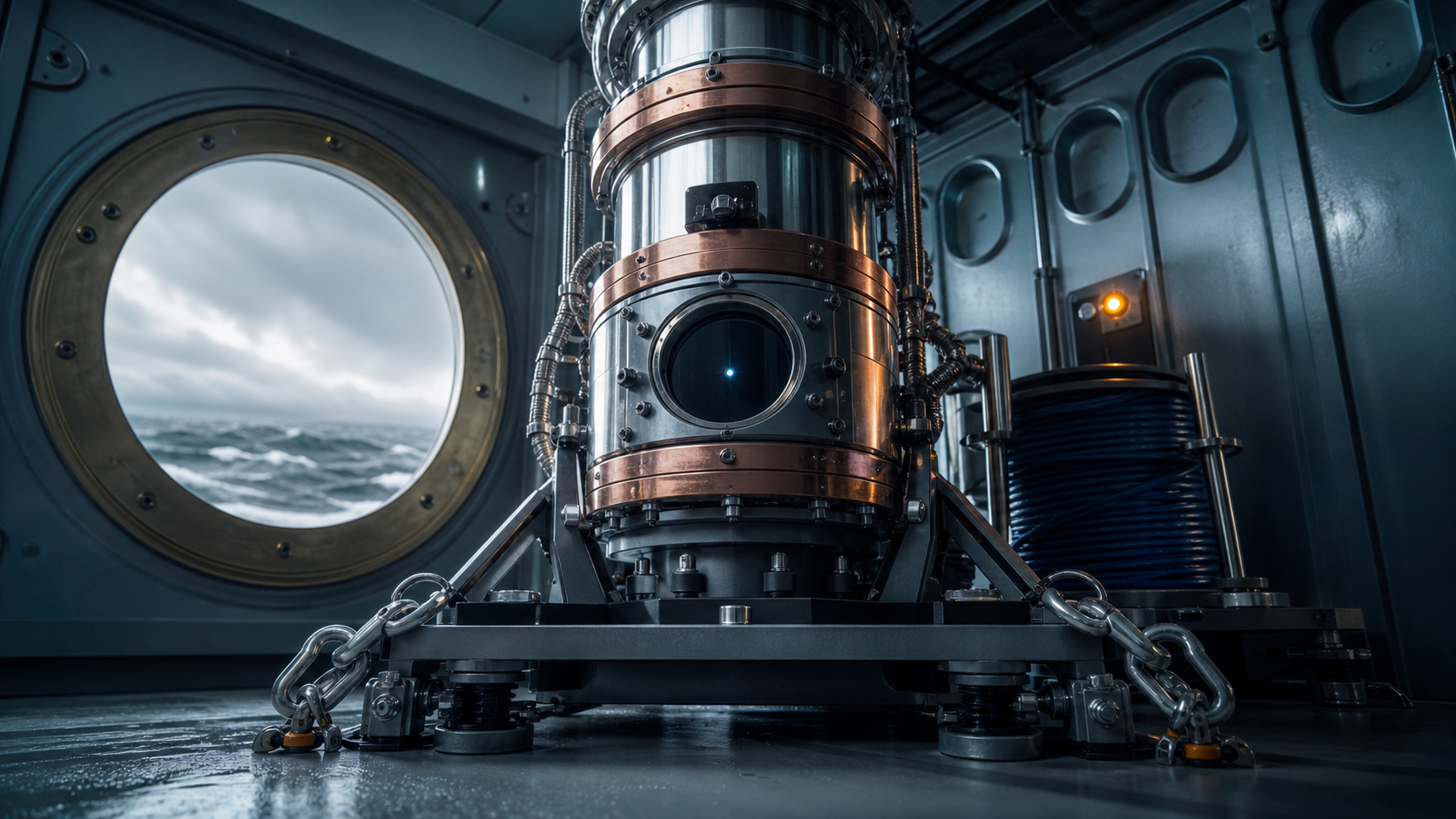
A preprint posted on 26 August 2026 (arXiv:2608.25563) reports gravity map matching aboard a 29-meter surface vessel: a mobile quantum gravimeter, hybridized with a classical accelerometer and installed in an uncontrolled cabin with no environmental stabilization and no calibration, corrected an inertial solution over an 83-kilometer maritime trajectory by referencing locally measured gravity to a satellite-derived anomaly map. The authors report bounded positioning at nautical-mile-level accuracy with satellite navigation excluded throughout. In a separate referenced survey mode the same system worked coastal routes up to Sea State 4 with mGal-level agreement and sub-mGal repeatability.
Which programs pay for it: DARPA's Robust Quantum Sensors, the Defense Innovation Unit and NASA
DARPA's Robust Quantum Sensors program exists to move quantum sensors off the bench onto moving platforms, and it has funded ruggedization work at Q-CTRL with Lockheed Martin and at Safran Federal Systems, whose planned first phase tests a quantum sensor on a military helicopter against electromagnetic interference and vibration. The Defense Innovation Unit's Transition of Quantum Sensing program covers inertial sensors, gravimeters, magnetic anomaly detection, magnetic navigation and components, and holds a prototype contract for a quantum-enabled inertial navigation system. Infleqtion announced on 27 August 2026 that NASA had awarded it a USD 20 million follow-on for a space-based gravity gradiometer.
What the published record does not show about replacing satellite positioning
No public result shows quantum inertial navigation replacing satellite positioning in operational use. These instruments are drift-limited, and the honest question is how much drift accumulates over how many hours under what vibration. These remain field experiments, and the published record stops there.
Princeton's New Quantum Institute Is Aimed at the Junction Inside Superconducting Qubits
A $290 million announcement, read against its own awards
On 25 August 2026 the US National Science Foundation announced more than $290 million across eight Quantum Leap Challenge Institutes — $28 million to $37.5 million each over five years, three of them new and five renewed, spanning 36 higher-education institutions in 19 states with the Department of Energy national laboratories, NIST and the Department of War as federal collaborators and more than 30 companies alongside. The number travelled as a marker in the quantum computing race. The award titles read differently.
What the money is actually aimed at
Princeton's new institute, MARQUIS, receives $27.9 million over five years to reinvent one component: the Josephson junction, two superconducting electrodes separated by an oxidized insulating barrier only a few atoms thick, whose dominant construction — aluminum with an aluminum oxide barrier — Princeton describes as essentially unchanged for more than 25 years. Yale's PRACTIQAL takes practical error correction. Chicago's QuBBE takes quantum sensing for biophysics. Colorado's Q-SEnSE takes $37.5 million for atomic clocks, the most stable lasers in the world, and sensors that read disease in a patient's breath. Not one of the eight is denominated in qubit count.
Two states, one week, opposite ends of the curve
In the same week India's C-DOT unveiled fourteen indigenous quantum-secure products, which its chief executive characterized as production-grade with revenue already booked. One state announced a product line; the other funded the layer underneath it. Both answers are defensible and they are answers to different questions — and only one of them has products to point at this year.
Five Days to Four Kelvin: Reading IBM's Modular Cryogenics Milestone
A refrigerator result, precisely dated
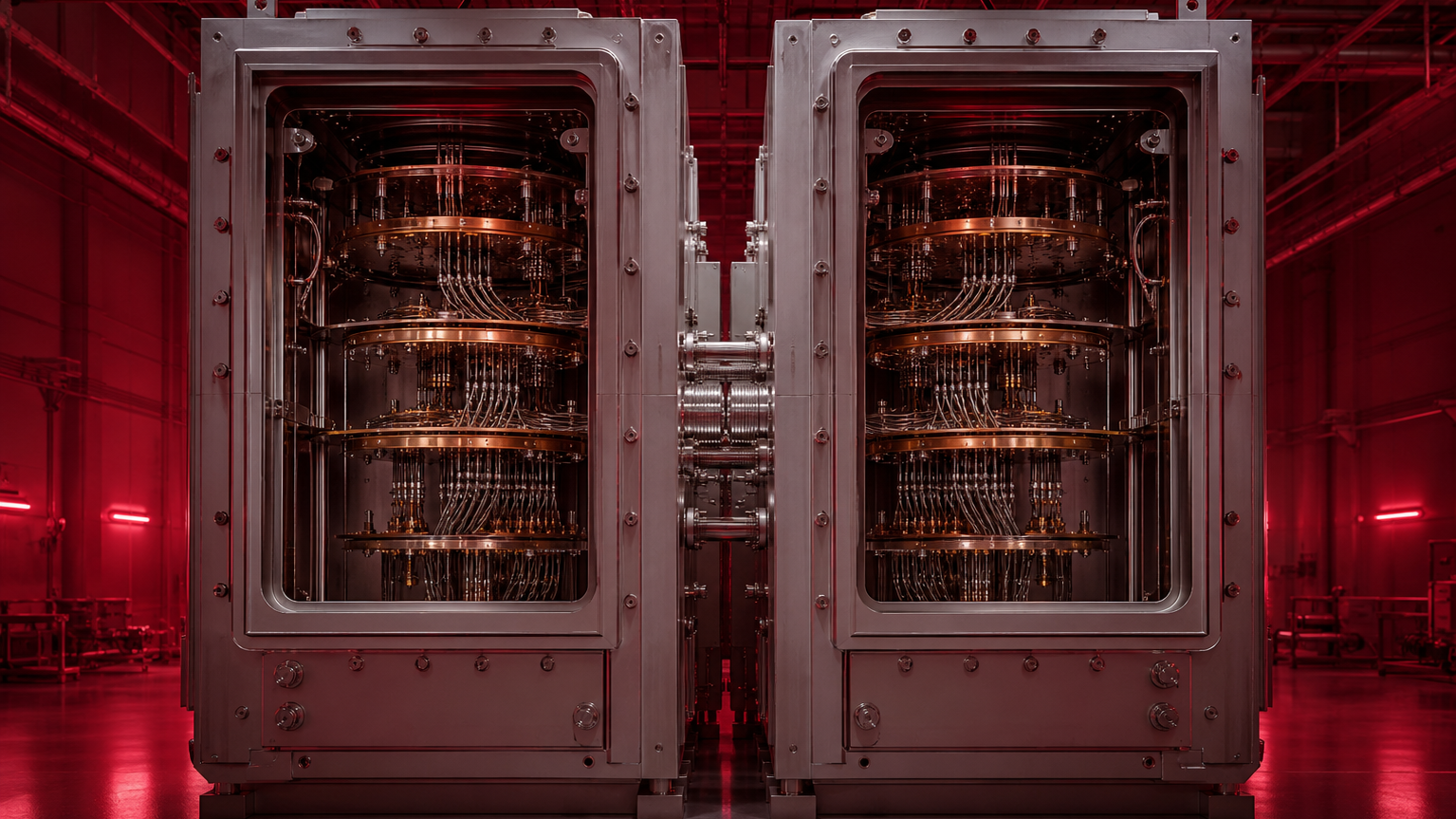
On 19 August 2026 IBM said it had connected and cooled its first two modular cryogenic systems into a single environment. Assembled, the two box-shaped modules stand more than eight feet tall and eight feet wide. They reached 4 kelvin in under five days and then went below 15 millikelvin, and each module’s vacuum enclosure offers up to twelve times more wiring space than IBM’s most widely used quantum systems — room sized for the chip-to-chip connections its L-coupler interconnect is meant to carry.
What was not announced
IBM reports no installed processor and no qubit result for this test. The release carries no qubit counts, no fidelities and no error-correction figures for the coupled pair, and IBM Quantum Nighthawk processors are due to go into the cells later in 2026 for operational testing. Filed accurately, this is a cryogenics and packaging result under a fault-tolerance roadmap, and it sits at the layer where long roadmaps either hold their dates or quietly slip.
The calendar it runs beside
IBM’s stated targets are L-coupler-linked processors totaling at least 1,000 programmable qubits by 2027 and Starling, billed as the first fault-tolerant quantum computer, in 2029. Beside those company dates runs a standards calendar that moves with neither: NIST’s draft transition report IR 8547 deprecates classical public-key algorithms at 112-bit security strength after 2030 and disallows them after 2035. Reading the two together is where quantum readiness stops being a posture and becomes a schedule with dates on it.
The Export Control That Fits Inside a Passport
Two governments, one control point
On 31 July 2026 China’s State Council published the Exit and Entry Administration Provisions, nineteen articles that take effect on 15 September. One of them lets competent State Council departments bar a citizen from leaving the country where that person violates export control or technology import/export rules in a way that “may endanger national industrial or technological security.” Seventeen days later, on 17 August, the Office of the Under Secretary of War for Research and Engineering notified thirty American universities to audit their institutional ties to foreign entities listed under Section 1286 of the fiscal 2019 defense authorization, with mitigation — up to terminating the partnership — reported by 31 August or future federal research funding is at risk. The same day, the White House published a national security science and technology strategy whose protected-technology list names quantum information technologies.
Why the wording matters
American law has treated a person as a channel for export since the deemed-export rule, so the direction is not new; a fundamental-research carve-out has kept university science largely outside it. What is changing sits at the edges of that carve-out. One instrument conditions a university’s research funding on the foreign affiliations in its own files; the other attaches an exit consequence to an individual on a forward-looking standard, with no fixed time limit where other categories of Chinese exit ban run six months to three years.
An unusually legible test case
Neither measure singles out quantum: the strategy lists it as one of fourteen protected areas, and the Chinese trigger is written around export control generally. Quantum research is simply where the change is easiest to observe, because the field is small, concentrated in a countable number of laboratories, and heavily co-authored across borders. A collaboration agreement signed in 2024 now carries exposure on both ends, and an affiliation cannot be recalled the way a shipment can.
Korea Funded a Quantum Drug Program That Plans to Make the Molecule
A program that publishes its verification loop
On 19 August 2026 Korean industry press reported that Baobab AiBIO had been named lead research institution of a Ministry of Science and ICT / National Research Foundation program applying quantum computing to targeted protein degradation, with LigaChem Biosciences, Yonsei University and the Institute of Molecular Design as co-institutions. The part worth reading twice is the workflow the program describes: design, then synthesis and evaluation, then Cryo-EM structural work, then redesign. Quantum-assisted molecular design is being pointed at a wet lab instead of at a benchmark table.
What that does and does not settle
Taking predictions into synthesis is not the same as demonstrating quantum advantage. That claim would additionally need a declared classical comparator, a stated endpoint and a resource comparison, and none of those is public yet. Nor is wet-lab work unprecedented here: a 2025 Nature Biotechnology paper reported fifteen molecules designed with a quantum-classical generative model, synthesized and assayed, two of them promising against KRAS. The Korean program adds public money on the testing half of the loop and a named synthesis partner.
The infrastructure running alongside
IBM joined and cooled its first two modular cryogenic units below 15 millikelvin the same week, on a roadmap to at least a thousand programmable qubits in 2027. That is parallel context and not a dependency: the Korean work names Yonsei's existing IBM QPU environment. For any reader judging a quantum-medicine claim, the useful test is whether a check has been scheduled.
Sunlight Replaced the Pump Laser in an Outdoor Entanglement Source
A four-year objection, answered outdoors
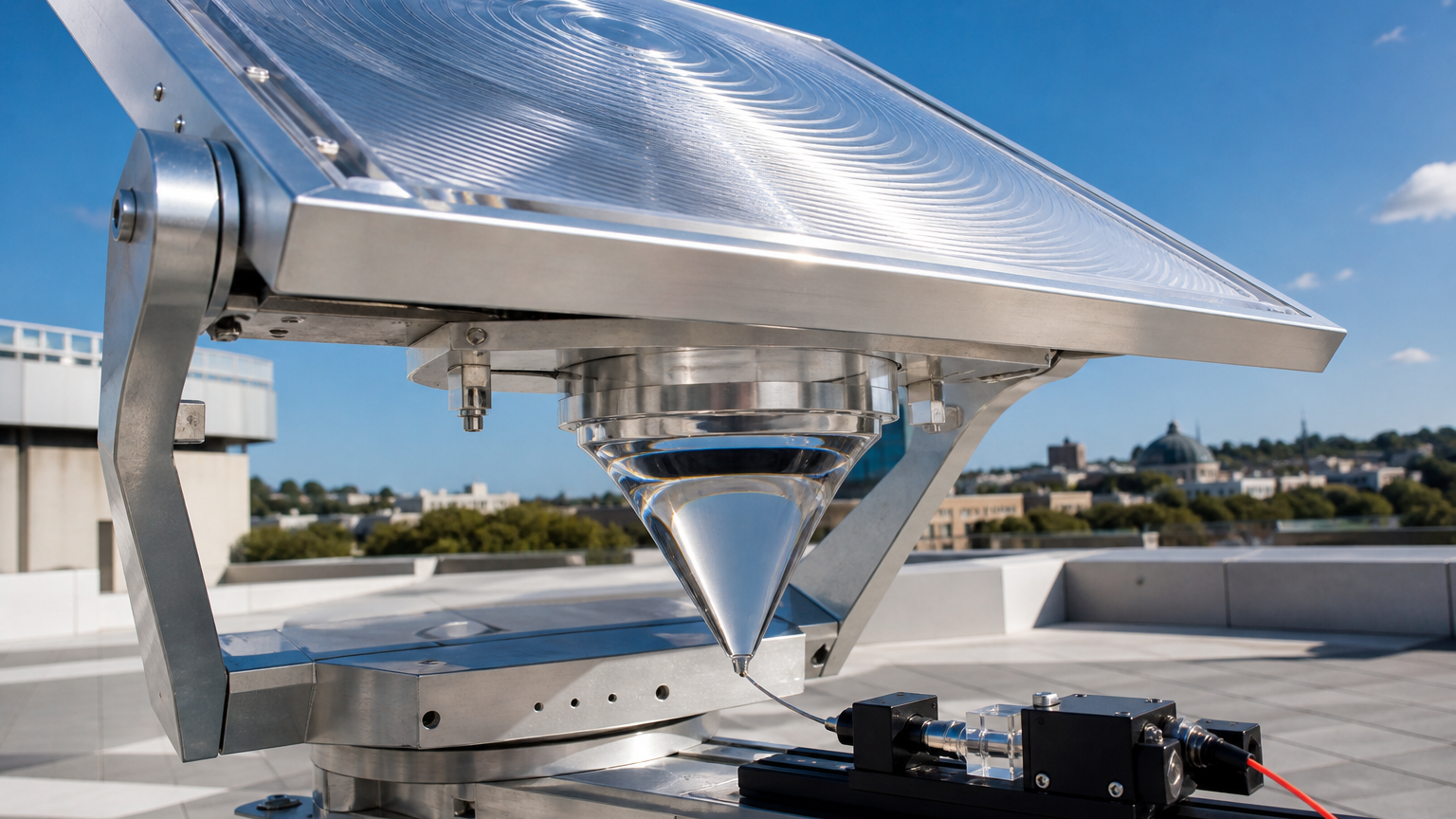
On 6 August 2026 Optica published a result whose lead author, Cheng Li, says has “met with repeated doubt and pushback” since the project began: polarization-entangled photon pairs generated with natural sunlight as the pump, measured outdoors, at a Bell-state fidelity of 0.939 and a CHSH value of 2.5408 against the classical bound of 2. The apparatus is a Fresnel collector about the size of a household window, a custom all-glass concentrator cone, a fiber about as wide as a human hair, and a ppKTP crystal at the end of it. The same lead author had shown in 2022 that an incoherent LED could pump weak entanglement; a Xiamen group showed in 2025 that sunlight could drive down-conversion at all. This joins those two records.
A substitution, not yet a subtraction
The energy overhead of the pump laser is the motivation the authors name, and running a source on light that is already falling on the instrument is attractive for exactly that reason. What the experiment swaps in, though, is a collector, a tracking mount, spectral filtering, a custom concentrator and crystal temperature control, and no published comparison yet shows that trade winning on total mass, power, thermal load or reliability.
What is not yet on the record
The preprint reports roughly 1,600 pairs per second per milliwatt, comparable to laser-pumped setups once normalized for effective phase-matching bandwidth. What is missing is mission-level throughput, a secure key rate, a sustained duty cycle across sky conditions, and an independent replication. Those are the numbers to watch before anyone writes a passive entanglement source into a space-segment work package.
Washington Would Take Equity in Nine Quantum Firms. One Prospectus Shows What That Means.
Nine non-binding letters, not nine closed deals
On 21 May 2026 the US Department of Commerce announced nine letters of intent worth $2.013 billion in CHIPS incentives across the American quantum computing industry — $1 billion to IBM for a 300-millimetre quantum wafer foundry in Albany, $375 million to GlobalFoundries, and $100 million each to Atom Computing, D-Wave, Infleqtion, PsiQuantum, Quantinuum and Rigetti, with up to $38 million to Diraq. Attached to each is a condition that changes the instrument: in exchange for the award, each recipient would issue equity securities to the Department. The letters are non-binding, and the definitive documents are still unsigned.
What one filing answers
Commerce described every stake as minority and non-controlling, and said little more. Several recipients have since added something of their own — D-Wave that it would issue $100 million in common stock, GlobalFoundries that the Department's position is about one per cent. Quantinuum's prospectus goes furthest by a distance, describing securities that would be non-voting so far as the law permits and freely transferable, carrying anti-dilution, registration, redemption, exchange, conversion, participation, tag-along and information rights, with funding released against named milestones across a five-year performance period. For that one company the control question is largely designed out. The custody question is not, and no recipient has answered it.
Own, screen, or buy
Three governments reached for three different instruments this season. Washington moved toward ownership. Brussels chose control over ownership: Regulation (EU) 2026/1386 puts quantum technologies into the mandatory screening scope of all 27 Member States for the first time. Israel chose procurement, tendering a sovereign quantum computer in August. Ownership is the instrument whose internal governance is least visible, and it is the one the United States picked in a field whose cost assumptions moved again in July.