
Quantum hardware claims need error budgets now
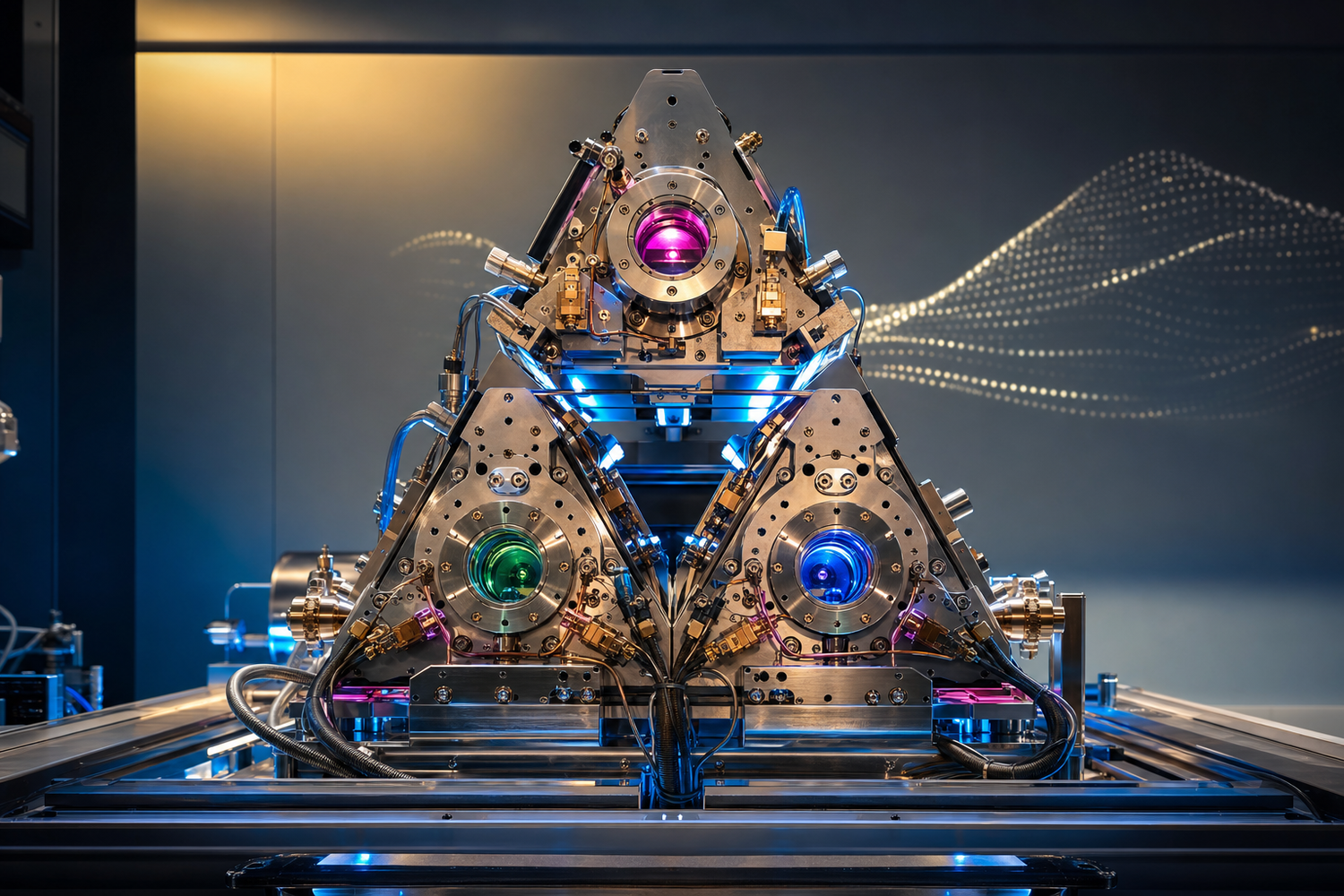
Quantum announcements are getting more precise. The useful ones now carry numbers: 98 trapped-ion qubits, average single-qubit error near 2.5 in 100,000, two-qubit error near 7.9 in 10,000, all-to-all connectivity, 1,024-qubit-class hardware planned in Kawasaki during FY2026, or a quantum current sensor claiming ±0.01% precision in industrial settings.
Those numbers change the governance question. A buyer can admire the hardware and still ask whether the quoted metric maps to the use case. A random-circuit benchmark does not price a derivative. A high-precision current reading does not validate an AI-driven HVAC decision. A future 1,024-qubit machine does not tell a finance team when encrypted stored data becomes a harvest-now-decrypt-later exposure. The market is no longer short of quantum narratives. It is short of disciplined translation between a technical claim and a contractual duty.
Practical takeaway. Treat each serious quantum claim as an error-budget question: what is being measured, how often, under which conditions, by whom, and with what consequence if the number does not survive deployment?
The claim
Quantinuum’s Helios is the cleanest hardware signal in this pack. Coverage of the Nature paper describes a 98-qubit trapped-ion processor built on a QCCD barium-ion architecture, with all-to-all connectivity and reported average error rates that make the machine more than a qubit-count headline. The Conversation’s useful analogy is a quantum railway: ions are stored, moved and brought into operation zones as the program requires. That architecture matters because control, routing and movement become part of the performance story.
Fujitsu adds a second kind of claim. Its quantum computing development base in Kawasaki, completed in autumn 2025, is preparing to install and operate a 1,024-qubit-class superconducting quantum computer during FY2026. The company also points to work with RIKEN on a 256-qubit machine and names use cases in materials, drug discovery, finance and robotics. A Fujitsu survey with the Financial Times says 96% of global executives believe quantum computing will deliver value, while 58% are discussing quantum strategy in 2026. The gap is not belief. It is preparation.
The sensing stream is narrower but more immediate. Ohio State’s $4 million NSF Phase II award under the National Quantum Virtual Laboratory backs a Distributed-Entanglement Quantum Sensing of Chemical Properties project, with industrial and biomedical translation in view. Xdotz, at Quantum Korea 2026, demonstrated a diamond NV-center current-sensing platform linked to IoT and AI analytics for industrial energy optimization. Those are not the same product category as Helios or Fujitsu’s roadmap, but they share the same buyer problem: the impressive number must be connected to validation, operating conditions and responsibility.
The record
Error rates are not magic words. In Helios, the reported two-qubit error rate near 7.9×10⁻⁴ is meaningful because two-qubit gates are harder and more important for useful circuits. All-to-all connectivity matters because it can reduce the movement and routing burden that fixed-neighbour systems face. Random-circuit sampling matters because it tests complexity. None of those metrics, standing alone, proves commercial usefulness in chemistry, finance or cryptography. They narrow the claim. That is valuable.
Roadmaps need a different reading. Fujitsu’s 2030 preparation story links quantum hardware with AI and supercomputers, and it names portfolio optimization with Mizuho-DL Financial Technology as an application lane. The careful reader should separate three claims: the existence of a scaling plan, the expectation that certain use cases may benefit, and the current readiness of an enterprise to govern the path from experiment to production. The survey numbers make that separation visible. Belief is running ahead of operational structure.
Quantum sensors expose the same gap at the edge. A sensor used for biomedical molecules, industrial current, HVAC optimization or predictive maintenance does not end at the measurement. Data moves into dashboards, models, recommendations and sometimes automated action. Peking University’s bias-corrected estimator work is upstream theory, but it names the practical problem clearly: theoretical limits such as the quantum Cramér-Rao bound do not answer how many measurements are needed in finite experimental conditions. That is the line between a beautiful sensitivity claim and a deployment claim.
The contract problem
Most contracts still read like the pre-quantum stack. Standard platform and B2B terms tend to speak about access, licenses, confidentiality, general security, liability caps and IP reuse. They rarely say who must maintain crypto-agility, who validates a quantum sensor’s precision, whether AI-derived recommendations fall inside a warranty, or whether “knowledge acquired” can be used for machine training and derivative generation. The missing language becomes visible only when the hardware claim is specific enough to test.
This is where recent Quentir coverage connects. Yesterday’s read of the Department of War post-quantum strategy dealt with acceptable quantum-safe security, while the earlier Project Farseer analysis treated quantum sensing as an acquisition-file problem. Today’s angle sits between them. Better hardware claims make the buyer’s file more demanding: not only which technology is named, but what the number means, who checked it, and which obligation follows if the number fails in the field.
The finance example is especially sharp. Fujitsu’s portfolio-optimization lane points toward a sector already carrying long-lived encrypted data, model-risk controls and regulated outsourcing habits. Quantum computing can be relevant to optimization without immediately changing every cybersecurity duty. At the same time, the same capability curve keeps pressure on post-quantum migration. A bank can be early in one quantum lane and late in another. The contract should not blur those lanes.
How Quentir reads it
The practical bridge is an error budget for adoption. For computing, that means asking which gates, circuit depth, connectivity and benchmark support the use case. For sensing, it means asking how many readings, under which conditions, are needed before the claim is operationally visible. For AI-linked industrial systems, it means separating the physical measurement from the inference layer. A buyer-friendly version has four parts: benchmark, deployment condition, validator and contractual remedy. One instrument may be precise while the recommendation built on top remains weak.
The paid layer should hold the reusable machinery. Quentir’s All-access membership is the natural home for the cross-post archive that tracks these connections across PQC, quantum sensing, standards, contracting and market power. This free post gives the core distinction and one working concept; the paid archive adds fixed scope, executive summaries, refresh triggers and a dated source spine for internal use.
The open tension is simple. Quantum capability is becoming specific before governance has become specific. That is good news. Specific claims can be tested, priced, insured, warranted and rejected. The next serious wave of quantum adoption will belong to organizations that can read the number without being dazzled by it.
Sources: Nature, Helios trapped-ion quantum-computer paper, 2026, snapshot 5 July 2026; Quantinuum, “Quantinuum Announces Commercial Launch of New Helios Quantum Computer”, 2026, snapshot 5 July 2026; Fujitsu, “2030: The Year Of Practical Quantum Computing”, 1 July 2026, snapshot 5 July 2026; Quantum Computing Report, “The Ohio State University Secures $4 Million NSF Phase II Award to Lead National Quantum Sensing Testbed”, 3 July 2026, snapshot 5 July 2026; The Quantum Insider, “Xdotz Unveils Quantum Current Sensor ‘XSI’ for the First Time at Quantum Korea 2026”, 3 July 2026, snapshot 5 July 2026; Quantum Zeitgeist, “Peking University Team Develops Bias-Corrected Moment Estimator For Quantum Metrology”, 5 July 2026, snapshot 5 July 2026.
Published intelligence, built to inform your own decisions. Published: July 5, 2026.