Does a Quantum Layer Change What a Medical AI Sees?
One layer makes the comparison unusually clean
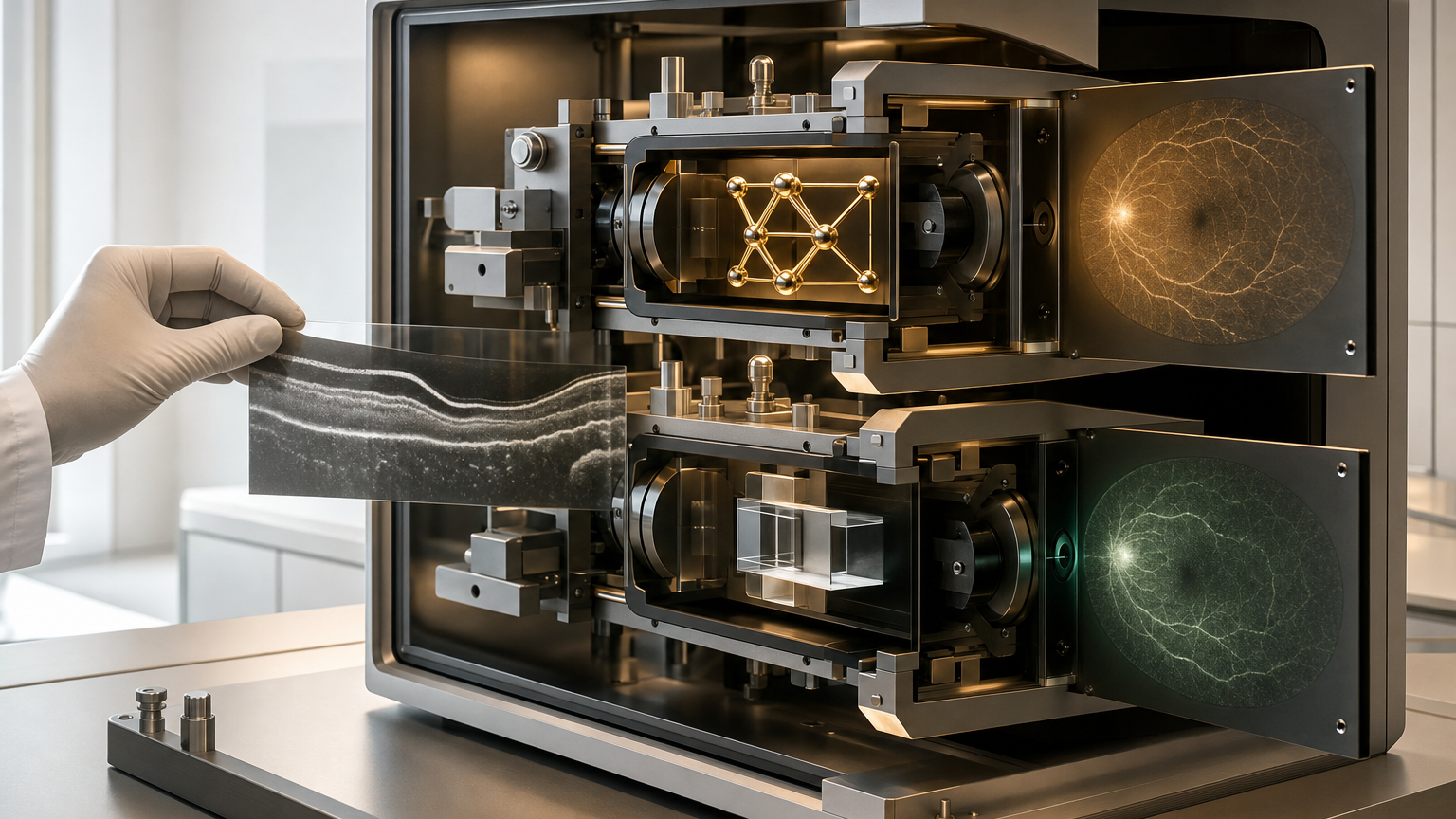
A July 2026 preprint compares two medical-image classifiers that share the same convolutional backbone and a comparable number of trainable parameters. They differ in one intermediate layer. One branch uses a dense classical layer; the other uses a four-qubit circuit emulated on a conventional computer. This parameter-matched comparison helps isolate the contribution of the circuit-shaped representation without changing the rest of the network.
The relative gain appeared between small and large datasets
The models classified retinal optical coherence tomography images, with training sets ranging from 200 to 30,000 examples. The hybrid model performed best relative to the classical comparator around 800 and 2,000 training images, an intermediate-data regime. At the largest sizes, the classical CNN moved ahead and reached the study's highest retinal test accuracy, 93.7 percent. A robustness check using two-dimensional slices from an OASIS-1 dementia MRI dataset followed the same broad pattern: the hybrid advantage narrowed with more data, then reversed slightly.
The attention maps changed with sample size
The researchers also compared SHAP attention maps, which estimate where image pixels influence a model's output. With 1,000 retinal images, the hybrid maps appeared more concentrated around retinal layers and disease-related structures, while the classical maps were more fragmented in the examples shown. At 30,000 images, the models' highlighted regions overlapped much more. These maps do not establish clinically validated biomarkers. The study includes no physical quantum-hardware run, prospective clinical test, external hospital validation, clinician reader study, or patient outcome. Its contribution is narrower and useful: a controlled account of when a small classically simulated circuit changed model performance and apparent visual focus, and when additional data favored the matched classical layer.
The Quantum Molecule Generator Hit a Chemistry Limit
A quantum generator enters the chemistry contest
A medicinal chemist can reject a proposed molecule in seconds. A model has a harder job: it must learn which structures are chemically legible, avoid repeating itself, and move toward useful properties without mistaking a score for a drug. A 2023 experiment placed a quantum molecule generator inside that contest. Researchers swapped variational quantum circuits into three parts of a molecular generative adversarial network and compared them on the QM9 dataset.
Fewer discriminator parameters, mixed chemical results
A quantum discriminator used only 50 learnable parameters, compared with about 22,000 in a deliberately reduced classical discriminator. The hybrid system containing the quantum discriminator produced 46.59 percent unique outputs among valid molecules, versus 2.08 percent for that reduced comparator, and had a better distributional-fit score. Its validity was only 31.34 percent, however, compared with 99.78 percent. Larger classical discriminators also surpassed it on uniqueness and distributional fit. In a separate goal-directed test, a quantum noise source improved mean drug-likeness and synthetic-accessibility scores, then produced far fewer valid, nonrepeated outputs. The selected objective rose as the useful range of generated chemistry narrowed.
What the benchmark can and cannot establish
The study is computational. It reports no run of the molecular generator on physical quantum hardware, no synthesized compound, no biological assay, and no drug candidate. Its contribution is architectural: different quantum components produce different bargains among parameter efficiency, property optimization, validity, uniqueness, and similarity to the training distribution. The quantum-generator variant also required roughly 3.5 days per epoch on the reported classical compute instance and struggled to generate unique and valid molecules after ten epochs.
For quantum medicine, that tradeoff matters more than the label on the model. A generator can look efficient while shifting work into chemical filtering. It can score well while returning to the same narrow family of structures. The study's lasting question is therefore precise: which chemical possibilities disappear when a quantum-assisted score improves? Better hardware will change runtime, but it will not answer that measurement question for medicinal chemists.
A Weak Magnetic Field Left Its Mark Around a Tadpole's Eye
A visible response around the eye
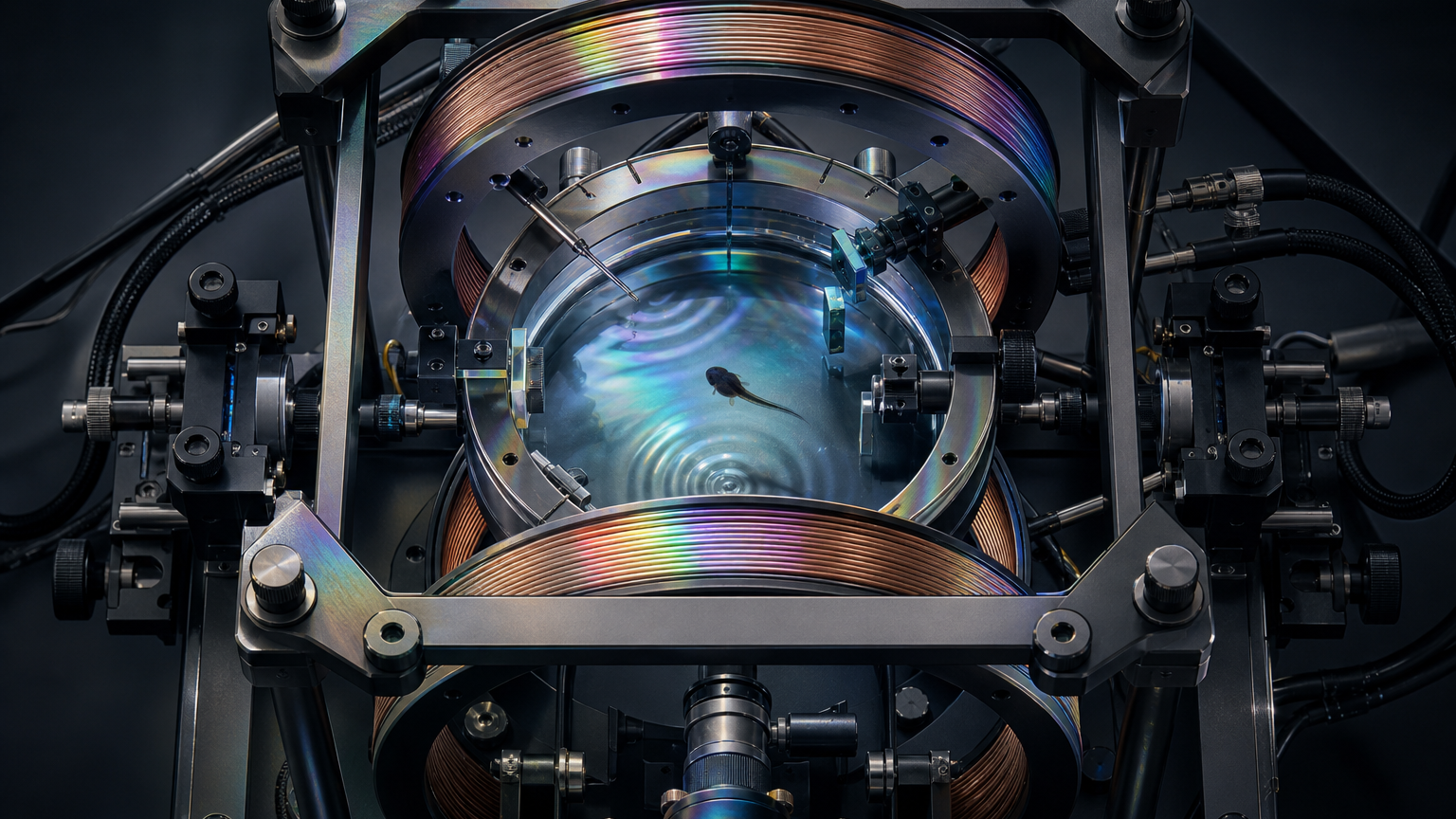
A tadpole raised on a white background changes its skin as its eyes read the light around it. In a Calgary laboratory, researchers placed that developmental response inside a controlled magnetic field and counted the result. A July 16 bioRxiv preprint reports that fields between 0.25 and 1 millitesla increased perioptic melanophores, the dark pigment cells around the eye, in a strength-dependent pattern. The response appeared only after the retina had become functional. It vanished in constant darkness and after both eyes were removed, controls that narrow the possible biology while leaving the responsible molecule unknown.
The model fits more than one molecule
The authors compared the field-response curve with spin-dynamics simulations. A model based on a flavin-tryptophan pair from cryptochrome 4 reproduced the rise and plateau, but so did a generic organic radical pair. The study's light-and-eye dependence makes a photosensitive retinal pathway plausible. The fit still cannot identify CRY4 or any other sensor. The preprint proposes tests that could weaken the mechanism, including CRY4 loss-of-function, wavelength dependence, radiofrequency disruption, and a predicted reversal at stronger fields.
A biological response is not a medical effect
This work offers a whole-animal assay for the radical-pair mechanism, a quantum-spin account of how weak magnetic fields can alter reaction yields. It does not report a therapy, diagnostic, human exposure effect, or clinical endpoint. The fields that produced the clearest pigmentation changes were above Calgary's local geomagnetic background, and the authors say their data do not explain geomagnetic-strength sensing. The medical value lies upstream: a vertebrate model may let researchers test whether quantum spin chemistry survives inside living tissue and identify the molecular path. Independent replication and causal genetic experiments come before any claim about medicine. That boundary makes the study worth following without turning a visible tadpole phenotype into a claim about patients or everyday exposure.
When Cancer Starves an Immune Cell, Quantum Sensors May Hear the Chemistry
Cell chemistry changes under pressure
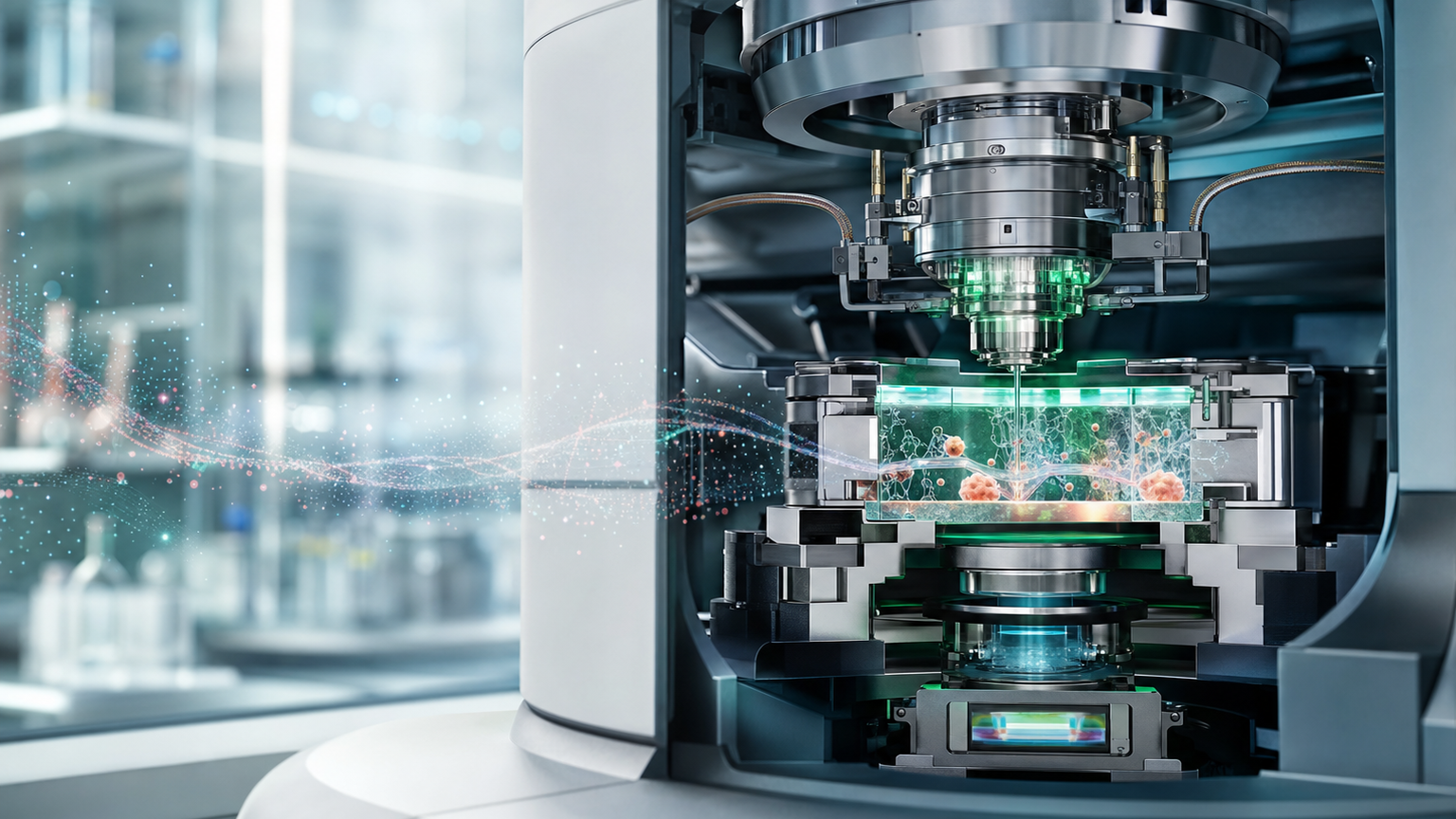
In a solid tumor, an engineered immune cell may carry the right receptor and still lose function as nutrients disappear and suppressive metabolites accumulate. A proposed four-year project at Heriot-Watt University aims to watch that chemistry in real time. The planned platform combines single-electron sensors, optical spectroscopy, and microfluidics to follow radical activity across many cells. Its medical premise is specific: the local chemical environment may help explain why cellular immunotherapies that have changed treatment for several blood cancers remain much harder to use against solid tumors.
A diamond spin can report a local signal
The program has an experimental starting point. In a 2024 Carbon paper, Claudia Reyes-San-Martin and colleagues, including fellowship leader Aldona Mzyk, used diamond-based quantum sensing to detect free-radical signals in migrating human breast cancer cells with subcellular resolution. They observed radical formation after defined periods of starvation and low-serum migration, then changed NOX2 activity and found that the radical measurement, broader reactive-oxygen readings, and cell migration did not move together. That result makes the sensing method interesting as a mechanistic probe. It does not establish a cancer biomarker or a patient-facing diagnostic.
The next experiment moves to immune-cell failure
Heriot-Watt's December 15, 2025 announcement says the funded work will study how the tumor microenvironment disrupts immune-cell metabolism. The National Cancer Institute describes that suppressive environment as one of several barriers facing CAR T-cell therapy in solid tumors, alongside target selection and tumor variation. The proposed system could give researchers a closer view of when individual cells begin to fail and how differently cells respond under the same conditions. Important questions remain open: whether the signal is stable across instruments, whether thousands-of-cells throughput can preserve nanoscale sensitivity, and whether a radical pattern predicts later immune function. The project is best understood as a laboratory measurement program with a credible route into cancer immunology and a long clinical distance still ahead.
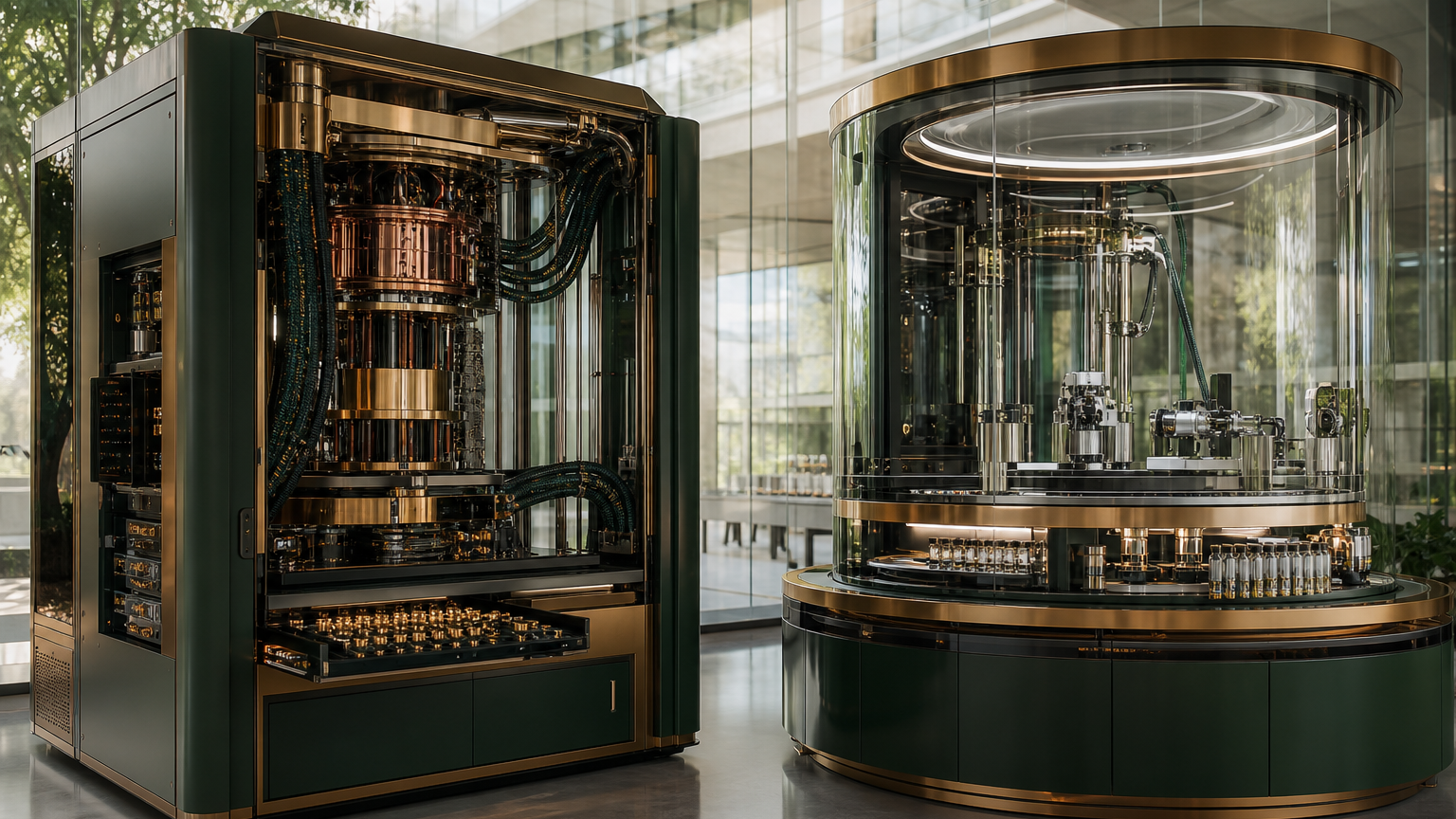
A Drug-Design Race With Two Different Finish Lines
Two systems pursue different molecular virtues
A 2026 Artificial Intelligence Chemistry paper compares a quantum-aided molecular generator with BInD, a diffusion model for structure-based drug design. QuADD treats molecular design as constraint-driven optimization: it searches for candidates that fit a defined binding pocket while satisfying several selected properties. BInD uses reverse diffusion to explore possible molecular structures and their interactions with the target. Both generated novel candidates for a thrombin binding site. The reported split matters. QuADD more consistently met the study's criteria for predicted binding affinity, drug-likeness, and preservation of key protein-ligand interactions. BInD produced greater structural diversity. That result describes two search philosophies as much as two software systems.
The clock measures a complete workflow
A company-supplied account reports that QuADD generated 3,000 molecules in roughly 30 minutes, while BInD required about 40 hours on a node with one NVIDIA GPU. The researchers selected the top 100 candidates from each set using predicted binding affinity. The timing is useful as a workflow observation. A broader quantum-advantage claim would need matched objectives, declared compute resources, complete timing boundaries, repeated runs, and a strong classical optimizer aimed at the same constraint set. The comparison article was written by researchers affiliated with Polaris Quantum Biotech, the company behind QuADD, so independent reproduction would add weight.
The medical threshold remains physical
The candidates in this study were ranked by computational proxies. The public record reports no synthesis campaign, measured binding assay, cellular result, toxicology study, or clinical outcome. Those later tests decide whether a promising structure can become a useful lead. This analysis follows the line from objective function to patient relevance: broad exploration can reveal unfamiliar scaffolds, while constrained search can reduce the number of weak or impractical candidates sent to the laboratory. A productive discovery pipeline may combine both. The immediate result is narrower and still worthwhile. In one thrombin task, the quantum-aided system prioritized the selected properties more consistently, while the diffusion model searched more widely. The next consequential step is a transparent, independently repeated benchmark joined to physical molecules and measured biology.
The Patient Record Outlives Its Encryption
Medical data has a longer clock
Long-lived medical data creates a timing problem that ordinary security planning can miss. A genome, a childhood record, a psychiatric history, or a diagnostic image can remain sensitive for decades. The public-key encryption and identity systems around those records will change much sooner. A July 2026 Frontiers in Health Services review connects that mismatch to harvest-now-decrypt-later risk: encrypted health traffic can be collected while current protection still holds and revisited if future quantum computers can break the algorithms that protected it. The exposure reaches across electronic health records, imaging archives, genomic repositories, telemedicine, research networks, and connected devices.
The standards are ready; the estate is mixed
Post-quantum cryptography now has deployable standards, including NIST's FIPS 203 for ML-KEM. It runs on classical computers and can enter many healthcare systems through software, protocols, certificates, or gateways. The clinical estate remains uneven. A hospital can operate modern cloud services beside imaging equipment with long service lives, laboratory instruments with vendor-controlled updates, old identity systems, and low-power devices that cannot absorb larger keys or signatures without measurement. The transition therefore depends on cryptographic identity, ownership, service life, memory, bandwidth, and the vendor's ability to update a product already in use.
Why integrity belongs beside privacy
Confidentiality is only half of the medical stake. Digital signatures help establish that firmware, certificates, audit records, and clinician identity assertions came from an authorized source. The Frontiers review identifies software update signatures as part of the integrity target for healthcare. A future weakness in that trust chain would not automatically alter a dose or disable an implant, but it would weaken confidence in the code and credentials around clinical action. Quentir reads the paper as a three-clock problem: the lifetime of the information, the replacement cycle of the system, and the arrival of a capable adversary. A credible migration preserves care while the mathematics underneath privacy and trust changes.

How a Light-Sensing Protein Became a Quantum Sensor
A protein engineered through selection
Researchers led by the University of Oxford used directed evolution to turn a fluorescent protein into a more sensitive magnetic-field probe. The resulting protein, MagLOV, changes its fluorescence when light, magnetic fields, and radio frequencies act on a radical-pair process involving the protein backbone and a flavin cofactor. The January 2026 Nature paper reports optically detected magnetic resonance at room temperature in living bacterial cells, with enough signal-to-noise for single-cell detection. The result connects evolutionary search with quantum spin physics in a material that a cell can produce for itself.
What the experiment adds to imaging
The team used magnetic-field gradients to localize fluorescence, describing an imaging method built around a genetically encoded probe. It also explored sensing of the molecular microenvironment, radio-frequency addressing, multiplexed bio-imaging, and lock-in detection for difficult fluorescent backgrounds. These are platform capabilities in engineered biological systems. The paper does not report a human scan, diagnostic accuracy, therapeutic benefit, or a clinical device. Its demonstrated single-cell setting is bacterial, and later work would have to address delivery, expression control, toxicity, tissue depth, spatial resolution, stability, and reproducibility.
Why the mechanism deserves attention
The study gives quantum medicine an unusual engineering route. Some sensors are fabricated as external hardware; this one is encoded in biology and improved by repeated mutation and selection. Its quantum response still depends on optical collection, radio-frequency control, calibration, and the chemistry around the protein. That mixed identity is the point. The work shows that a biological component can be shaped into a readable spin sensor while remaining inside a living cell. Medical value will depend on comparisons with established probes and on whether the extra magnetic-resonance channel reveals information that changes a research or clinical decision. For now, the result is best read as a research instrument whose performance must be tested against established biological probes.
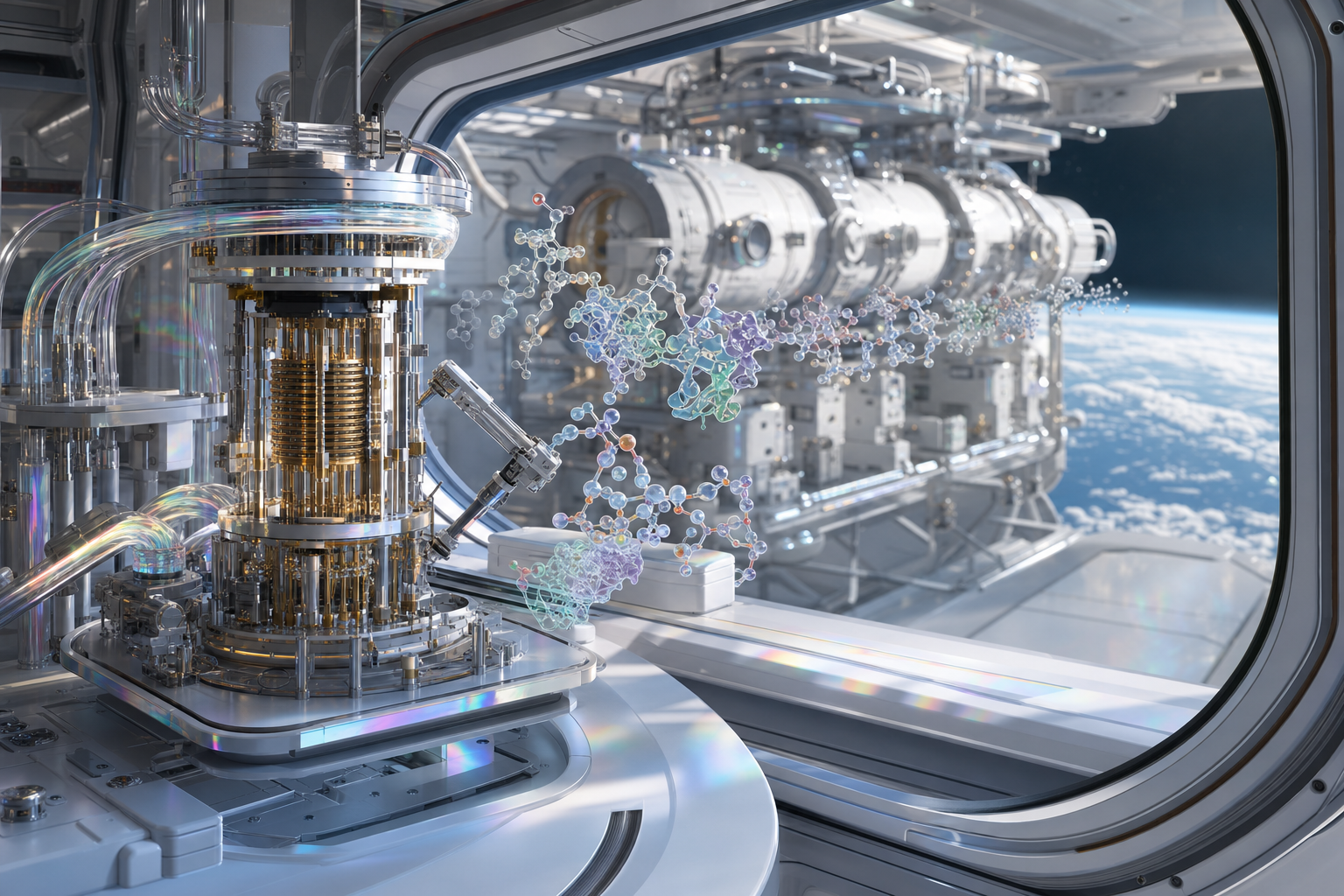
Why a 12,635-Atom Protein Simulation Still Needs Supercomputers
A protein-scale calculation divided across machines
A May 2026 arXiv preprint joins quantum processors with the Fugaku and Miyabi-G supercomputers to model trypsin and T4 lysozyme with ligands and surrounding water. The larger system is a 12,635-atom protein-ligand complex. That total describes the biological scene, not one enormous quantum circuit. The researchers used embedding to divide each molecule into electronic fragments, assigning selected difficult fragments to quantum hardware while classical systems prepared and assembled the wider calculation. This heterogeneous quantum-classical workflow is the central result: current quantum processors can participate in a large biomolecular simulation when their task is bounded carefully and supported by substantial classical computation.
What the resource record establishes
The team used two IBM Heron r2 processors and up to 94 qubits in individual calculations. It ran 9,200 circuits for more than 100 hours, collected 1.3 billion measurement outcomes, and processed the sampled data on two supercomputers. The paper reports a system more than 40 times larger than an earlier 303-atom demonstration and up to 210 times better accuracy than a previous quantum-centric approach in one workflow step. Selected fragment energies matched a respected coupled-cluster classical reference. IBM also states that the complete method still trails leading classical approaches.
Why drug discovery still has another threshold
The study establishes enabling infrastructure for biomolecular simulation. It does not report a prospective compound-selection campaign, blinded prediction, wet-lab confirmation, or a medicine advanced because of the calculation. Drug discovery needs reliable differences between candidate molecules, not an atom total alone. A later benchmark could show whether this method ranks a difficult ligand series more accurately or predicts an experimental energy difference that practical classical approximations miss. That is the bridge from a large computing experiment to a laboratory decision. Quentir reads the current work as a serious architecture milestone whose most useful feature is its transparent account of quantum execution, classical support, comparison limits, and remaining medical distance.
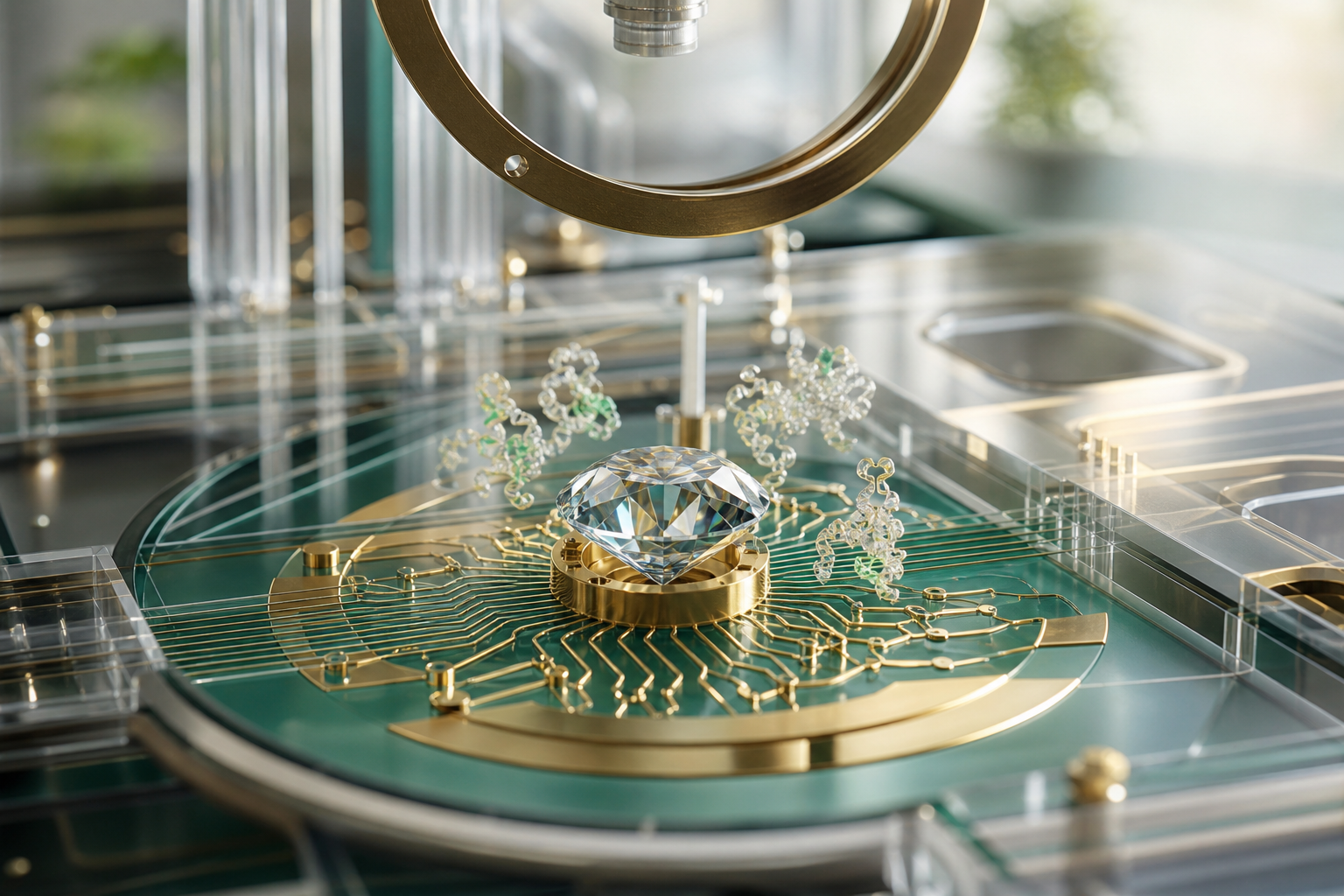
The five-nanometer film that lets diamond hold a protein
A surface thin enough for quantum sensing
A dry diamond chip and a protein in salt water present an awkward engineering problem. The quantum sensor needs an exceptionally clean, quiet surface. The biological target needs chemistry that can hold it without destroying its structure. Mouzhe Xie and colleagues joined those requirements in a sub-five-nanometer interface built from aluminum oxide and polyethylene glycol. Their 2022 PNAS study immobilized individual proteins and DNA molecules on diamond that hosted nitrogen-vacancy quantum sensors near the surface. The film also gave the researchers control over how densely proteins attached, a practical requirement for experiments that aim to observe one molecule at a time.
What the experiment established
The prepared surface preserved near-surface qubit coherence approaching 100 microseconds and remained chemically stable for more than five days under physiological conditions. Those measurements make the interface a credible piece of enabling science for quantum biosensing. The experiment established controllable biomolecule attachment and compatible quantum performance on the same chip. It did not detect disease, validate a clinical assay, or compare a diagnostic device with current care. The authors predicted that an individual carbon-13 nuclear-spin signal could be detectable with an integration time as short as 100 seconds under the measured distance and coherence conditions. They also described possible routes into pulldown assays, proteomics, drug discovery, and cancer-marker detection. This Quentir Medicine Monitor analysis follows the interface from materials processing through surface chemistry and quantum coherence to the medical claims that may eventually rest on it. The humane promise is information from very small samples: a binding event or structural change that bulk measurements can blur. A useful medical device will still have to turn that nanoscale sensitivity into reproducible answers about a person's health. The film matters because it makes that later work physically possible while leaving the clinical claim open, visible, and ready for a different standard of proof.

A Quantum Radiotherapy Model Awaits Independent Reproduction
The speed claim and its setting
Adaptive radiotherapy changes a cancer treatment plan as the patient’s anatomy changes. That makes calculation time clinically interesting, provided confidence in the delivered dose survives the faster workflow. A 2025 Scientific Reports paper places quantum algorithms inside this task and reports a 15-fold speedup against classical Monte Carlo simulation. The proposed system combines Harrow-Hassidim-Lloyd and variational quantum eigensolver routines with deep learning and a Monte Carlo radiation model. It also reports lower mean absolute error and modestly better gamma-index metrics in its selected comparisons. Those numbers belong to a defined computational architecture, dataset, and comparator, so the details around the ratio matter as much as the headline figure.
The clinical distance inside the paper
The article uses public imaging collections and simulated voxel phantoms, then describes simplified patient models and limited dataset diversity among its limitations. It says that the system has not been compared with commercial treatment-planning platforms and has not entered a prospective clinical study. This Quentir Medicine Monitor analysis reads the speed figures as a reported computational result pending independent reproduction. The linked public repository contained one README when checked on July 16, 2026. It presented high-level pseudocode with undefined helper calls, without executable circuits or backend records. That preserves the paper’s interesting connection between quantum linear algebra, medical AI, and radiation dosimetry while keeping later steps visible: executed-backend details, full timing boundaries, independent reproduction, strong contemporary classical comparison, multi-center validation, and prospective use. For a patient, speed becomes valuable when it shortens the path from imaging to a trustworthy plan without weakening protection for healthy tissue. The paper offers a specific research claim that others can inspect. It also shows why quantum-medicine results need two readings at once: one for the computation that was demonstrated and one for the medical responsibility the demonstration may eventually carry. The clinic will ask a different question about whether the faster mathematics supports a plan that professionals can safely deliver to the person in front of them, across changing anatomy and the practical constraints of a treatment day.
Why quantum medicine's prize money comes in two sizes
Two rewards, two thresholds
Wellcome Leap's Q4Bio program attaches different rewards to different stages of quantum-health progress. A $2 million prize is available to each qualifying team for an experimental realization on a quantum computer with more than 50 qubits, a substantial program depth, and a clear route toward larger systems. A $5 million grand prize asks for execution within a defined resource envelope and leaves the final health-significance judgment to expert evaluators. The split makes quantum medicine milestones easier to read without collapsing a hardware result into a patient outcome.
Why the split matters
Medical discovery runs on several clocks. A computation can narrow a search space quickly, while laboratory validation and clinical study take much longer. Q4Bio's design gives early technical achievement a serious threshold of its own, then reserves the larger reward for a more demanding resource fit. That sequence connects research finance, quantum engineering, biomedical judgment, and the humane purpose of the work. It also gives readers a better vocabulary for asking what a result has actually reduced: uncertainty about device execution, uncertainty about scale, or uncertainty about health value. Quentir reads the program as a compact model for resource-bounded health claims, where optimism is rewarded through increasingly consequential demonstrations and patient benefit remains the reason the technical work matters.
A quantum sampler leaves the whiteboard
Drug discovery often begins with a search through more molecular possibilities than any laboratory could ever test one by one. A quantum version of a familiar sampling routine has now run on Quantinuum's H2 and Helios systems, producing accurate results on physical qubits in a tightly bounded experiment. The practical lesson is demanding rather than triumphant: useful sampling methods must survive hardware noise before any theoretical speedup can help real molecular research.
The method at the center of this work is Markov Chain Monte Carlo, a workhorse for drawing samples from complicated probability distributions. In chemistry, those distributions can describe the many configurations a molecule may adopt, and the questions that matter often reduce to an average taken over that vast space. The appeal of a quantum approach is specific and bounded: quantum amplitude estimation offers a quadratic reduction in the resources needed to estimate certain averages, provided the machine can first prepare the right probability distribution. That proviso has always been the awkward part, and it is exactly what this experiment set out to test on real hardware.
In a March 2026 preprint, Baptiste Claudon, Sergi Ramos-Calderer and Jean-Philip Piquemal encoded two-state Markov chains, prepared their stationary distributions, and ran the algorithm on Quantinuum's H2 and Helios computers, within a collaboration between the Centre for Quantum Technologies in Singapore and Qubit Pharmaceuticals. They keep the claim modest: the experiment uses the simplest non-trivial chains and tests the building blocks of the method, not a pharmaceutical molecule. That restraint is what makes it useful. It isolates the sampling machinery, shows which pieces can already survive a real device, and hands researchers something concrete to improve next: state preparation, circuit depth, error behavior, and the handoff between quantum sampling and classical analysis. For medicine, the humane stake arrives much later, after years of chemistry, toxicology and clinical work, so the near-term value is scientific discipline rather than a faster cure. A hardware run with clearly stated limits is more useful to a decision-maker than a grand promise, because it lets the field see exactly how far the computation has traveled and how far it still has to go, one reproducible step at a time.

The heart scan that keeps almost arriving
Magnetocardiography reads the faint magnetic field thrown off by the heart's own electrical activity, without touching the patient. It is around sixty years old, it keeps producing evidence that it sees things a standard ECG cannot, and it is still not accepted as a routine clinical tool. The gap between those last two facts is where quantum medicine actually lives.
The clearest account comes from the people who have lived the technique. In a 2023 review in Frontiers in Cardiovascular Medicine, Brisinda, Fenici and Fenici, whose group has worked on magnetocardiography since the early 1980s, write that a large body of research and several clinical trials have shown it reliably supplies diagnostic electrophysiological information beyond what conventional non-invasive electrocardiographic methods provide. Because the sensors sit outside the body, the signal escapes much of the distortion that skin, fat, muscle and bone impose on readings taken at the surface.
So why is it not in the emergency department down the road? The obstacle is noise, and for decades the only answer was a magnetically shielded room that a handful of institutions could afford. That constraint is loosening: optically pumped magnetometers have removed the liquid-helium cooling that chained the method to specialized facilities, and unshielded systems are now being tested against real patients in multicenter trials. The computational side of the field runs on a slower and more honest clock, with its own literature candid that today's noisy qubits leave known algorithms for practical problems out of reach on current machines. Read both clocks together and the useful question is the same for either: what does the accumulated record support today, and where does it stop? Quantum sensing is at the door of the bedside, with a device clearance in hand and multicenter trials under way, while quantum computation in medicine is doing disciplined work well inside a limit its own authors describe out loud. Chest pain drives millions of American emergency-department encounters a year, so the value of getting the first judgment right is considerable, and the value of not overstating the second is just as real. Answer both honestly, one study at a time, and the frontier stops being a slogan and becomes something a clinician, an investor, or a board can actually plan around.