When a Quantum Computer Misses the Temperature
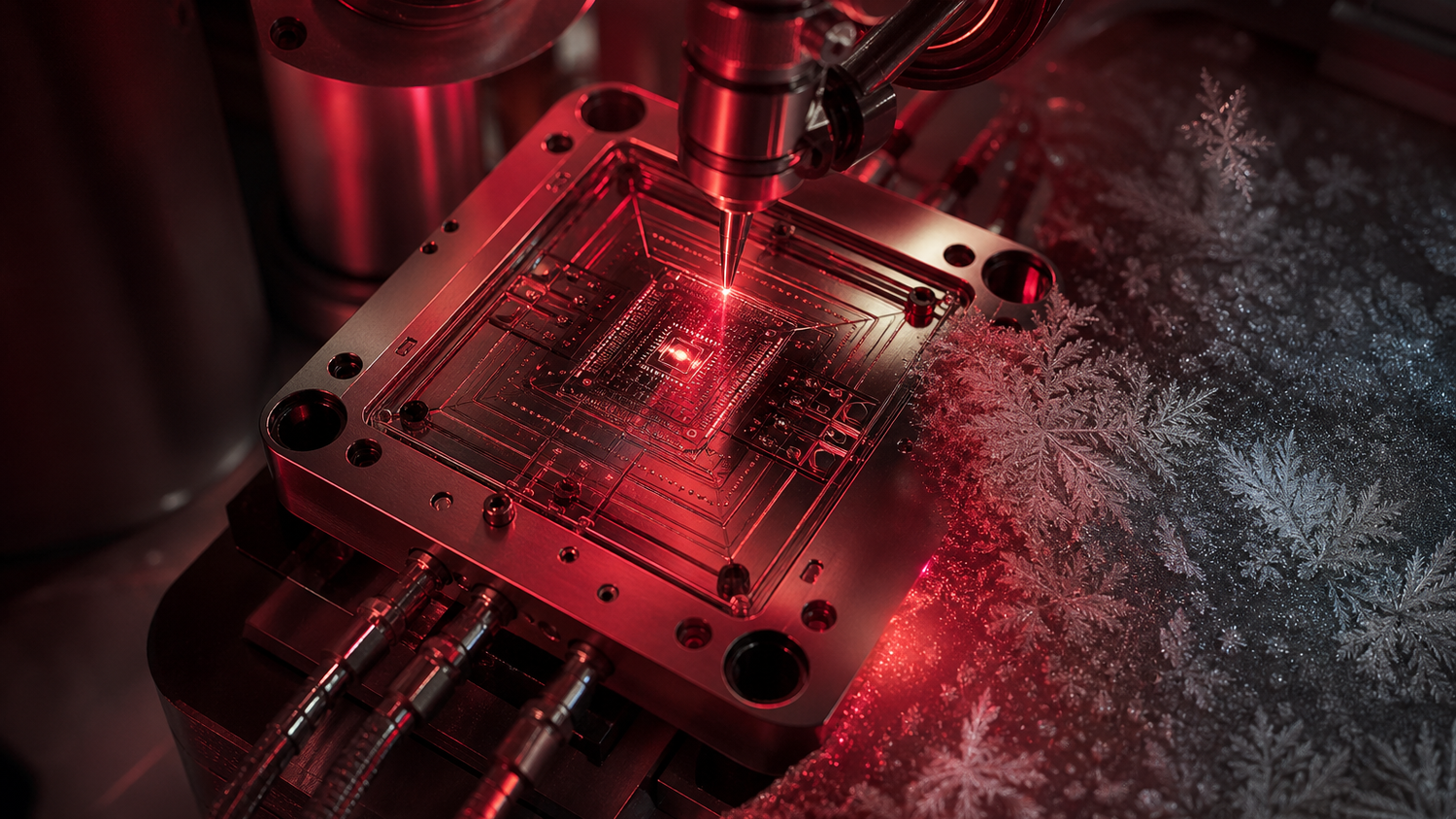
A nineteenth-century physicist could describe a hot gas without tracking every molecule. The trick was statistical: assign probabilities to the possible energy states and let temperature determine their distribution. That distribution, now called a Gibbs state, became part of the grammar of thermodynamics. It helps explain magnets, chemical reactions and materials in equilibrium. In modern laboratories, it also offers a demanding question for quantum computers: can a machine prepare the distribution that nature would produce at a specified temperature?
A paper published on 11 July 2026 in npj Quantum Information gives a wonderfully physical answer. Reece Robertson, Mirko Consiglio, Josey Stevens, Emery Doucet, Tony J. G. Apollaro and Sebastian Deffner implemented a variational Gibbs-state algorithm on IonQ trapped-ion hardware. They trained the parameters with classical simulation, ran the resulting circuits on the quantum device and used state tomography to compare the prepared state with the intended one. The machine could prepare the target family of states, but its errors did something recognizable: they made the answer look warmer.
Practical takeaway. A quantum simulation should be judged by the physical condition it actually reproduces, including the effective temperature created by noise, not only by whether the circuit completed.
The paper asks a narrow, revealing question
Gibbs states encode probabilities across energy levels. At higher temperatures, many levels can carry meaningful weight. At lower temperatures, probability concentrates toward the ground state. Preparing those distributions is useful in quantum thermodynamics and chemistry, and Gibbs states can initialize sampling procedures used in quantum machine learning. They are also difficult to create faithfully because the calculation must reproduce both the spectrum of a system and the correct weighting of its states.
The experiment used a hybrid variational method. A classical optimizer first trained a parameterized circuit by minimizing free energy. The trained circuit was then mapped to IonQ hardware. Trapped ions offer full connectivity, so the team could avoid some SWAP operations that other architectures need to move quantum information between distant qubits. That architectural advantage shortened the circuit. It did not erase the effect of noise.
The measurements exposed two limits. Fidelity decreased as inverse temperature increased, meaning colder target states were harder to reproduce. Fidelity also declined as the modeled system grew. These are modest systems, and the authors do not present the work as commercial advantage. Its value comes from making an error visible in the language of the modeled world. The output was not simply less accurate. It behaved as though thermal fluctuations in the hardware had raised the prepared state above the requested temperature.
Cold hardware can still produce a warmer model
The phrase sounds paradoxical because physical and simulated temperature are different things. Ion traps operate under highly controlled laboratory conditions, yet the Gibbs temperature in this experiment belongs to the mathematical system encoded by the circuit. Noise changes amplitudes and probabilities. Once those changes are read through a thermodynamic distribution, the prepared state can resemble one associated with a higher effective temperature.
That distinction has consequences outside physics. Imagine a quantum simulation used to compare molecular conformations in drug discovery. A temperature shift can alter which configurations appear likely and how often rare states occur. In materials research, it can blur the boundary between phases or change an estimate of equilibrium behavior. The machine may execute the requested sequence while returning a distribution that describes a different physical condition. A plausible-looking result can therefore carry the wrong scientific meaning.
This is where engineering becomes governance. Researchers need calibration data, uncertainty bounds and a clear description of the target and realized state. A laboratory buying access to quantum hardware needs enough information to decide whether a mismatch is tolerable for its use. A pharmaceutical sponsor or public research funder needs to know which conclusions rest on hardware runs, classical training or post-processing. Publicly funded researchers and smaller institutions should receive the same realized-condition disclosures as large commercial buyers. Patients never see the circuit, but they may eventually inherit decisions made from its output. The chain from qubit noise to human consequence is long, yet it is traceable.
A result that travels needs a temperature label
Scientific assurance usually develops around the variables that can quietly invalidate comparison. Clinical trials control dose and population. Semiconductor metrology records process conditions. Climate models publish scenarios and ensembles. Quantum simulation will need an equally mature account of realized conditions. For Gibbs-state preparation, effective temperature is a candidate reporting variable because it translates an abstract fidelity loss into a physical deviation readers can interpret.
The paper also complicates vendor benchmarking. A single fidelity score can conceal where error lands. Two devices might report similar aggregate performance while producing different biases across energy states. Full connectivity can reduce routing overhead, yet another architecture may have different noise or scaling behavior. Procurement claims about chemistry or optimization should therefore identify the state family, system size, target temperature, tomography method and uncertainty. Those details make comparisons possible without pretending that one experiment settles an architecture contest.
There is a legal bridge here as well. Scientific marketing claims often migrate from papers to investor decks and procurement descriptions faster than their limitations do. If a vendor says its machine prepares thermodynamic states for useful chemistry, the meaning of "prepares" matters. Does the claim cover a tiny demonstrator, a classically trained circuit, a verified hardware state, or a result corrected after the run? The 11 July paper offers a precise vocabulary for asking that question without inflating its own achievement.
How Quentir Reads It
Recent Quentir coverage has followed the control and runtime problem. Our analysis Can a quantum computer stay calibrated long enough to matter? examined systems that learn from error signals during operation. Gibbs-state preparation shows the complementary issue: even when a run finishes, the modeled condition can drift away from the requested one. Runtime stability and semantic accuracy belong in the same assurance conversation.
The connection is easy to miss because the fields use different nouns. Engineers speak about noise, fidelity and tomography. Chemists speak about ensembles and temperature. Lawyers and purchasers speak about representations, acceptance criteria and reproducibility. A credible quantum market will need translations among all four. Otherwise, hardware success can be announced at the circuit layer while failure remains hidden at the scientific layer where the result is used.
Quentir’s Signature Report adds the fixed scope, executive synthesis, dated source spine and internal-use license needed for deeper institutional assessment. This post stays with one concrete experiment and one implication: useful quantum computation will require labels for the physical world the machine actually reproduced.
The useful machine may be the one that confesses its weather
A thermometer is valuable because it reports conditions, including inconvenient ones. Quantum computers will earn scientific trust in much the same way. Their progress will be measured by qubit counts and gate errors, but also by whether a researcher can tell when a simulated material ran warm, when scale changed the answer, and when a polished output no longer described the requested system.
The trapped-ion experiment leaves an honest tension open. Full connectivity helps. Variational preparation works on real hardware. The colder and larger cases still pull away from the target. That gap is where the next scientific advances will happen, and where standards, contracts and public claims should remain exact.
Published intelligence, built to inform your own decisions. Published: July 12, 2026.
Sources: Reece Robertson et al., "Variational Gibbs state preparation on trapped-ion devices", npj Quantum Information, published July 11, 2026; Quantum Zeitgeist, "Variational Algorithm Prepares Gibbs States on IonQ Computers", July 12, 2026. Publication metadata and live links checked July 12, 2026.
Published intelligence, built to inform your own decisions. Published: July 12, 2026.