
The Quantum Laboratory Has an Overnight Shift
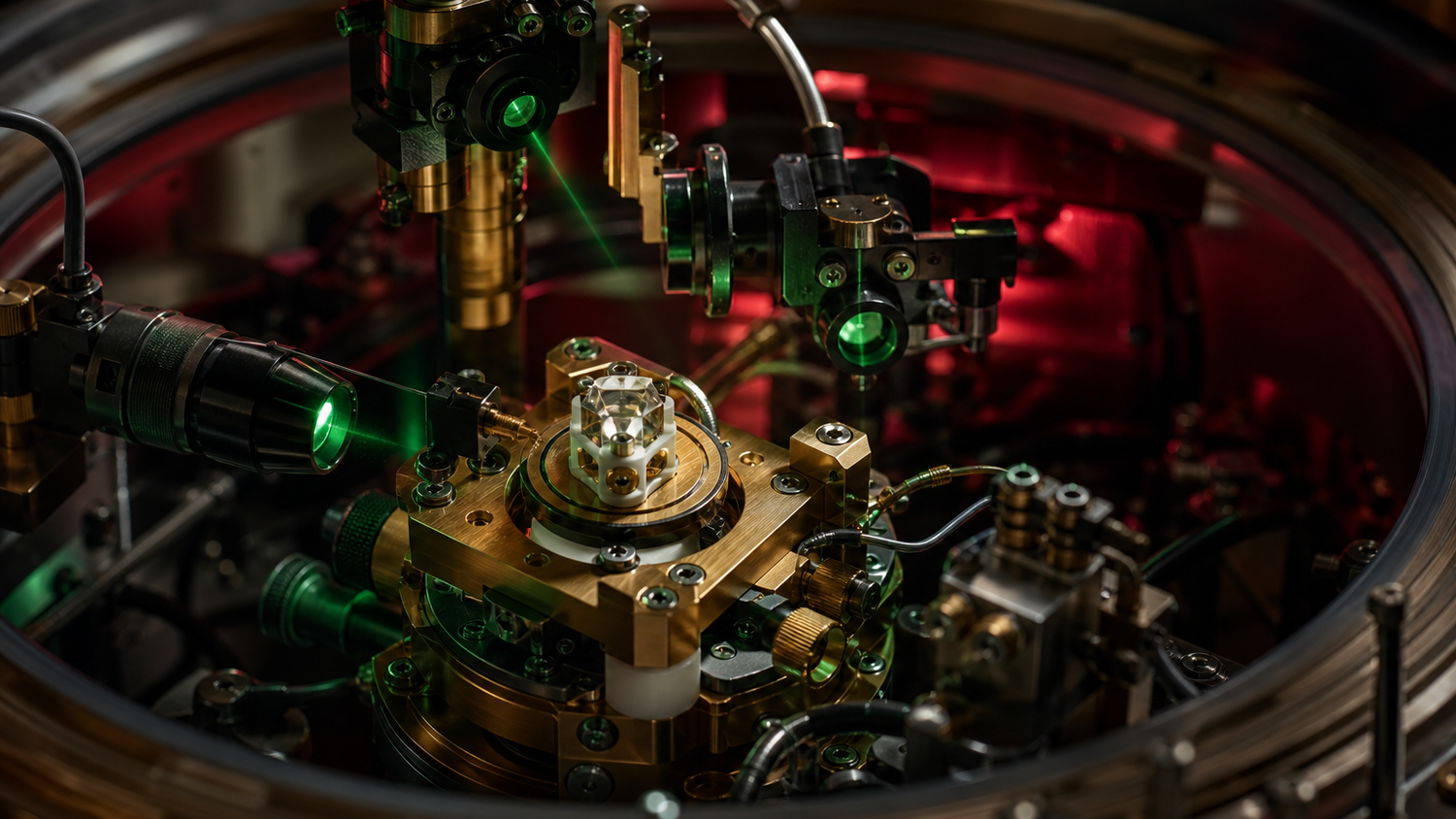
Late in a quantum-sensing run, the software chose a single nitrogen-vacancy center in diamond, calibrated its resonant frequency, measured its coherence time and added another pulse sequence to investigate a weak feature. No one had written that exact sequence of steps into a fixed automation script. According to the researchers, a language-model agent made the choices while deterministic controls operated the equipment.
That scene comes from a July 27 preprint by Takuya Isogawa, Ryotaro Okabe, Nutdech Phadetsuwannukun, Mingda Li and Paola Cappellaro. It is one of four papers posted within two days that place AI agents inside quantum experiments, code discovery and hardware design. Read together, they describe a change in the laboratory division of labor: software is beginning to choose experimental actions, while people retain responsibility for the scientific claim.
Four papers, one transfer of agency
The papers cover different layers of the stack. The diamond-sensing workflow joins project records, quantitative analysis tools and deterministic experiment control. A neutral-atom study by Constantin Dalyac, Alexandre Dauphin, Loïc Henriet and Christophe Jurczak moves from a published paper or patent to an overnight campaign on two Pasqal cloud processors. OmniQEC, from Ge Yan and colleagues, coordinates candidate generation, screening, syndrome-extraction synthesis and circuit-level evaluation in a search for quantum error-correcting codes. ContractHIL-HLS, by Jingbo Zhang, Haoxiang Sun, Wenbo Wang and Wenbo Zhang, translates natural-language requirements into hardware interfaces, constraints, validation checks and rollback rules.
The shared development is easy to miss if each paper is treated as a specialist result. These systems can carry an intention across several technical boundaries: scientific literature into a cloud experiment, natural language into programmable logic, or a code idea into a circuit-level test. The agent becomes connective tissue between stages that previously required a researcher or engineer to perform every translation by hand.
Practical takeaway. Autonomous science needs a boundary around delegated judgment. The durable record should distinguish the goal set by a person, the actions selected by software, the measurements produced by an instrument and the interpretation accepted by a named researcher.
The overnight campaign records its own failures
The most valuable result in the neutral-atom paper may be two things that went wrong. The authors report that the agent selected an inadequate observable in one experiment and later produced a plausible but incorrect hardware diagnosis. Domain experts caught both errors. Its overnight speed was real; so was the need for scientific intervention.
This is a more useful account of autonomy than a benchmark score alone. A laboratory agent can make a choice that is locally reasonable and scientifically wrong. The error may survive because plots look coherent, the code runs and the machine returns data. Fluency can now reach the instrument panel. Review therefore has to examine the chain from research question to control command, measurement and interpretation. A final chart cannot reveal every mistaken choice upstream.
The sensing paper reaches a similar conclusion from another direction. Its authors separate reasoning benchmarks from laboratory execution. Greater reasoning effort generally helped identify a residual calibration offset in one benchmark. In the pulsed-ODMR data-evaluation benchmark, pulse-sequence information alone produced more false-positive resonance judgments at higher reasoning effort; requiring an expected-signal calculation kept false-positive rates low across all tested models and settings. They separate end-to-end demonstrations from offline checkpoint benchmarks and argue for selective higher reasoning alongside deterministic analysis tools. That is close to experimental method in software form: make the stopping points visible before the machine starts improvising.
A laboratory can draft its operating contract
ContractHIL-HLS gives the clearest name to the intermediary object. Its structured “contract” turns an instruction into explicit interfaces, constraints, validation checks and rollback rules. Hardware compilation, runtime, power and failure results feed back into later revisions. On 94 locally executable HLS-Eval tasks, the authors report that the structured contract raised the estimated single-sample testbench pass rate from 64.0% to 70.2%; the full workflow then carries the design toward hardware closure.
The legal analogy has limits, but the institutional connection is useful. A commercial contract allocates authority and consequences between parties. This engineering contract allocates authority between human intent, software agents and a physical device. It can record which constraints are mandatory, which measurements count as acceptance and when rollback must occur. The control object is becoming inspectable, which matters when a design later enters a regulated product, a critical system or a patent dispute.
OmniQEC adds another version of the same pattern. Its fast loop explores candidates through inexpensive code-level proxies. Its slower loop estimates circuit-level logical error rates through noisy sampling and selected decoders, then returns that simulation output to the search. Code-level plausibility and simulated circuit performance are different currencies. The authors call the system an “AI scientist.” Institutions may prefer a less anthropomorphic description, yet they still need to decide who owns a discovered code, who validates its performance and which version of the search process supports the published claim.
Scientific credit and industrial liability move together
Experimental science already distributes responsibility across principal investigators, instrument scientists, technicians, software authors and facilities. Agentic workflows add a participant that can initiate consequential steps without holding professional duties or bearing liability. The pressure will surface first in ordinary places: authorship statements, lab notebooks, cloud-QPU terms, procurement specifications, invention disclosures and insurance questions.
U.S. patent practice will face a particularly awkward boundary. Current USPTO guidance says AI systems are tools, only natural persons can be inventors, and conception remains central under the Patent Act. ContractHIL-HLS can begin with requirements; the neutral-atom workflow can begin with a paper or patent; OmniQEC can search design families. If an agent proposes the configuration that makes a result work, the institution still needs a human account of conception, validation and chain of title. Trade-secret protection also depends on knowing which prompts, intermediate designs and vendor logs left the organization.
The civic stake arrives when these methods move from research infrastructure into systems that affect people. Quantum sensing can touch navigation, materials, diagnostics and security. Automated design tools can shape chips and control systems. A convincing result with an unclear decision chain weakens public trust even when the underlying physics is sound. Conversely, a well-bounded workflow can make scientific work more reproducible by preserving failed branches and calibration choices that human notebooks often compress.
How Quentir Reads It
Quentir calls this pattern instrument delegation: software receives an objective, chooses among permitted physical or design actions and returns a result on which another institution may rely. The category connects science governance, product assurance, intellectual property and procurement.
Quentir’s earlier analysis, “The Learning Machine Has No Final Version,” examined continual learning after deployment. The laboratory papers expose an earlier point in the lifecycle. The system is already adaptive while the claim is being created. Versioning, authority and review therefore begin before a product exists.
A credible operating model has three distinct thresholds. Permission authorizes the agent to act within a defined experimental envelope. Validation checks the resulting measurement or design through tools that do not depend on the agent’s own narrative. Acceptance remains a human institutional act, attached to a name, date and purpose. These thresholds should never collapse into one green status.
The handoff will decide whether autonomy earns trust
The four preprints are early research reports, and their claims remain those of their authors. Together they make one development hard to dismiss: autonomous agents are moving beyond literature search and code suggestions into the physical and design loops of quantum technology. The decisive institutional artifact will be the handoff, the moment when machine-selected action becomes a result that a researcher, buyer or regulator accepts.
For readers tracking that handoff across AI, quantum technology, standards and commercialization, Quentir’s All-access membership carries fixed-scope editions, dated source tracking, refresh triggers and archive continuity. This post remains an initial synthesis of four new preprints.
Overnight operation will make laboratories faster. The stronger achievement would be a morning record that lets another person understand what the agent tried, where it failed, what the instrument measured and why the scientist signed their name.
Sources: Takuya Isogawa, Ryotaro Okabe, Nutdech Phadetsuwannukun, Mingda Li and Paola Cappellaro, “Agentic AI for Scientific Reasoning in Autonomous Quantum Sensing Experiments”, arXiv:2607.25145v1 (submitted July 27, 2026); Constantin Dalyac, Alexandre Dauphin, Loïc Henriet and Christophe Jurczak, “Lowering the Implementation Barrier of Neutral-Atom Quantum Computing with Agentic Workflows”, arXiv:2607.25834v1 (submitted July 28, 2026); Ge Yan et al., “OmniQEC: Discovering Practical Quantum Error-Correcting Codes by an AI Scientist”, arXiv:2607.25865v1 (submitted July 28, 2026); Jingbo Zhang, Haoxiang Sun, Wenbo Wang and Wenbo Zhang, “ContractHIL-HLS: Contract-Aligned Multi-Agent Workflow with Hardware-in-the-Loop Feedback for HLS Design”, arXiv:2607.25283v1 (submitted July 28, 2026). United States Patent and Trademark Office, “Revised Inventorship Guidance for AI-Assisted Inventions” (published November 26, 2025). Public-source snapshot: July 29, 2026.
Published intelligence, built to inform your own decisions. Published: July 29, 2026.