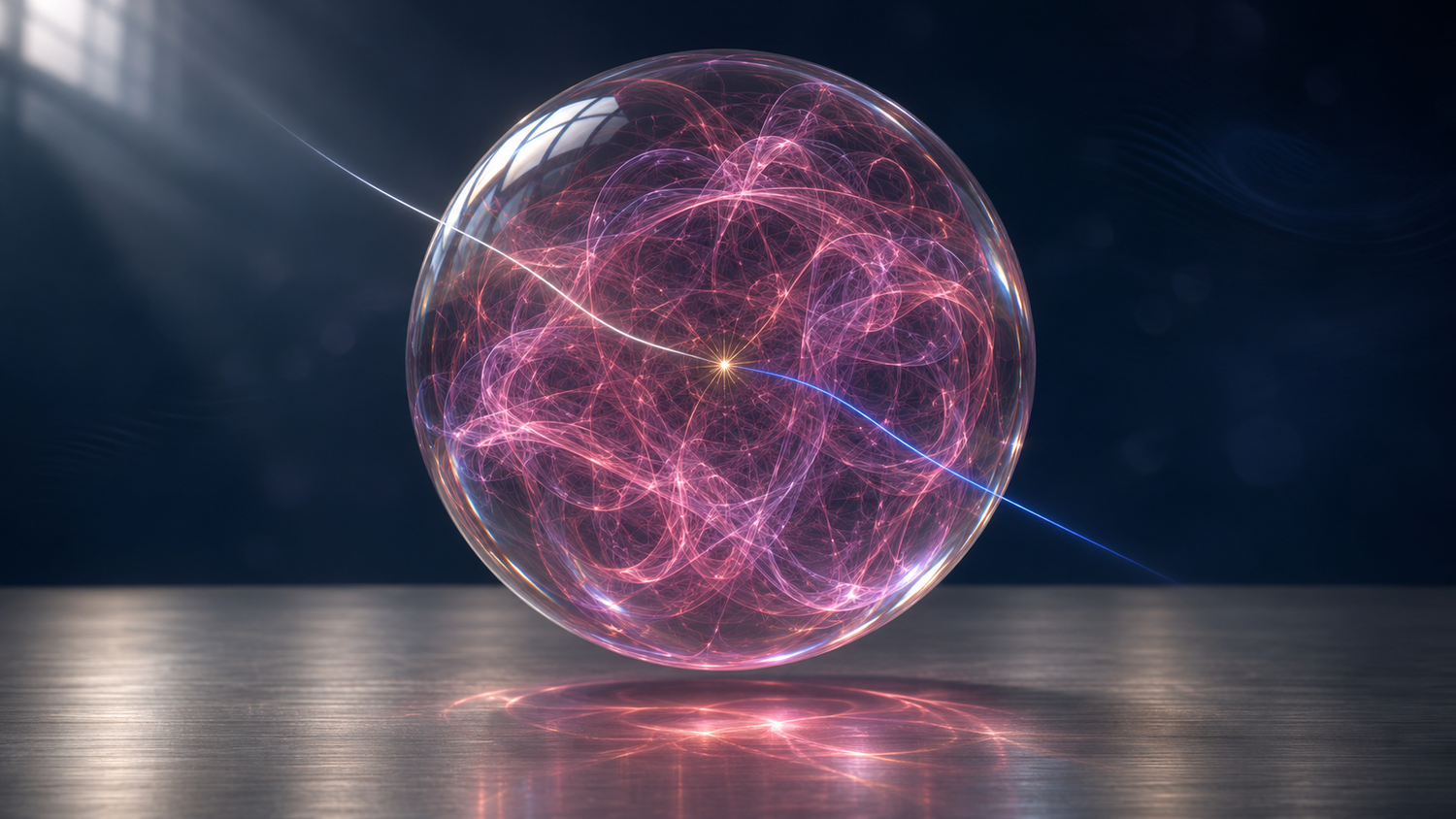
On 3 November 2026 the LHCb collaboration at CERN presented the first evidence from a single experiment for the decay of a neutral B meson into a muon and an antimuon, written B0 → μ+μ− and known among physicists as "Bd to mu mu." The Standard Model predicts that about one in ten billion of these beauty particles decays this way, and the search began with the CLEO experiment in 1984. A joint analysis of CMS and LHCb data reported evidence for the decay in 2015, which later analyses did not confirm. The new analysis, led from the Cavendish Laboratory at the University of Cambridge, combines data recorded with the upgraded detector in 2024 and 2025 with LHCb data from 2011 to 2018. It gives a branching fraction of 1.14 × 10⁻¹⁰, with a statistical uncertainty of +0.42 and −0.39 and a systematic uncertainty of +0.06 and −0.05 in the same units, against a Standard Model prediction of 1.03 × 10⁻¹⁰, at a statistical significance of 3.2 sigma. That level counts as evidence. A discovery in particle physics requires five sigma, and the result has not yet been peer reviewed. Because the decay runs through quantum loops, it is sensitive to heavy particles at distances of about a zeptometer, and the same quantum physics links it to dark matter searches, to the unresolved questions of dark energy and the Planck length, and to the quantum technologies used to pursue them.
The zeptoverse and the ladder of length scales
The Cambridge team uses "zeptoverse" for the range of distances around a zeptometer, 10⁻²¹ meters, a billionth of a trillionth of a meter. The scale is easiest to grasp as a ladder. An atom measures about 10⁻¹⁰ meters and a proton about 10⁻¹⁵. The Large Hadron Collider resolves structure directly down to about a hundred zeptometers, 10⁻¹⁹ meters. A zeptometer lies two steps further down. The Planck length, 1.6 × 10⁻³⁵ meters, lies another fourteen orders of magnitude below that.
In quantum mechanics, distance and energy are tied together: a probe resolves a distance roughly equal to ħc divided by its energy, and ħc is about 197 MeV times a femtometer. A hundred zeptometers therefore corresponds to an energy scale of about 2 TeV, and a zeptometer to about 200 TeV, far beyond any collider in operation or under construction. The LHC has found no particles beyond the Standard Model, so if heavier particles exist, their effects may be confined to these shorter distances. Precise measurements of rare decays offer a way to reach them without producing them.
Quantum loops in Bd to mu mu
A B0 meson consists of a down quark and a beauty antiquark. For it to turn into two muons, the beauty antiquark and the down quark must annihilate, which changes the flavor of a quark without changing its electric charge. The Standard Model forbids such a flavor-changing neutral current at the simplest level of interaction. The decay can proceed only through quantum loops, in which W bosons, Z bosons and top quarks appear briefly as virtual particles and disappear again before the muons emerge. Physicists draw these processes as "penguin" and "box" diagrams.
Three effects make the decay rare. The loop itself suppresses the amplitude. The transition from a beauty to a down quark depends on a small element of the Cabibbo-Kobayashi-Maskawa matrix, which describes how strongly quark generations mix. And because the B meson has no spin, the two muons must emerge in a configuration that the weak interaction disfavors; the amplitude grows with the muon mass, which is small. The related decay of the Bs meson, which contains a strange quark in place of the down quark, is about thirty-five times more frequent. A joint CMS and LHCb analysis observed it in 2015, and LHCb observed it alone in 2017.
New physics would add a second route. A heavy particle that no collider can produce, such as a new Z′ boson, a leptoquark or an additional Higgs boson, can still take part as a virtual particle, either inside a loop or as a direct exchange between the quarks and the muons, and open a second route to the same two muons. Quantum mechanics adds the amplitudes of both routes, so the rate can rise or fall depending on the new particle's mass and couplings. In some extended Higgs models the rate grows steeply with the ratio of the two Higgs vacuum values. Because the Standard Model rate is so small and predicted precisely, a new contribution of comparable size can become measurable as the data grow, which is why physicists have long called these decays golden channels for new physics. The comparison of the Bd and Bs rates adds a second test. If new particles couple to quark flavors in the same pattern as the Standard Model, the ratio of the two rates stays fixed. A departure from that ratio would show that new physics treats down and strange quarks differently. LHCb measures the ratio at 0.035, with a statistical uncertainty of +0.014 and −0.012, in line with the Standard Model.
How LHCb found one decay in ten billion
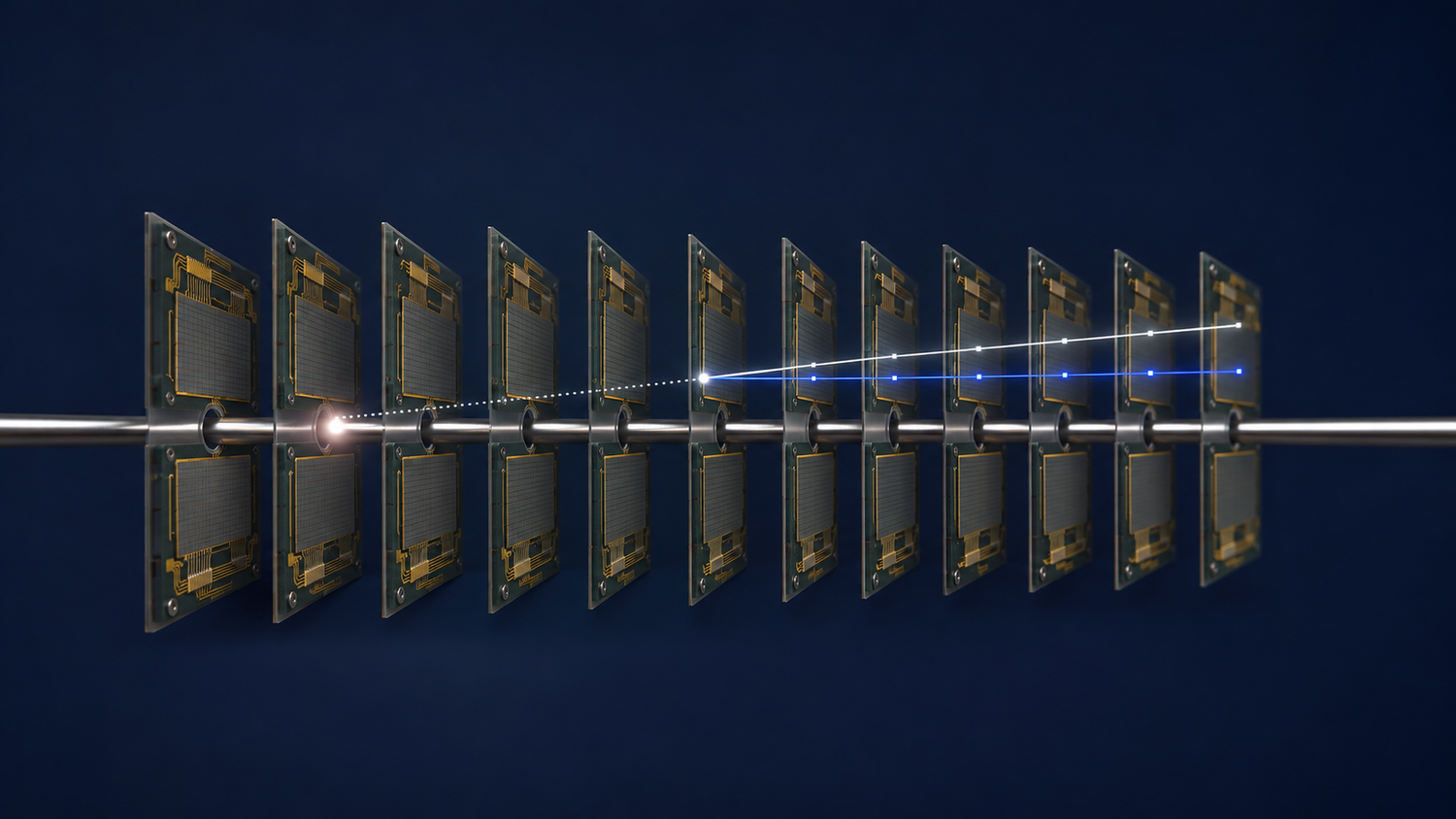
LHCb was built to study beauty quarks, which do not occur in ordinary matter but are produced in large numbers in LHC collisions. A beauty particle lives for about one and a half trillionths of a second and travels a few millimeters before it decays. The experiment must locate that displaced decay point, identify two muons that came from it and distinguish them from the far more common muons of ordinary collisions.
The upgraded detector does this in real time. Since the upgrade, LHCb reads out every collision and selects events in software, and it records data at up to five times its earlier rate. Its Vertex Locator, a silicon pixel detector and a major UK-built component of the upgrade, sits five millimeters from the LHC beams and fixes where each beauty particle was produced and where it decayed. The analysis team, about twenty physicists from the United Kingdom, Germany, Italy, Spain and the Netherlands, used machine learning to suppress the background that would otherwise bury a signal this rare. The upgraded experiment will collect a much larger data set into the early 2030s, including the first years of High-Luminosity LHC operation, and a further LHCb upgrade planned for the middle of the 2030s would raise the data rate by another factor of ten.
Quantum computing and lattice QCD
The prediction against which LHCb compares its measurement depends on the strong force that binds the quarks inside the B meson. That contribution enters through a single number, the B meson decay constant, which physicists compute in lattice quantum chromodynamics on classical supercomputers. Together with the quark-mixing parameters, it sets the precision of the Standard Model prediction, and it will need to keep pace as the LHCb data grow.
Quantum computers may eventually extend lattice methods to real-time processes. Lattice calculations on classical machines handle static quantities such as decay constants well, but they cannot follow the real-time evolution of quarks and gluons, because the required sums suffer from the sign problem. Quantum simulation of gauge theories addresses that limitation directly, and trapped-ion and superconducting processors have already simulated simplified one-dimensional models. A quantum computer that simulates full quantum chromodynamics at useful scale remains a long-term research goal. CERN's Quantum Technology Initiative, launched in 2020, also studies quantum machine learning for event classification; that work remains at the research stage and has not yet shown an advantage over the classical machine learning that made the present result possible.
Dark matter and the reach of rare decays
Dark matter makes up about five sixths of the matter in the universe, and the Standard Model contains no particle that could account for it. Rare B decays constrain dark matter models indirectly. Many of these models need a mediator, a particle that couples dark matter to ordinary quarks and leptons. Where such a mediator also couples to beauty and down quarks and to muons, it contributes to Bd to mu mu, and a rate that agrees with the Standard Model narrows the masses and couplings it can have. Other B decays search more directly. Belle II in Japan reported in 2023 evidence, at 3.5 sigma, for the decay of a charged B meson into a kaon and two neutrinos, with a rate 2.7 sigma above the Standard Model prediction; light invisible particles could hide among the missing energy in that channel.
The Cambridge result does not detect dark matter. The LHCb upgrade planned for the 2030s is designed to turn this evidence into a precision measurement that can constrain or exclude whole families of models.
Quantum sensors for dark matter
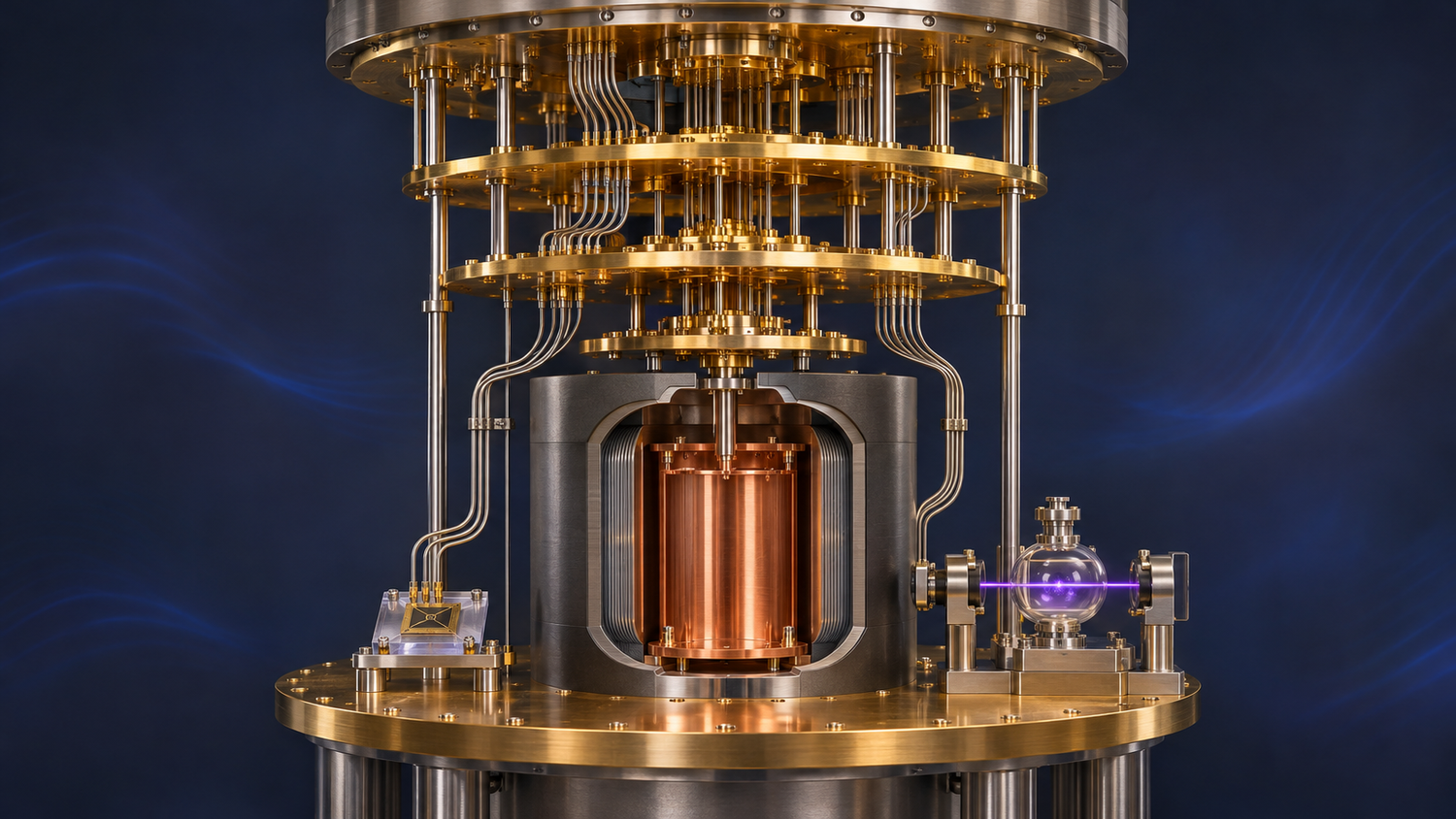
Bd to mu mu can constrain heavy mediators. Quantum sensors search at the light end of the possible mass range, where dark matter would behave less like a particle and more like a faint oscillating field filling space, and where the measuring instrument is itself a quantum device.
Axion searches show the method. An axion haloscope places a microwave cavity in a strong magnetic field, where an axion would convert into a single faint photon at a frequency set by its mass. The Axion Dark Matter Experiment amplifies that signal with quantum-limited Josephson parametric amplifiers. The HAYSTAC experiment at Yale reported in 2021 that squeezed microwave states doubled the speed at which it could scan for axions, because squeezing lowers the quantum noise in the measured quadrature. Superconducting qubits, the building blocks of many quantum computers, have counted single microwave photons for dark photon searches without destroying them. Optical atomic clocks search for ultralight dark matter that would make fundamental constants oscillate, by comparing clocks built on different atoms over months. These sensors draw on the same components as quantum computers: dilution refrigerators, superconducting circuits, low-noise microwave electronics and stabilized lasers.
Dark energy and the vacuum energy problem
Bd to mu mu says nothing directly about dark energy. Dark energy belongs in this account because it marks the place where quantum theory and observation disagree most sharply. Observations of supernovae, the cosmic microwave background and the clustering of galaxies show that the expansion of the universe accelerates, driven by a form of energy that makes up about seventy percent of the cosmic energy budget. Quantum field theory predicts that empty space carries an energy from the zero-point fluctuations of every field. Estimated naively up to the Planck scale, that vacuum energy exceeds the observed dark energy by about 120 orders of magnitude.
Recent data have reopened the question of whether dark energy is constant. The Dark Energy Spectroscopic Instrument reported in 2025 that its measurements of baryon acoustic oscillations, combined with other data, favor a dark energy that weakens over time, at a significance between about 2.8 and 4.2 sigma depending on the supernova sample. If dark energy changes, some theories describe it as a new scalar field whose force is screened in dense environments. Atom interferometers have tested such "chameleon" fields in vacuum chambers by measuring the acceleration of atoms near a test mass, and they have excluded a large part of the parameter range.
The Planck length and quantum gravity
The Planck length is the scale at which quantum effects of gravity are expected to become as strong as the other forces. It corresponds to about 10¹⁹ GeV, fifteen orders of magnitude above the energy of the LHC, and no accelerator will reach it. Through virtual contributions, rare decays can be sensitive to particles up to about a hundred times heavier than direct searches reach, depending on how strongly those particles couple, which still leaves the zeptoverse fourteen orders of magnitude above the Planck length.
Physicists have therefore turned to tabletop experiments that test whether gravity itself obeys quantum mechanics. In 2017 two groups, Sougato Bose and colleagues and Chiara Marletto and Vlatko Vedral, proposed placing two small masses in quantum superpositions close to each other. They argued that if gravity alone entangles the masses, gravity cannot be a purely classical interaction; other physicists have questioned how far that inference holds across models of quantum-classical interaction. The experiment requires masses large enough to gravitate measurably and isolated well enough to stay coherent, which places it at the frontier of quantum control. Laboratories working on levitated particles and matter-wave interferometry are developing the techniques it needs.
How Quentir Reads It
The Bd to mu mu evidence measures a quantum effect, the interference of virtual particles, with a detector that an international collaboration of about 1,900 members designed and built over fifteen years; the Manchester group built its Vertex Locator with nearly ninety UK companies. The dark matter searches at the light end of the mass range rely on quantum-limited amplifiers, superconducting circuits, cryogenics and atomic clocks, components that quantum computing and quantum sensing companies also build and sell.
The European Commission's Quantum Act proposal of 25 November 2026 covers several of these technologies. Annex III lists among the priority areas for strategic quantum infrastructures a network of quantum gravimeters and Union quantum clocks, with a cross-border quantum timing network to be demonstrated by 2030. Atomic clocks and atom interferometers, the technologies behind those infrastructures, are also instruments of the dark matter and dark energy searches described above. Article 9(4) would limit access to strategic quantum infrastructures to Union-controlled entities, with access for other entities under partnerships the Union concludes under Article 31. CERN, an intergovernmental organization whose members include the United Kingdom, Switzerland and Norway alongside EU member states, shows what open cooperation across those borders delivers: the UK-led upgrade behind this result was built by an international collaboration and operates at CERN. Professor Mauritz Kop's two-pillar blueprint for a European Quantum Act, published in the Columbia Journal of European Law in 2025, drew its priority applications, including quantum machine learning and quantum simulation, from the Open Quantum Institute at CERN.
Sources: University of Cambridge, "Physicists step closer to the zeptoverse", 3 November 2026; University of Manchester, "Manchester physicists step closer to the Zeptoverse after 42-year particle search", November 2026; LHCb collaboration, "Evidence for the decay B0 → μ+μ− and improved measurements of the decay B0s → μ+μ−", arXiv 2611.00230 (October 2026; presented at CERN, 3 November 2026; not yet peer reviewed); CMS and LHCb collaborations, "Observation of the rare Bs0 → μ+μ− decay from the combined analysis of CMS and LHCb data", Nature 522 (2015) 68; LHCb collaboration, "Measurement of the Bs0 → μ+μ− branching fraction and effective lifetime and search for B0 → μ+μ− decays", Phys. Rev. Lett. 118 (2017) 191801; Belle II collaboration, "Evidence for B+ → K+ ν ν̄ decays", Phys. Rev. D 109 (2024) 112006; K. M. Backes et al., "A quantum enhanced search for dark matter axions", Nature 590 (2021) 238; A. V. Dixit et al., "Searching for dark matter with a superconducting qubit", Phys. Rev. Lett. 126 (2021) 141302; DESI collaboration, "DESI DR2 Results II: Measurements of Baryon Acoustic Oscillations and Cosmological Constraints" (2025); P. Hamilton et al., "Atom-interferometry constraints on dark energy", Science 349 (2015) 849; S. Bose et al., "Spin entanglement witness for quantum gravity", and C. Marletto and V. Vedral, "Gravitationally induced entanglement between two massive particles is sufficient evidence of quantum effects in gravity", Phys. Rev. Lett. 119 (2017) 240401 and 240402; E. A. Martinez et al., "Real-time dynamics of lattice gauge theories with a few-qubit quantum computer", Nature 534 (2016) 516; European Commission, Proposal for a Quantum Act, COM(2026) 965 final and Annexes, 25 November 2026; Mauritz Kop, "Towards a European Quantum Act: A Two-Pillar Framework for Regulation and Innovation", Columbia Journal of European Law 31(1) (2025). Links checked 25 November 2026.
Published intelligence, built to inform your own decisions. Published: November 25, 2026.