Alice & Bob's ePrint 2026/2665 of 28 October 2026 Puts RSA-2048 at 22,593 Cat Qubits and 3.14 Days, Assuming a Bit-Flip Time of About 100 Years
What Alice & Bob posted to the IACR ePrint Archive on 28 October 2026
On 28 October 2026 the Cryptology ePrint Archive received and approved paper 2026/2665, "Shor's algorithm compiled on cat qubits: 22 593 qubits for RSA-2048 in 3.14 days". Nine of its ten authors work for Alice & Bob, the Paris company that builds superconducting cat qubits; the tenth, André Schrottenloher, is at Inria and the University of Rennes. The paper compiles Shor's algorithm from its mathematics down to the placement and scheduling of physical qubits on a chip, and reuses the result for Bitcoin's secp256k1 curve: at most 30,000 cat qubits and one hour.
Which assumption carries the 22,593-qubit headline
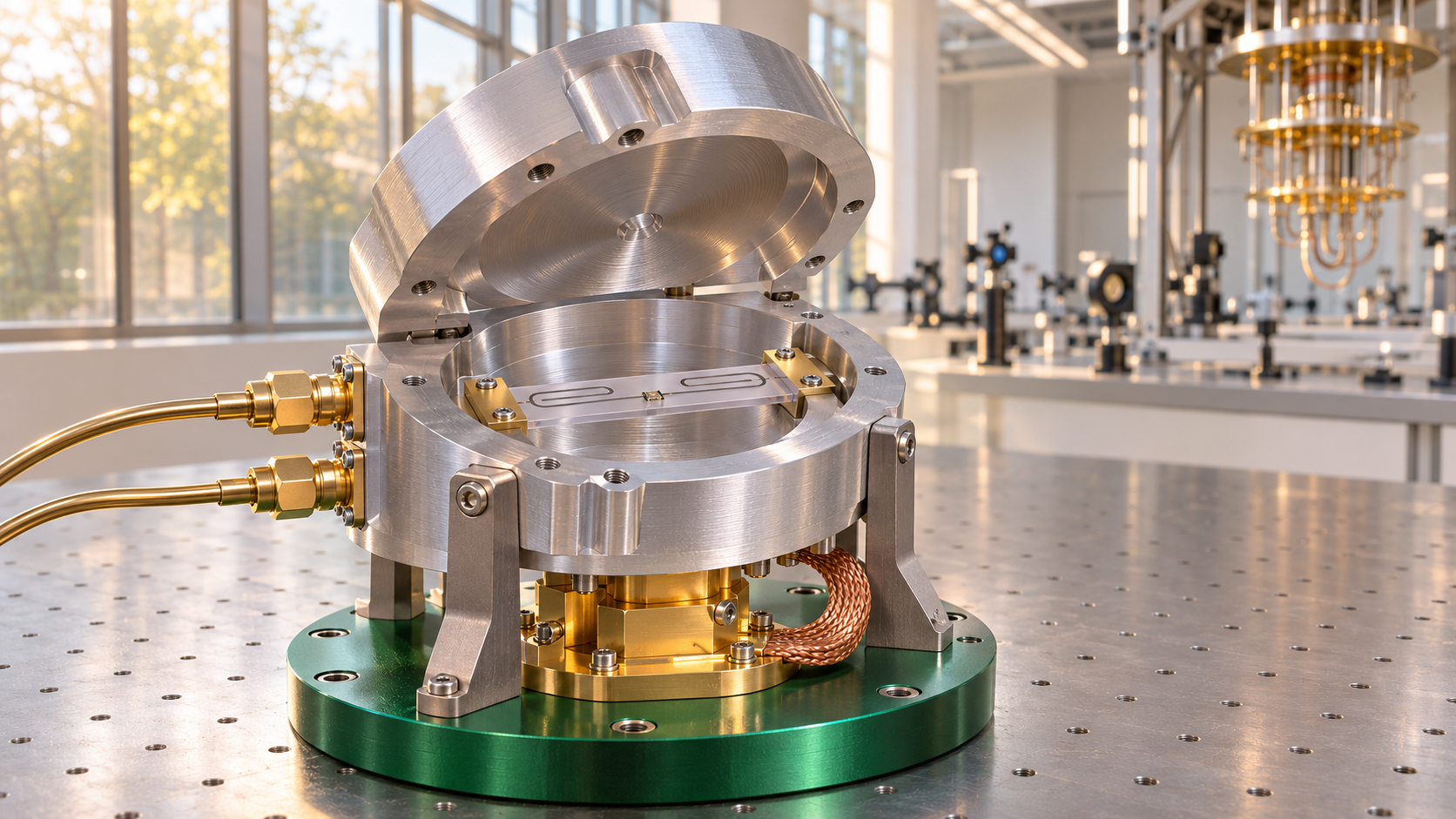
The headline assumes a 1-microsecond error-correction cycle, phase-flip noise of 5 × 10⁻⁴ per cycle and negligible bit flips, which the authors equate to a characteristic bit-flip time of about 100 years. With an extra distance-3 code, a bit-flip time of about one hour suffices and the count rises to about 45,000 cat qubits. In September 2025 Alice & Bob reported an average bit-flip time of 44 minutes, with a 95% confidence interval of 33 to 60 minutes, for one fully characterized cat qubit, plus preliminary traces above three hours on three other qubits that the company says are not by themselves enough to claim the same level of control.
Why the estimate leaves the 2030 dates where they are
The RSA-2048 resource estimate moves the attack cost again, but NIST's final IR 8547 and the HKMA's 2030 aim were set without it. The paper is a company preprint, not yet peer-reviewed, and its value lies in stating every hardware number an attacker would need.

Google's Magic-State Cultivation Result in Science, 15 October 2026: What the Willow Experiment Tests in the Under-a-Million-Qubit RSA-2048 Estimate
What Google published in Science on 15 October 2026
Google Quantum AI reports in Science that magic-state cultivation, a technique its researchers proposed in 2024, works on real hardware. On the Willow processor the team measured an upper bound of about 1 × 10⁻⁴ on the error of cultivated T-type magic states, roughly 40 times lower than without cultivation, counting only the runs with no detected error; about 8% of attempts were kept. In a separate step it grafted a cultivated state from a small color code into a distance-5 surface code. Magic states supply the non-Clifford operations needed for universal fault-tolerant computation, and they are among its most costly ingredients.
Why the result matters for RSA-2048 and post-quantum planning
Craig Gidney's May 2025 estimate that a machine with fewer than one million noisy qubits could factor a 2048-bit RSA key in under a week relies partly on cultivation to shrink the space spent on magic states. The new paper is the first hardware test of that assumption. It confirms the mechanism at small scale and leaves the scale-up open: the measured error bound of about one in 10,000 sits roughly six orders of magnitude above the one-in-10-billion magic-state quality cited for breaking RSA-2048. This post reads the paper closely and sets it beside NIST's proposed transition dates for post-quantum cryptography and the separate procurement and platform deadlines already running.