A Diamond Payload Begins Australia's Quantum Space Climb
Quentir Defense Monitor
Evidence-based insights for quantum defense and security. Published by Quentir Systems LLC · August 7, 2026.
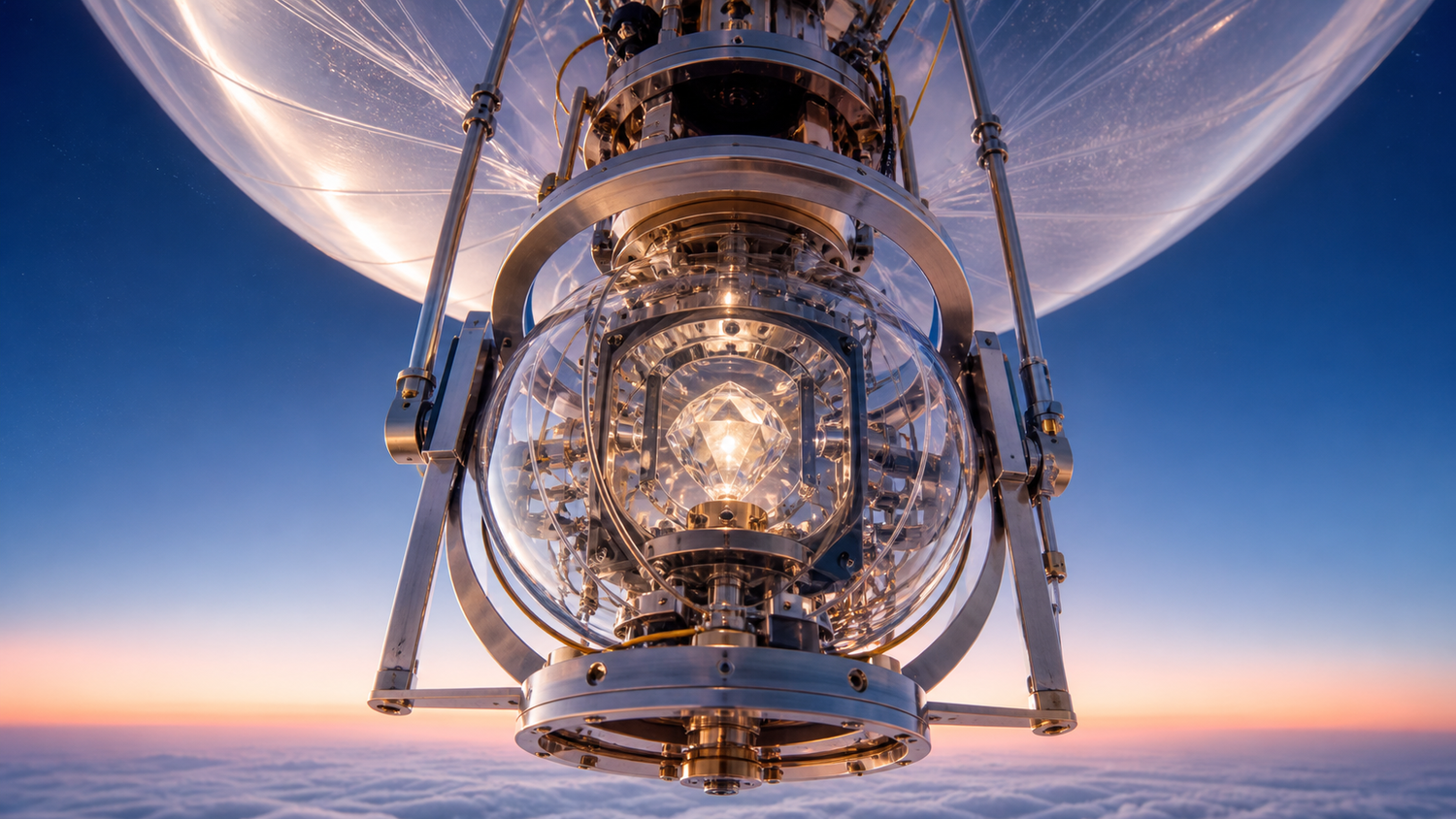
In November 2026, a stratospheric balloon will lift off from Winton, in outback Queensland, carrying a sealed payload to roughly 20 kilometers. Inside sits a small quantum diamond device: the core photonic component of HaloCore, a quantum-secure communications system under development by the Australian startup Space CoLAB. According to the announcement reported by Space & Defense, the flight, operated by Orbit2Orbit under its Pathfinder program, will expose the component to the cold and low pressure of near space and to the vibration of the ride up. The payload then comes back down and goes onto the inspection bench.
Read alone, a planned balloon flight from a pre-seed startup is modest news. Read as a defense capability signal, it is worth a briefing, because it shows, step by visible step, how an allied nation tries to build a quantum-secure communications capability it does not currently possess, from component fabrication upward. Most of what a defense reader hears about quantum communications arrives either as laboratory physics or as finished national infrastructure on the Chinese model. The middle of that story, the unglamorous qualification work that turns a photonic device into military hardware, is rarely announced in public. This flight is exactly that middle.
It also has clear limits. The November flight is an environmental exposure test of one component. No optical link will be established, no key will be exchanged at altitude, and no data rate will be measured. Space CoLAB founder and chief executive Carley Scott describes it plainly as flying "an early-stage component to find out how they respond to near space conditions." What the flight buys is engineering evidence about survivability, and a recovered device that the team can take back to the design bench.
What is actually flying
HaloCore is described by the company as a free-space optical system for quantum-secure direct communications, intended to operate in space and in critical infrastructure settings. The system is currently in early-stage fabrication validation, with a design review scheduled for later this year. Space CoLAB says the hardware draws on Australian fabrication with allied supply chain inputs, a framing the company repeats often enough that it should be read as a deliberate product feature rather than a footnote.
The technical bet underneath is the diamond. Business News Australia reported in November 2025 that the Geelong-based company, founded in 2023 by Carley Scott and backed by the venture firm Antler, is engineering a room-temperature, diamond-based quantum communications platform aimed at two persistent barriers in the field: the harvest risk hanging over conventionally encrypted traffic, and the dependence of many quantum systems on cryogenic cooling. The stated design goal is secure quantum transmission at useful data rates across distances up to 10 kilometers without fiber infrastructure. Color centers in diamond can emit and process single photons at room temperature, which is what makes the material attractive for room-temperature quantum transceivers; the company has published little beyond that about its specific approach, and the 10 kilometer figure is a design target, since no measured link performance has been released.
The intended customer is not hidden. On its own site, Space CoLAB positions HaloCore for mobile platforms and for remote and tactical environments, with a stated ambition running "from submarines to satellites," and lists a string of defense innovation awards including a winning pitch at an AUKUS Pillar II event. The company describes itself as building sovereign hardware for allied security through Australia's national fabrication network.
Quantum pillar: networking (satellite quantum communications). Use posture: dual-use. Technology readiness: editorial estimate TRL 3 of 9, from the disclosed early-stage fabrication validation; no formal assessment has been published. The diamond transceiver core exists as real early hardware in fabrication validation, and the balloon flight is designed to gather the environmental evidence that later bench qualification and field trials will demand.
Why a balloon comes before an orbit
The flight makes sense as a readiness ladder move. Orbit2Orbit runs the Pathfinder balloon under its Lab2Space program, which its founder Bradley Hatton-Jones describes as support for technology readiness progression: getting "meaningful flight data early enough to improve the design before the cost and complexity of an orbital mission." At 20 kilometers, a payload experiences deep cold, low pressure, and the mechanical stress of ascent and descent — conditions a thermal-vacuum chamber and a shaker table can each reproduce, but which the flight delivers as one integrated, flight-representative exposure. Unlike a satellite, a balloon payload comes home, so a component that behaves oddly at altitude can be opened on the bench and revised within weeks.
For a program office, stratospheric balloon testing is a familiar and honest instrument. It sits exactly where the readiness ladder puts trials in a relevant environment, after bench work and before an operational platform. The pattern here is worth noticing because quantum communications ventures more often announce satellite ambitions first and qualification plans later, if at all. A startup that spends its early capital on environmental exposure of a single photonic component is signaling that it understands where its risk actually lives: in whether delicate quantum optics survive the ride, long before anyone argues about key rates.
The honest reading of the ladder also runs downward. A component test at altitude establishes survivability and nothing else. Between this flight and a working quantum link stand an integrated terminal, pointing and tracking optics, a demonstrated key exchange over free space, and measured performance under realistic atmospheric conditions. Each of those is a separate, checkable milestone that has defeated better-funded programs before.
What a force would actually gain
The capability at the end of this road is worth stating in operational terms, and precisely. HaloCore is described as a quantum-secure direct communications system — a different protocol family from key distribution, and the planned flight exchanges no keys at all. What quantum-secure communications links of this broader class offer is key establishment whose security argument rests on measured physics rather than computational assumptions: the exchange of key material is protected against passive interception, provided the implementation authenticates its channels and endpoints. Set against the harvest now, decrypt later collection model, that protection covers the key-establishment step — recorded application traffic stays only as safe as the encryption algorithms, key handling and retention practices behind it — which still matters for the long-lived secrets a defense ministry cares about: force dispositions, sustainment plans, industrial data with decades of shelf life. A free-space system that needs no fiber would put that protection on mobile and austere users, from ships and forward headquarters to island territories and in time satellites, rather than only on fixed metropolitan links.
The space segment of this idea is proven at national scale, just not by an ally. China's Micius satellite demonstrated entanglement-based secure key distribution over 1,120 kilometers between ground stations, published in Nature in 2020. The record reviewed here shows no equivalent sovereign demonstration by Australia or its partners. That asymmetry is what gives a small Queensland balloon flight its strategic color: it is an early rung on a ladder whose top China has already reached once, and the sovereign supply chain framing addresses the assurance question a buyer must ask about any cryptographic hardware, namely who built it and who could have touched it.
The posture is dual-use in the plain sense of the capability map. The same transceivers would protect civilian critical infrastructure, from banking backbones to power grid control traffic, on one side, and military command and sustainment networks on the other. There is no direct offensive reading; the capability denies an adversary the future value of collected ciphertext and gives its owner confident secure channels, which is protection and enablement rather than an effector.
If the room-temperature claim holds at useful data rates, it removes a defining deployment obstacle in this field, because several classes of high-performance quantum communications hardware depend on cooling and supporting infrastructure that tie them to fixed sites. Warm, compact diamond photonics is what would let quantum security ride on a vehicle, a vessel, or a small satellite bus. That conditional carries the whole investment case, and it remains unmeasured in public.
The distance to a program office
A buyer reading this development should hold three gaps in view. First, the evidence gap: there are no published key rates, error rates, or independent characterizations of HaloCore, and the flight will not produce any. The available public record is company statements, investor coverage, and now a test manifest. Second, the integration gap: a quantum link generates keys, and those keys still have to feed conventional encryptors, key management, and network operations, alongside the post-quantum cryptography migration that allied ministries are already running on their networks. Any procurement office will ask where a physics-based key layer fits in that architecture, and for which small set of links its cost is justified. Third, the qualification gap: between a recovered balloon payload and a deployable defense communications terminal stand years of design reviews, then security evaluation and field trials with realistic targets and weather.
None of those gaps is a criticism of the November flight. They are the reason the flight exists. The watchpoints for the next year are concrete: the design review Space CoLAB has scheduled after payload integration, the post-flight inspection results, and after that the first free-space link demonstration with numbers attached. A company that keeps publishing rungs of its ladder, including the ones that wobble, will be easy to evaluate. The Monitor's readiness note for this development is deliberately low and deliberately unworried: early hardware, honestly staged, aimed at a capability whose strategic value the published record already establishes.
Sources
Primary source: Space & Defense reporting on Space CoLAB and Orbit2Orbit, with statements from Carley Scott and Bradley Hatton-Jones; other material from Business News Australia, Space CoLAB, and Yin et al. in Nature.