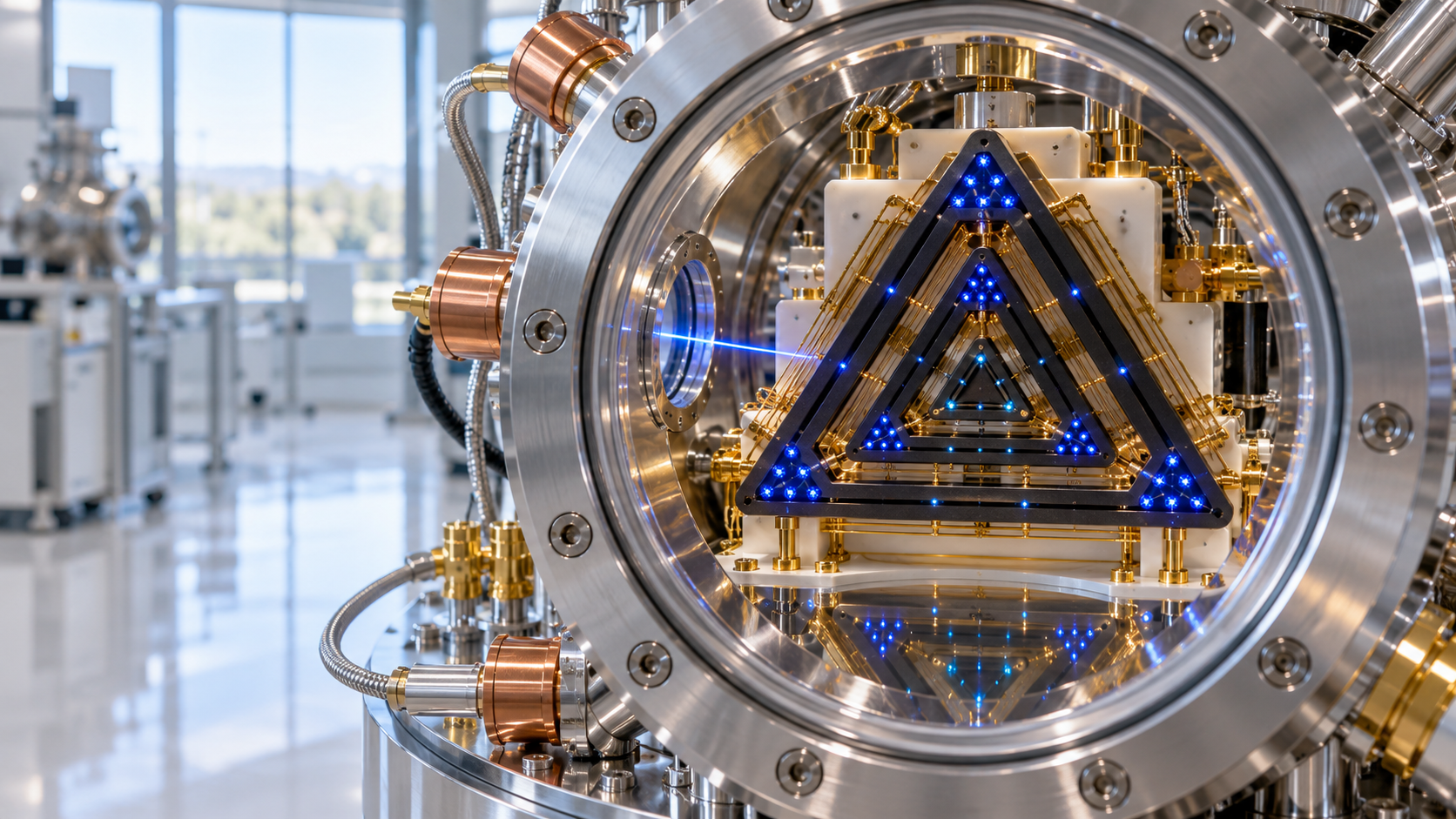
Quantinuum's Helios Holds a Distance-7 Color Code at Five Logical Errors per Million Rounds, 19 October 2026: What 73 Barium Ions per Logical Qubit Change in the RSA-2048 Clock, TRL 3
Quantinuum reports a trapped-ion logical qubit at five errors per million rounds on Helios with a distance-7 color code and a suppression factor of 12. The Defense Monitor reads what the result changes in the RSA-2048 resource estimate, why the clock speed stays open, and what it means for the post-quantum migration dates of 2030 and 2035.

MIT and Google Cryptographers Refute Daniel Simon's Claimed Quantum Attack on the Lattice Problems Behind ML-KEM
Daniel R. Simon of AWS claimed a polynomial-time quantum algorithm for the dihedral coset problem, a result that would have reached the lattice mathematics underneath ML-KEM. Aparna Gupte, Seyoon Ragavan and Mark Zhandry answer with an impossibility proof: the algorithm, and every design like it, leaves key recovery at random guessing. We read what the three-week episode means for post-quantum cryptography migration and the program offices behind it.

Sixty Hours of AI Cryptanalysis Retired the Hawk Signature Scheme
An Anthropic frontier model found a hidden lattice symmetry that roughly halves the lattice dimension needed to attack Hawk, and the team withdrew the scheme from NIST's process a day later. AI-assisted cryptanalysis is now a working method, with direct consequences for post-quantum cryptography buyers and the case for crypto-agility.