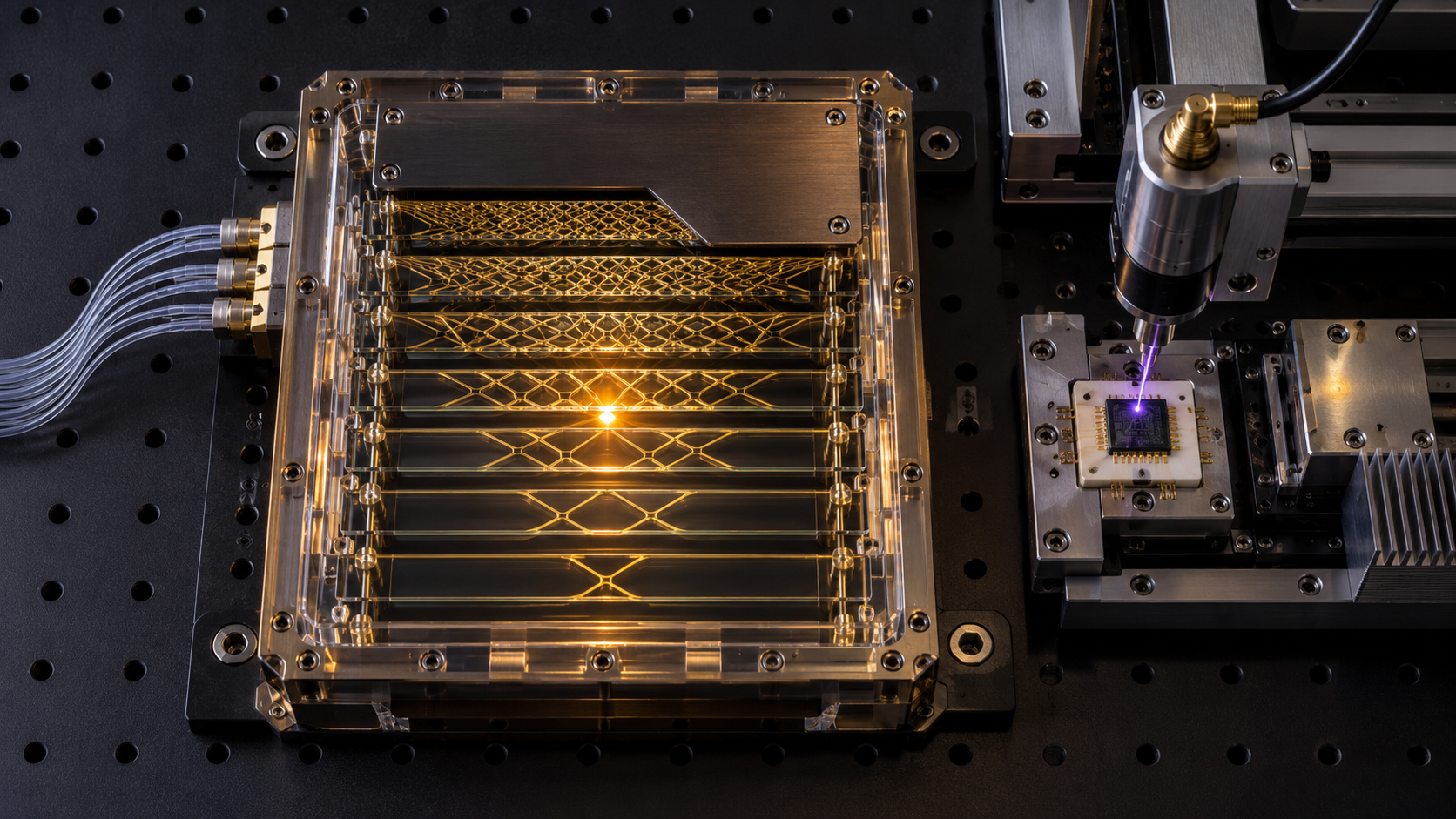
Georgia Tech's Gupta Puts a Ceiling on What One Twiddle Fault Leaks From ML-KEM and ML-DSA Key Generation, arXiv 2610.30383, 21 October 2026: 254 of 256 Coefficients Exposed on Paper, TRL 2
Defense Henry Quentir Defense Henry Quentir

Georgia Tech's Gupta Puts a Ceiling on What One Twiddle Fault Leaks From ML-KEM and ML-DSA Key Generation, arXiv 2610.30383, 21 October 2026: 254 of 256 Coefficients Exposed on Paper, TRL 2

Georgia Tech's Chakshu Gupta proves, in Lean 4, how much a single corrupted twiddle constant in the number-theoretic transform exposes during ML-KEM and ML-DSA key generation: a rank that halves by layer from 128 to 2, a ceiling of 254 of 256 coefficients with one fault per layer, and two coefficients no static twiddle fault can reach. The Defense Monitor reads what the fault attack bound means for a hardware root of trust that regenerates keys from a stored seed, how it extends the 2023 electromagnetic attack on pqm4, and what a module buyer should ask next.
Read More
Forescout Finds Post-Quantum Key Exchange on More Than 19 Million of 160 Million SSH Servers, With OT at 16 Percent and Medical Devices at 6 Percent
Defense Henry Quentir Defense Henry Quentir

Forescout Finds Post-Quantum Key Exchange on More Than 19 Million of 160 Million SSH Servers, With OT at 16 Percent and Medical Devices at 6 Percent

Forescout's Vedere Labs measured post-quantum key exchange across more than 160 million internet-facing SSH hosts: support grew 72 percent in a year, to more than 19 million servers, with Forescout attributing most of the growth to OpenSSH upgrades. The same measurement puts operational technology at 16 percent, medical devices at 6 percent, and embedded Dropbear stacks at 3 percent. We read the two-speed migration as a capability question for the long-lived equipment defense estates run on, and what crypto-agility clauses should demand of 2027 contracts.
Read More
MIT and Google Cryptographers Refute Daniel Simon's Claimed Quantum Attack on the Lattice Problems Behind ML-KEM
Defense Henry Quentir Defense Henry Quentir

MIT and Google Cryptographers Refute Daniel Simon's Claimed Quantum Attack on the Lattice Problems Behind ML-KEM

Daniel R. Simon of AWS claimed a polynomial-time quantum algorithm for the dihedral coset problem, a result that would have reached the lattice mathematics underneath ML-KEM. Aparna Gupte, Seyoon Ragavan and Mark Zhandry answer with an impossibility proof: the algorithm, and every design like it, leaves key recovery at random guessing. We read what the three-week episode means for post-quantum cryptography migration and the program offices behind it.
Read More
Lazarus Fits Its Zero-Day With a Post-Quantum Key Exchange
Defense Henry Quentir Defense Henry Quentir

Lazarus Fits Its Zero-Day With a Post-Quantum Key Exchange

Check Point Research found the North Korea-linked Lazarus Group using a Kyber-based key-encapsulation step to protect delivery of a privilege-escalation payload inside a Windows zero-day chain aimed at aerospace and defense targets. The post-quantum scheme from which the ML-KEM standard was derived has now surfaced as an offensive tool.

Read More