Inside the 156-Qubit Enzyme Calculation
Quentir Medicine Monitor
Evidence-based insights for quantum medicine. Published by Quentir Systems LLC · August 7, 2026.
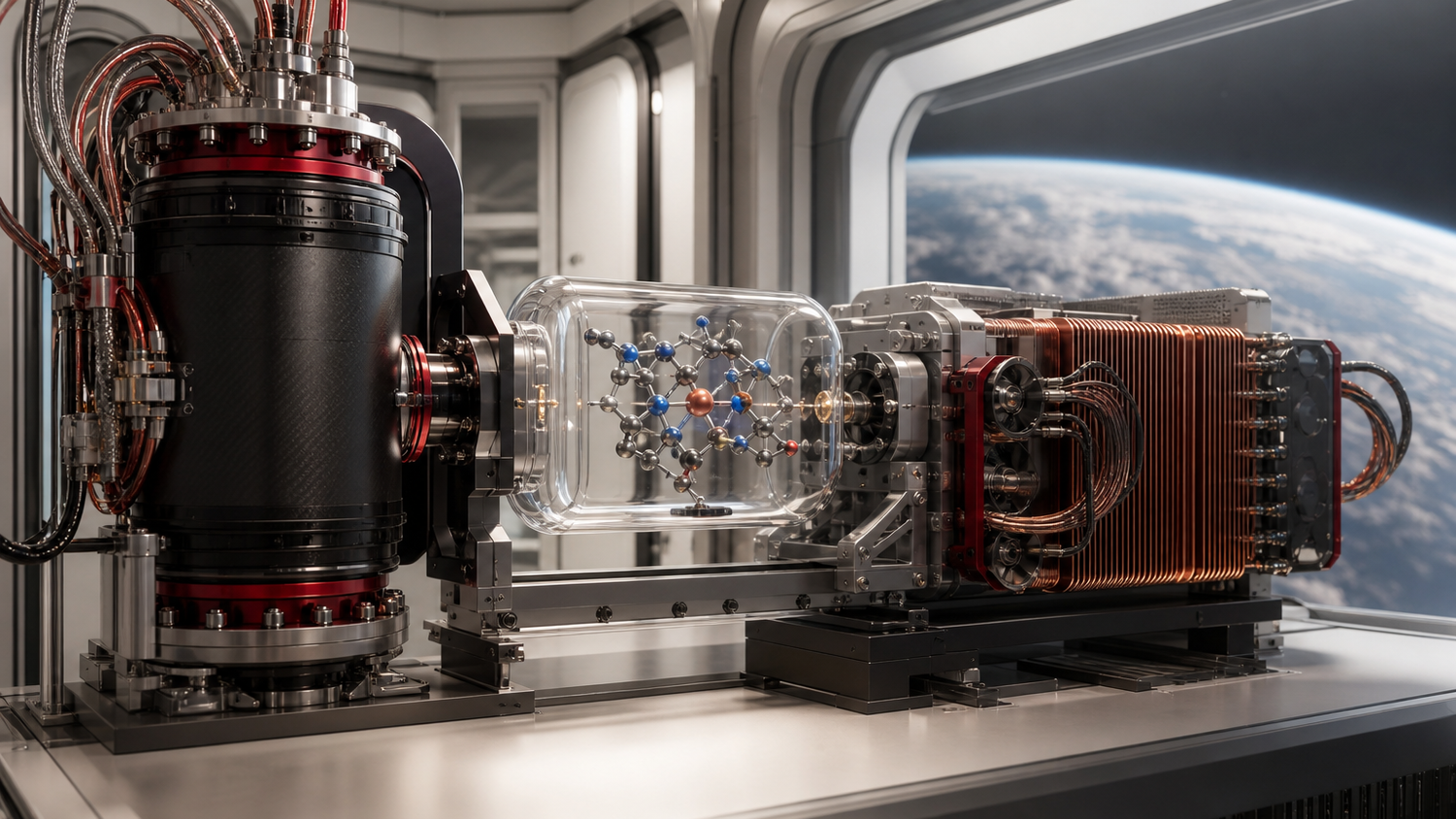
A molecular calculation can now look like a relay bench. GPUs, conventional chemistry methods, and quantum measurements each carry a specialized part of the reported work. The public release does not disclose how those tasks were divided. The handoff matters as much as the machine at the end.
QC Ware says it used that arrangement to calculate the electrostatic interaction energy of nitric oxide reductase, a metalloenzyme, with quantum measurements performed on IBM's 156-qubit Heron processor. The company calls it a technology demonstration. It also says the workflow has not become an integrated Promethium product capability.
That unusually clear product boundary makes the announcement useful. QC Ware reports putting a medically relevant class of molecular calculation on named quantum hardware, while leaving open the questions that decide whether the method improves chemistry, drug discovery, or a buyer's research program.
Practical takeaway. The announcement documents QC Ware's report of a hybrid run on named hardware for one molecular property. It does not establish a quantum speedup, improved chemical accuracy, a production workflow, or a drug-discovery result.
The calculation concerns electrostatic energy
The QC Ware release published August 7, 2026 identifies the target as electrostatic interaction energy. In plain terms, the calculation concerns how charged parts of a molecular system attract or repel one another. Those interactions help shape molecular binding and structure. They also affect chemical behavior. They are one ingredient in computational chemistry, never a complete account of whether a candidate molecule will become a medicine.
Nitric oxide reductase makes the example more demanding than a toy molecule. It is a metalloenzyme, so its chemistry involves a metal-containing active region and an electronic structure that can be difficult to approximate. The public release does not disclose the exact molecular partition, circuit design, measurement count, error-mitigation method, classical baseline, or final numerical error. It therefore supports what the company reported about the run and its target property, while offering too little detail for an independent technical comparison.
That distinction is important for drug and molecular discovery. A useful computational method must eventually answer a practical question with enough reliability to change what a chemist synthesizes, tests, or discards. A calculation can be scientifically relevant before it is decision-relevant. The public account places this work at the first of those thresholds.
The architecture is hybrid by design
The hybrid chemistry workflow combines GPU-accelerated molecular modeling, classical chemistry methods, and measurements from a superconducting quantum processor. QC Ware presents Promethium as the software platform used in the demonstration. The announcement does not disclose the partition among those elements. It also does not say that the whole enzyme was encoded on 156 qubits, or that every qubit on the Heron processor participated in one circuit.
IBM has described the wider architecture behind this kind of work. Its December 2023 account of Heron and System Two explains a heterogeneous system in which quantum processors operate alongside classical runtime servers and circuit-knitting methods. That official page describes the first 133-qubit Heron generation, not the 156-qubit device named in QC Ware's later release. The older page is useful for the architecture; the August 2026 release is the source for the specific hardware claim in this demonstration.
The division of labor is sensible. GPUs are already strong tools for large numerical workloads. Quantum circuits remain scarce and noisy. They also demand expensive experimental attention. A credible workflow should reserve them for a subproblem where quantum measurements may eventually add value. The hard part is showing that the added step changes the answer, cost, or scale enough to justify the extra machinery.
Quantum pillar: simulation. Technology readiness: TRL 3 of 9. The company reports quantum measurements on existing hardware for one molecular property, while it still describes the workflow as a technology demonstration outside its integrated product.
The missing comparison carries most of the commercial meaning
A 156-qubit label sounds like a scale result. Qubit count alone does not tell a chemist whether the calculation was accurate, efficient, or useful. The relevant comparison would hold the chemical task constant and report what the hybrid method contributes against a strong classical workflow. That comparison needs a reference value and an error measure. It also needs resource counts, a runtime, and enough procedural detail for another group to reproduce the result.
The release supplies none of those measurements. It also makes no claim of quantum advantage. That restraint should be preserved. Promethium's separate claim that selected conventional workloads can run up to twenty times faster than main conventional platforms concerns its GPU-native software, according to the company. It should not be transferred to the quantum-assisted demonstration.
For a pharmaceutical research group, the missing information is more concrete than an abstract debate about advantage. Could the method improve an energy estimate that changes a ranking of compounds? Does it handle an active site that defeats the buyer's current method? How much operator time and quantum access does one useful result require? The public material cannot answer those questions yet.
Why one enzyme still matters
Early computing systems often entered science through narrow calculations that exposed both their promise and their awkwardness. The humane value of molecular computation lies far downstream: fewer unproductive experiments, a clearer view of difficult chemistry, and a better chance of finding a useful candidate before resources are exhausted. Patients benefit only after those gains survive laboratory validation and the long disciplines of drug development.
This demonstration sits much earlier. Its value comes from reporting a workflow around a chemically serious object and stating where productization stops. The enzyme is a bridge between quantum hardware and a domain scientists recognize. It is not a clinical result, a molecule generated for treatment, or a substitute for wet-lab work.
The announcement also shows why procurement language matters in frontier science. "Uses quantum hardware" is a factual architecture statement. "Improves discovery" would require comparative performance and a decision outcome. Keeping those propositions separate allows a research leader to follow progress without turning each hardware run into a business case.
How Quentir Reads It
Quentir reads the demonstration as a useful boundary marker for quantum molecular simulation. QC Ware reports that a named computational-chemistry workflow used a quantum processor to measure a property associated with a complex enzyme. The public record stops before comparative accuracy, resource efficiency, reproducibility, and integration into the commercial platform.
The most interesting connection is between scientific modularity and commercial accountability. A hybrid architecture can hide weak contribution as easily as it can unlock a hard subproblem. When several computing layers share one result, each layer needs an identifiable job. Otherwise the final number may be chemically meaningful while the quantum contribution remains impossible to judge.
The next persuasive milestone is therefore a comparison with enough detail to attribute value. It could show lower error at a fixed cost, a useful calculation beyond a practical classical limit, or a repeated workflow that changes an experimental decision. Until then, the reported achievement is narrower: QC Ware says one enzyme calculation crossed a working quantum-classical interface, and the company left the product claim on the other side.
Sources
Primary source: QC Ware Corp., company release published August 7, 2026. Hardware and hybrid-architecture context: Jay Gambetta, IBM Quantum, December 4, 2023.