A One-Number Test for the Brain's Signal Carriers
Quentir Medicine Monitor
Evidence-based insights for quantum medicine. Published by Quentir Systems LLC · August 12, 2026.
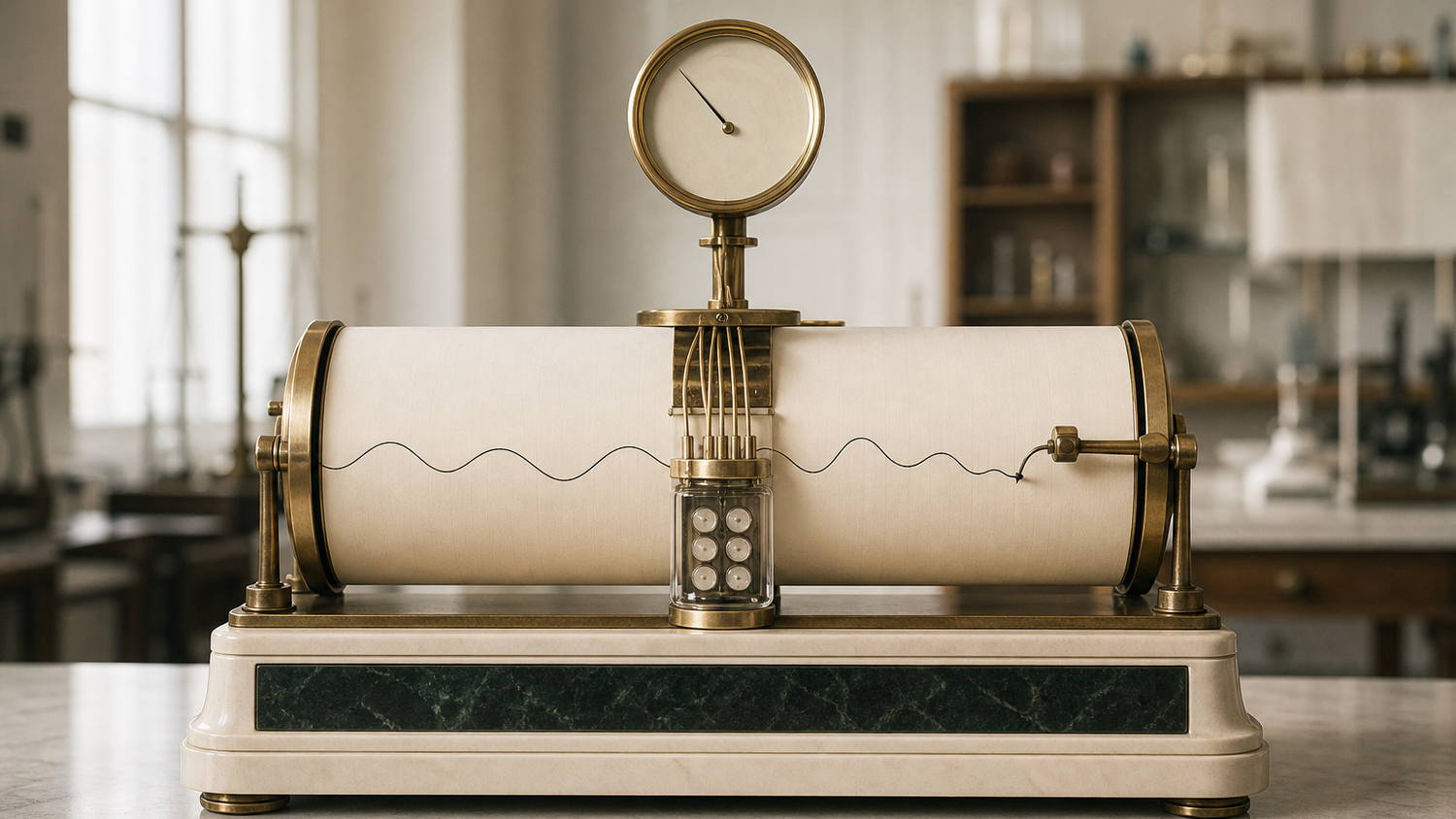
Every brain-computer interface, and every theory of how the brain moves information, rests on an assumption about which physical signal actually carries the message through living tissue. That assumption has been argued one proposal at a time, with each candidate defended and attacked on grounds particular to itself, so the arguments rarely settle anything across the field.
A preprint posted to arXiv on August 11 changes the shape of that argument. Eran Kopel proposes a single screening number for any oscillating signal asked to carry information in biology: the quality factor, computed as two pi times the carrier frequency times the coherence time. Spectral distinguishability alone bounds the number of distinguishable labels an oscillator can carry by that quality factor. The ceiling follows from the relation between linewidth and coherence time, so it holds for any substrate and any mechanism, and it can be evaluated from two published quantities.
Practical takeaway. Before a laboratory, a company, or a national program builds on an exotic brain-signal carrier, two published numbers, the frequency and the coherence time, now allow a first honest check of whether that carrier can hold information at all.
A ceiling computed from two published numbers
The screen was designed for a debate that had no shared standard. Proposals invoking collective vibrational modes, endogenous electromagnetic fields, microtubule excitations and oscillatory phase codes have each been judged on separate terms. Kopel's bound puts them on one scale. It also takes no position on quantum effects in biology, which matters, because that neutrality lets researchers on every side of the quantum-brain question accept the arithmetic before they resume disagreeing about mechanisms.
The screen extends beyond the headline inequality. Six further criteria follow from the same standpoint, including a two-sided persistence window: a label that carries information for the brain must stay stable long enough to be read, and it must remain rewritable rather than frozen. A carrier can therefore fail in either direction, by decaying too fast for readout or by persisting so rigidly that nothing can update it.
A proposed cortical microwave field fails by every route
The paper's worked example shows the instrument's teeth. Applied to a recently proposed 30 gigahertz microwave field inside cortical columns, the screen returns a quality factor of 0.19: the linewidth exceeds the carrier frequency five-fold, so the oscillation dissolves before it completes a cycle of the code it was supposed to carry. The apparent rescue, a driven emitter that is spectrally narrower than its gain medium, requires a resonant cavity, and the model's own geometry forbids one. An independent bound on metabolic power is exceeded by five to nine orders of magnitude.
Numbers of that scale speak plainly. On the paper's arithmetic this proposal falls short on two independent grounds at once: a spectral ceiling it misses five-fold, and an energy budget it misses by five to nine orders of magnitude.
Quantum pillar: sensing. Technology readiness: TRL 2, concept formulated. The screen is a theoretical instrument worked out on paper with published numbers, and a future role we see for quantum-enabled sensing is supplying better-measured linewidths and coherence times for screens of this kind.
Only the low-frequency neural rhythms survive
Kopel screens eleven proposed carriers. Only the low-frequency neural rhythms pass, the familiar slow oscillations of electroencephalography. High-frequency molecular carriers fall out for a reason the debate had missed: brevity. Their labels live too briefly to be read, whatever their other virtues. The fragility argument the debate has assumed turns out to be unnecessary for the verdict.
This lands directly on the quantum-consciousness literature. Microtubule excitations, a fixture of those theories, now face the same one-number entry test as every other candidate, and the test can be run by anyone with the published frequency and coherence time. A proposal that clears the ceiling earns the harder mechanistic conversation. A proposal that misses it by orders of magnitude can be set aside without another decade of dispute.
Braintech already rides the carriers that pass
The engineering side of neurotechnology already works in the frequency range the screen favors. Closed-loop neuromodulation research integrates electroencephalography with electrical stimulation, and the hardware around those recordings keeps maturing: a platform described on arXiv this month pairs high-rate EEG recording with temporal interference stimulation in a portable design, where existing platforms have often relied on benchtop instrumentation.
Public money is moving the same way. South Korea's Seven Major SEED strategy, announced August 12, targets commercial brain-computer interface products by 2035, and Henan's provincial development commission named quantum technology and brain-computer interfaces among its priority investment fields this week. Programs that put dates on products benefit from a cheap way to separate carriers that can work from carriers that cannot. A screen that costs two published numbers is inexpensive governance for an expensive field.
How Quentir Reads It
The screen is a preprint, and its verdicts inherit the quality of the numbers fed into it. The bound is honest about that dependence: improve the inputs and the ceiling moves. That is how a good instrument behaves, and it is why we place the work at TRL 2 on the readiness ladder, a concept formulated with its numbers.
The deeper value for quantum medicine is methodological. This field runs on proposals whose evidence quality varies widely, and reviewers have lacked a first question that applies to all of them. Now there is one: state the frequency, state the coherence time, and accept the ceiling they imply. We also see a natural future role for quantum sensing here. If magnetometers built on quantum effects deliver better measurements of faint biological signals, the frequencies and coherence times they report would feed screens of exactly this kind, and quantum technology would then sit on the side of testing brain-signal claims as well as generating them.
A screen the debate can share
Neurotechnology now appears in national plans with explicit product dates, and provincial governments list the field next to quantum technology among their investment priorities. Claims tend to arrive faster than the experiments that test them. A substrate-independent ceiling that anyone can compute from two published quantities gives hospitals and funders a shared floor under that acceleration.
The brain's information carriers have long been an open list. As of this week there is a proposed shared screen for shortening it, posted openly for anyone to test with two published numbers. Its first worked example rejects one candidate on the paper's stated inputs and passes the low-frequency rhythms that electroencephalography already records. Progress in this field looks exactly like that: fewer candidates, better measured.
Sources
Primary source: Eran Kopel, "How many labels can a biological oscillator carry? A quality-factor screen for proposed information carriers," arXiv:2608.10560, August 11, 2026. Engineering context: Le Xing and colleagues on a portable EEG-tES closed-loop platform, arXiv:2608.06783. Policy context: Reuters on South Korea's Seven Major SEED technology strategy, August 12, 2026.