Quantum Imaging Starts With a Long Trip to Care
Quentir Medicine Monitor
Evidence-based insights for quantum medicine. Published by Quentir Systems LLC · July 21, 2026.
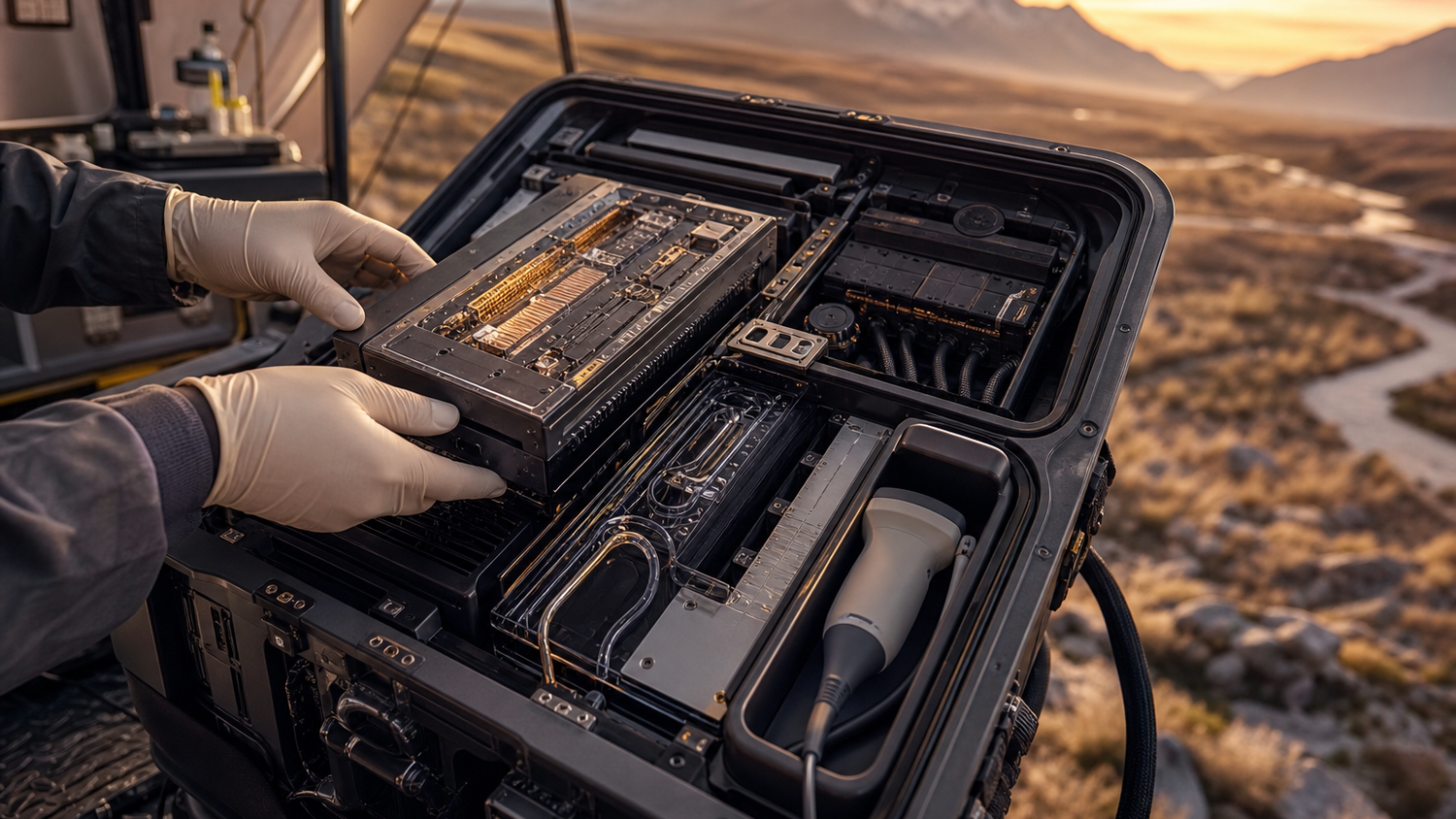
A sharper scan can begin far from the specialist who will read it. In remote Aboriginal communities, remote ultrasound can reduce the first distance to imaging, while image quality still determines how much a clinician can see.
An Australian consortium has received a feasibility grant to study whether quantum computing can improve reconstruction of those images. The project places diagnostic access beside an exact technical question: can a new computational method recover useful detail from portable scans without claiming a clinical result before one exists?
The journey is part of the medical problem
The University of Western Australia account, published on October 2, 2025, describes limited access to high-quality diagnostic imaging in remote Aboriginal communities. Professor Jingbo Wang says that people who need such care can face long-distance travel and delayed diagnoses. Portable wireless ultrasound is available in some places, but the resulting images may be suboptimal.
Ultrasound has qualities that make it attractive outside a large imaging department. The equipment can be portable, it does not use ionizing radiation, and a scan can be performed close to the patient. Portability solves only part of the access problem. A weak or noisy image can leave the reader with less anatomical detail, while specialist interpretation, referral, follow-up, connectivity, and local clinical capacity still shape what happens next.
That makes image quality a form of geography. When a scan cannot answer the clinical question, distance reappears as another journey, another appointment, or more time before a diagnosis. A computation that improves a portable image could therefore matter even if the scanner itself never changes. The value would come from preserving more useful information at the point where travel is hardest.
What the public grant actually funds
The Australian Government's successful-applicants page, dated July 11, 2025, lists Q-CTRL as the applicant, with North Metropolitan Health Service, Quantinuum, and UWA as project partners. The project is titled “Quantum-Enhanced Medical Imaging Diagnostics for Remote Communities” and received AUD 432,453 in feasibility funding. It is one of four grants under a challenge focused on life expectancy and health outcomes, with access to health technology for First Nations peoples.
The word feasibility sets the present boundary. According to UWA, the first stage lets consortia test technical viability. Successful projects may later seek demonstrator funding to build a working prototype or demonstration. The public record describes an intended investigation of computational bottlenecks in image and signal processing. It reports no reconstructed patient image, measured speedup, diagnostic accuracy, reader study, field trial, or health outcome.
That boundary gives the project a useful place on the research ladder. Public funding has joined a health service, a university, quantum software companies, imaging infrastructure, and First Nations X around a defined access problem. The next question is whether the collaboration can produce a reproducible quantum image-reconstruction result under conditions that resemble the scans and constraints found in remote care.
Reconstruction sits between the probe and the diagnosis
An ultrasound probe sends sound into the body and receives echoes. Hardware and software turn those echoes into an image. Reconstruction and signal-processing methods suppress noise and estimate structure while making patterns visible to the reader. A quantum algorithm would enter this computational layer. It would not replace the probe, perform the scan, or decide what a finding means.
UWA says the consortium aims to explore higher-resolution reconstruction and the identification of subtle patterns that traditional methods may miss. Those are research aims. A later result would need a declared classical comparator, realistic noise, full timing boundaries, and enough detail for independent reproduction. If the method runs on remote quantum hardware, network delay and availability belong in the measurement. If it uses a simulator or a hybrid workflow, the classical contribution belongs there too.
Medical usefulness adds another threshold. A cleaner image can look impressive without improving a clinical decision. Clinical validation would ask whether qualified readers detect relevant features more reliably, whether uncertainty falls, and whether any gain changes referral or treatment. It would also examine failure cases. Reconstruction can sharpen structure, yet aggressive processing can create artifacts or encourage confidence in detail that the original signal did not support.
Access includes everything around the scan
Technology projects aimed at First Nations health carry an institutional obligation alongside the engineering. The public pages identify the challenge and the participating organizations. They do not describe community selection of priorities, consent arrangements, governance of medical images, data location, cultural safety, workforce plans, or how benefits would be assessed by the communities concerned.
Those details will matter if the work moves beyond feasibility. Medical images are health data. Remote computation may create transfers between a clinic, a cloud service, and a quantum provider. The route affects privacy, security, latency, and responsibility when a result is unavailable or wrong. Community governance also affects whether a technically promising system earns trust and fits local care.
The humane promise is easy to state: fewer disruptive journeys and faster access to a useful image. The route to that promise is more exacting. It includes equipment that works in the field, staff who can acquire a reliable scan, communication links, specialist interpretation, referral capacity, maintenance, and a method whose limits are known. Better reconstruction can strengthen one link in that chain. It cannot carry the whole chain by itself.
How Quentir Reads It
This project is best read as a public, feasibility-stage experiment in moving computation toward an access problem. The grant amount, named partners, challenge, and two-stage program provide a concrete institutional frame. The technical claim remains prospective. That combination is valuable because it lets readers separate what has been funded from what has been demonstrated.
The original connection is between image quality and distance. In a metropolitan hospital, an inconclusive portable scan may lead quickly to another modality. In a remote setting, the same uncertainty can carry travel and delay, plus family disruption and scarce clinical time. A computational improvement would matter through that social geography, provided it survives technical comparison and clinical reading.
The next meaningful public milestone will be a result that shows the reconstruction task, the hardware used, the classical baseline, the data conditions, and what changed for an expert reader. Until then, the project deserves attention for choosing a humane problem and for keeping its present status modest: a funded test of whether quantum computation can help a portable image travel farther than the patient has to.
Sources
Primary source: University of Western Australia, October 2, 2025. Also drawn on: Australian Government Critical Technologies Challenge Program Round 2 successful applicants, dated July 11, 2025.