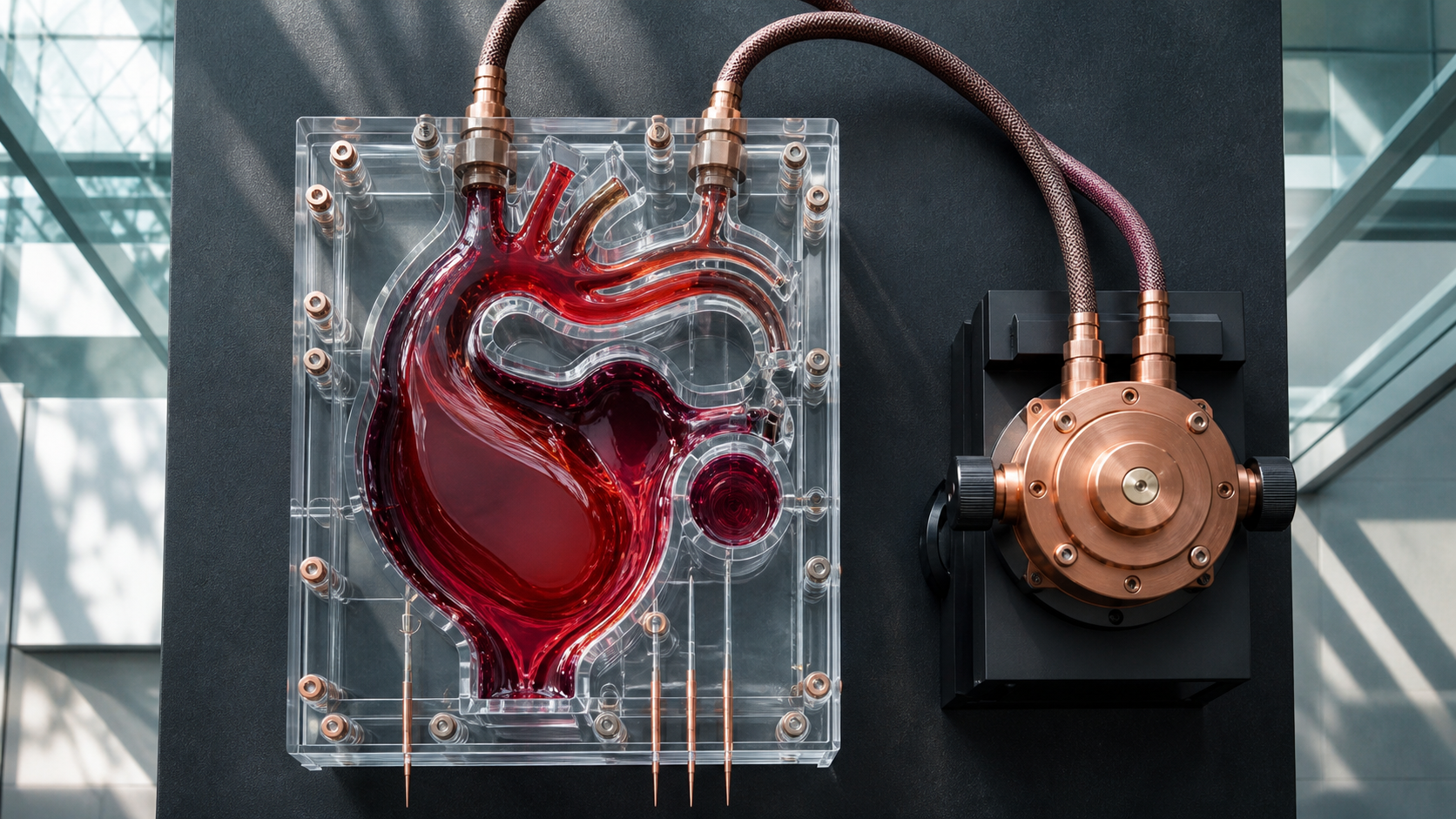
Atrial Fibrillation Is Where Seoul Will Look for Quantum Advantage
A grant to find out whether quantum computing helps
On August 25, 2026 a Korean consortium was given two and a half years and 2.5 billion won to find out whether a quantum computer can compute cardiovascular blood flow on a schedule a clinic could live with. Seoul St. Mary's Hospital of the Catholic University of Korea, the University of Seoul and the medical software company Flownics were selected for a new 2026 challenge program run by Korea's Ministry of Science and ICT with the National Research Foundation. What the grant buys is a measurement rather than a product: the team has been funded to establish the conditions for quantum gain on one clinical calculation and to report those conditions as numbers, including how many circuits and how many measurements the answer cost.
What a hospital can already see, and what it cannot
A cardiologist reading a CT scan of a narrowed artery can measure the narrowing and cannot measure the flow. Velocity, pressure and wall shear stress are quantities that inform the risk of a clot forming or a muscle being starved, and none of them is in the picture. Computational fluid dynamics recovers them from the anatomy, and cardiology has begun buying it: pressure ratios computed from coronary CT are an established adjunct in stable chest pain assessment and have cleared a national payer's technology assessment in England. The trouble is what happens when a clinician asks for more. A finer mesh, honest nonlinear terms and patient-specific boundary conditions each multiply the arithmetic, and past a certain point the answer arrives too late to be part of a decision.
Atrial fibrillation first, adjudicated by imaging
The first target is atrial fibrillation, the most common sustained arrhythmia, present in roughly two to three percent of the population. In a fibrillating heart the left atrium stops emptying cleanly, blood stagnates in its appendage, and stagnation is where thrombus begins. Whatever the solver computes will be checked against real patients imaged with 4D Flow MRI, which records the speed and direction of the blood itself alongside the geometry of the vessels carrying it. The plan starts on classical hardware with a three-dimensional deep learning model that segments the heart, the left atrium and the aorta from CT, and a quantum hemodynamic model is built on top of that, stacking a variational algorithm, a Krylov subspace method, classical shadow measurement and non-Markovian error mitigation.
Ninety-five percent is a parity target
The headline figure deserves a careful reading. The stated aim is for quantum-based computational fluid dynamics to reach at least ninety-five percent of the precision of the classical method, which is a target to match the incumbent rather than to beat it. Any advantage the project finds will have to appear somewhere other than accuracy: in time to answer, in cost, or in problem sizes the classical solver cannot reach inside a clinical window. Stating it that way is unusually disciplined. The project fixes the accuracy at parity, names the baseline, names the disease, names the imaging modality that will adjudicate, and puts the burden of proof on resources. A hospital procurement officer has something to hold the team to in 2028, and a negative result in that year will be as informative as a positive one.