UOW's Diamond Voltage Imaging Microscope for Motor Neurone Disease: Dzung Do-Ha Receives QUBIC's First Cathy Foley Fellowship, Reported 26 November 2026
Diamond quantum sensing for motor neurone disease at UOW, reported 26 November 2026
Quentir Medicine Monitor
Evidence-based insights for quantum medicine.
A neurologist meets motor neurone disease after the damage has begun: by the time weakness shows, many of the motor neurons that carry signals from brain and spinal cord to muscle have already died. Researchers at the University of Wollongong want to watch those cells misfire long before that point, with a microscope whose sensor is a small chip of lab-grown diamond.
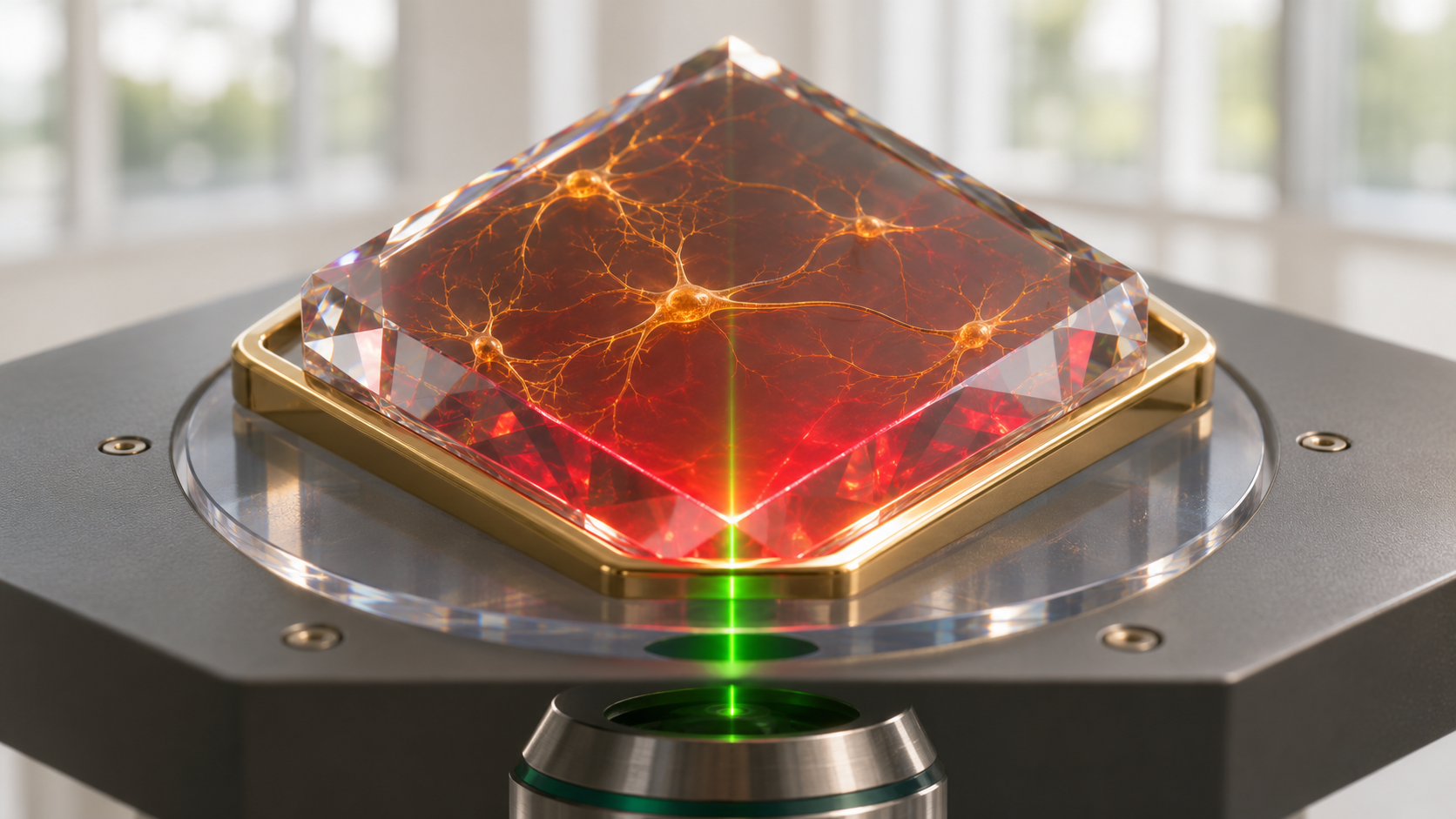
The instrument is a diamond voltage imaging microscope, and the University of Wollongong describes it as only the second of its kind in the world. Its sensing elements are atomic defects in diamond that change their glow when a nearby neuron fires, which lets a camera follow electrical activity in living motor neurons cell by cell. The person who has spent three years bringing it into MND research has now received a two-year fellowship to use it on the earliest stage of the disease.
What UOW reported on 26 November 2026 about Dzung Do-Ha and QUBIC
In a media release of 26 November 2026, the University of Wollongong reported that Dr Dzung Do-Ha, a cellular neuroscientist at its Molecular Horizons institute, had been announced that week as the inaugural recipient of the Cathy Foley Early Career Research Fellowship. The award comes from the QUBIC, the quantum biotechnology research center funded by the Australian Research Council, in which UOW is a partner. The fellowship honors the physicist and former Australian Chief Scientist Dr Cathy Foley and runs for two years.
Dr Do-Ha works in Professor Lezanne Ooi's Neurodevelopment and Neurodegeneration Lab at UOW, which she joined as an honors student and where she has studied MND since her PhD. The diamond technique came to the lab through three years of collaboration with Dr Dan McCloskey and Professor David Simpson, diamond quantum sensing specialists at the University of Melbourne. Her stated aim is precise: to find when motor neurons first start to misfire in MND, and whether that change is visible in single cells and across small networks before the cells are lost.