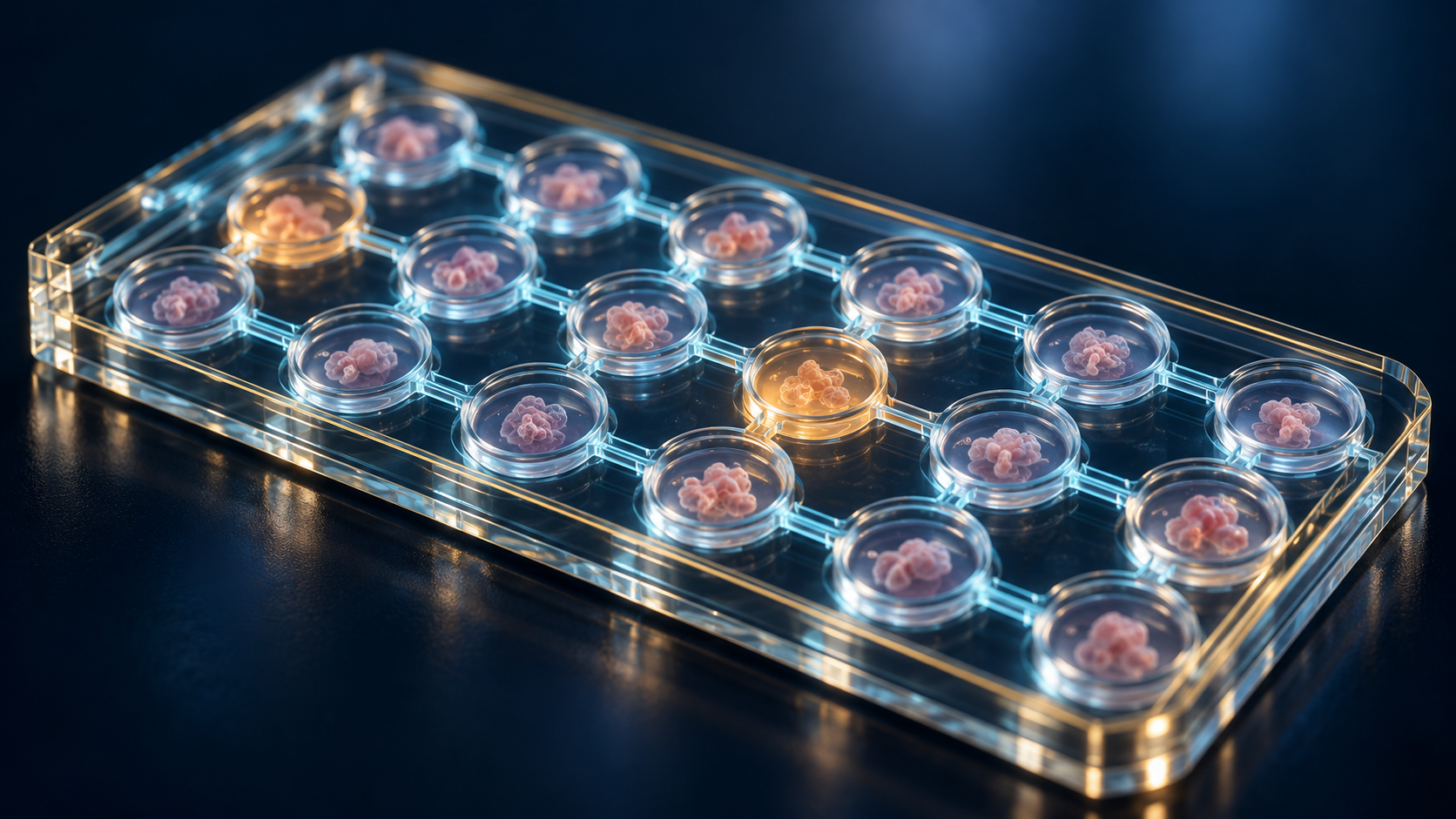
Kipu Quantum Ran a Molecular Toxicity Classifier on QuEra's 256-Qubit Aquila: What 200 Neutral Atoms Added for 122 Drug-Candidate Molecules
Kipu Quantum tests neutral-atom features for drug toxicity prediction
Quentir Medicine Monitor
Evidence-based insights for quantum medicine.
The German quantum software company Kipu Quantum has reported a molecular toxicity experiment run on QuEra Computing's Aquila, a neutral-atom quantum processor with up to 256 atoms. Each of 122 molecules from a public toxicity dataset was encoded into the controlled quantum-state evolution of 200 atoms, and the measured patterns were turned into about a thousand new numerical features per molecule for an ordinary machine learning classifier.
On those 122 molecules, drawn from a dataset of 171 laboratory-tested compounds, the quantum features raised the balanced accuracy of the toxic or non-toxic call from about 0.55 to about 0.70, according to the authors. For anyone who screens drug candidates for safety, the result is an early test of whether a quantum device can make a classical prediction model better at spotting the harmful minority of compounds.
The work is described in a technical blog post on the company's site, Reading Toxicity of Molecules with Neutral-Atom Quantum Processors, by Antonio Ferrer Sánchez, Carlos Flores and Alejandro Gómez Cadavid, carrying a publication date of 10 July 2026. Quantum Computing Report brought it to wider attention on 17 October 2026. The post is not a peer-reviewed paper, and it neither links nor cites a preprint with the full methods. The figures below are the authors' own, read from the post.
Aquila is an analog machine. It holds single atoms in place with focused laser beams and drives them with smooth light pulses into a highly excited Rydberg state; when one atom is excited, its close neighbors respond, and this interaction shapes how the whole array evolves. QuEra's product page states that Aquila has been publicly available through Amazon Braket since 2022, with a minimum atom spacing of 4 micrometers.
Kipu Quantum's method, which it calls quantum feature extraction, writes the description of each molecule into the settings of that evolution. The team assigned each molecule its own set of driving schedules and atom spacings, laid out 200 atoms on a grid of 14 by 15 positions a few micrometers apart, and let the system evolve for a little under four microseconds before reading out every atom. The authors write that they reached the machine through their own Kipu Quantum Hub platform.
They submitted the training set one molecule at a time, with 500 independent measurements per molecule, and processed 122 molecules in total, roughly two thirds labeled non-toxic and one third toxic. From the strings of excited and unexcited atoms they built about 1,000 features per molecule. A conventional classifier then made the final toxic or non-toxic decision. The quantum processor never classified anything itself; it acted as a transformation step in front of standard software.