Zhao, Preskill and Huang's 8 April 2026 Paper Puts a 68,000-Cell Blood Dataset Benchmark Under 60 Logical Qubits: What a Quantum Memory Advantage Means for Hospital Genomics
Quentir Medicine Monitor
Evidence-based insights for quantum medicine.
On 8 April 2026 seven authors from Caltech, MIT, Google Quantum AI and the startup Oratomic, among them John Preskill and Hsin-Yuan Huang, posted a 144-page proof that, for a specified family of classification and dimension-reduction tasks under stated assumptions, a quantum computer of polylogarithmic size reaches a prediction performance that any classical machine would need exponentially more memory to match. The claim reached a wider readership on 11 September 2026, when WIRED Japan explained it to museum visitors as an advantage in size, not in speed.
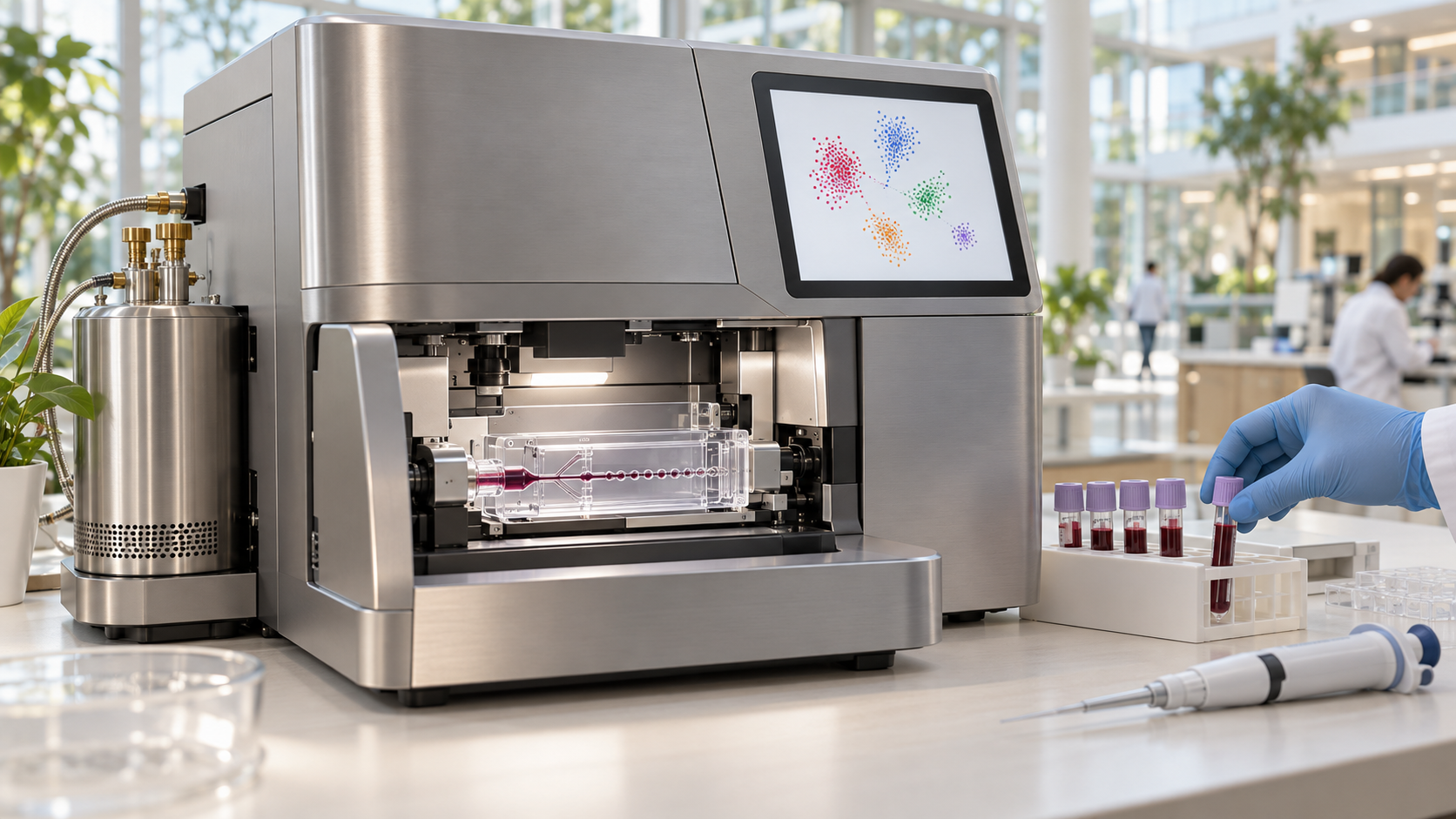
The paper's medical test case is a genomics one. In a numerical benchmark on the expression profiles of 68,000 peripheral blood cells, the authors report that their method separates cell types and finds the main axis of variation with a calculated requirement of fewer than 60 logical qubits, where the classical methods chosen for comparison need four to six orders of magnitude more memory units. The proposed protocol draws random samples, processes each once and discards it; the benchmark reports performance and an estimated memory requirement, and it did not run that stream on a quantum machine. The advantage the authors prove is one of memory, not speed, and that distinction decides what a hospital genomics group should make of it.