Kvantify's Simulated DNA Base-Stacking Curve Nears CCSD(T) With 53 Instead of 236 Orbitals; Two Geometries on Quantinuum's H2 Matched Simulation, the Company Reported on 20 November 2026
What Kvantify reported on 20 November 2026 about DNA base stacking on Quantinuum H2
Quentir Medicine Monitor
Evidence-based insights for quantum medicine.
The Danish quantum software company Kvantify has calculated how strongly two stacked rings taken from a DNA structure attract each other, using its BEAST-VQE algorithm and Quantinuum's System Model H2 trapped-ion quantum computer. The calculation targets dispersion interactions, the weak attractions between electron clouds that help hold DNA and proteins together and shape how a drug molecule binds to its target. In exact classical simulation of its quantum circuits, Kvantify reports that an extended version of the method came close to the classical reference method CCSD(T) across the interaction curve while describing the electrons with 53 active orbitals, where the CCSD(T) reference used 236. On the quantum computer itself, the company ran two geometries and reports that the results were almost identical to the ideal simulations. Kvantify presented the work in an article that Phys.org published on 20 November 2026.
The study belongs to the early, careful stage of quantum chemistry for drug discovery. Kvantify calls it a molecular benchmark: a test of whether a calculation reproduces a trusted answer, without any claim that a quantum computer outperformed a classical one. Only two molecular geometries ran on quantum hardware, and the molecular model was simplified. As of 23 November 2026 we could not locate a preprint or peer-reviewed paper, so the figures below rest on the company's own account.
Why the attraction between stacked DNA bases is hard to compute
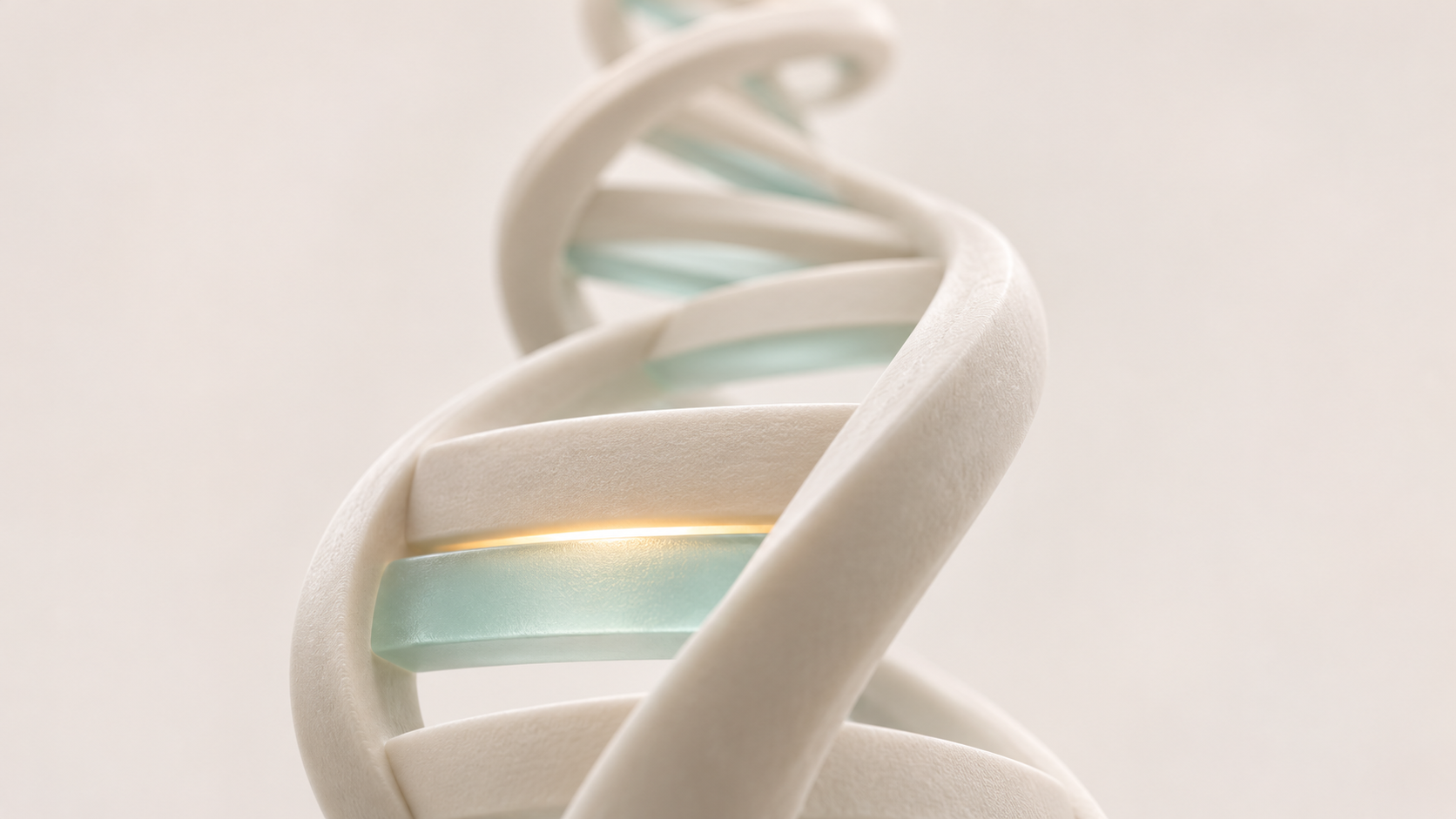
The two strands of DNA are held together by hydrogen bonds between paired bases, and the bases are also stacked on top of one another along the helix like the steps of a spiral staircase. Each flat, ring-shaped base attracts its neighbors above and below through dispersion, a force that arises because the electrons in one molecule respond to the momentary positions of the electrons in the other. Every single contact is weak. Summed over a whole double helix, or over the contacts between a drug and the pocket of a protein, these forces contribute substantially to stability and binding. Drugs that slide between DNA base pairs, such as the anticancer agent doxorubicin, rely on the same kind of stacking.