The CT Map Moves During Robotic Bronchoscopy
Why the CT map moves
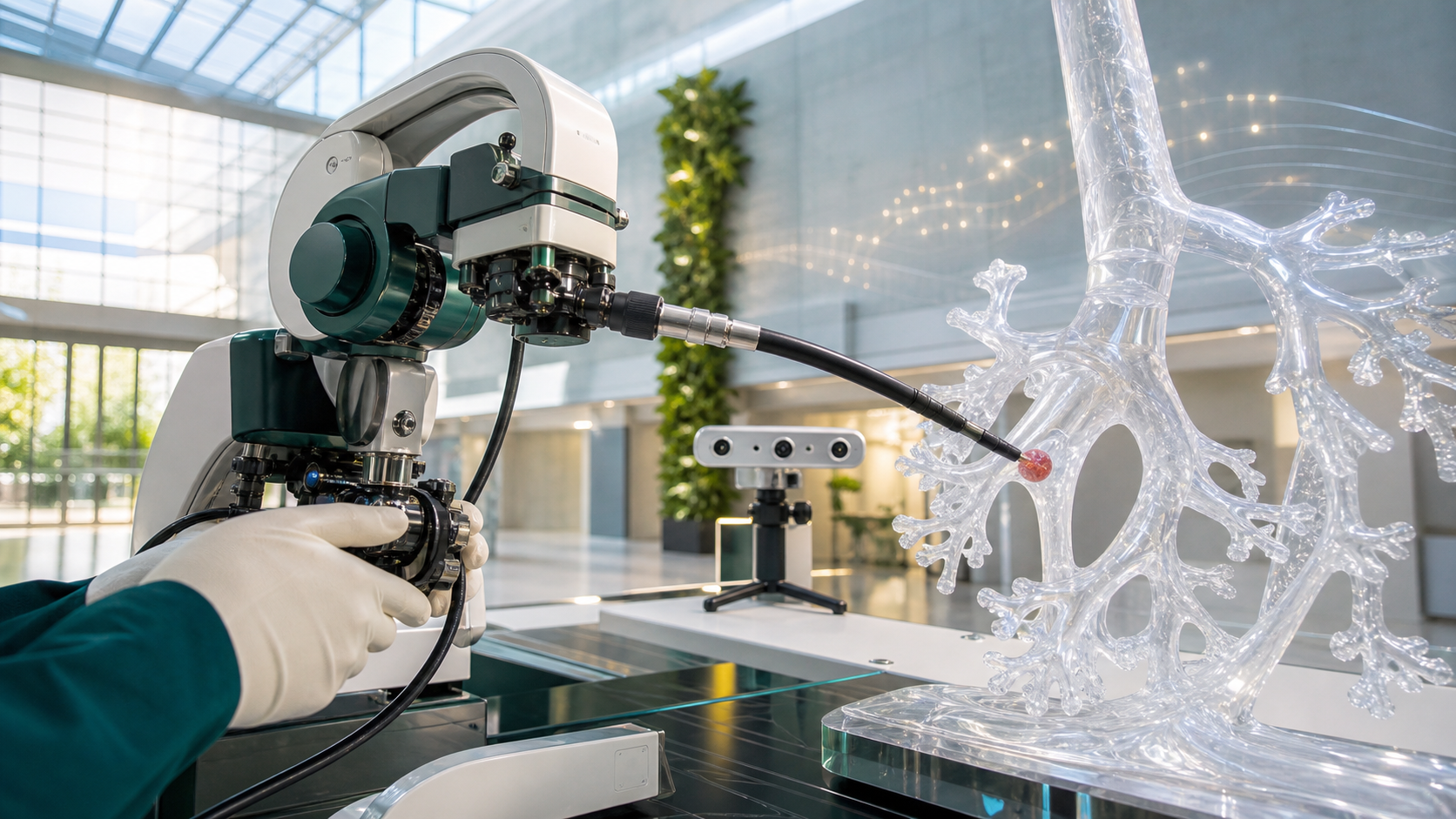
A bronchoscopy route begins as a CT map of the lungs. By the time a clinician advances a scope, the patient is positioned, sedated and ventilated under different conditions. Airways can deform or partially collapse, leaving a small peripheral lesion in different coordinates relative to the planning image. This CT-to-body divergence is the engineering problem behind Johnson & Johnson's MONARCH QUEST 3 software update. The August 17 announcement describes changes to registration and navigation, a three-dimensional compass overlay, wider compatibility with cone-beam CT systems and one-click segmentation of lung nodules.
What the clearance establishes
The FDA public record lists K260382 for the MONARCH Platform, with a substantial-equivalence decision dated July 25, 2026. That places the finished update at TRL 8 of 9 under Quentir's shared readiness ladder: qualified for commercial release, with the final rung reserved for documented operational use of this exact version. The regulatory decision does not establish that the new features improve diagnostic yield or reduce complications. Johnson & Johnson's announcement relies on internal technical reviews for segmentation, registration and scope-tip estimation, without publishing a patient-level performance dataset for QUEST 3.
The clinical question remains open
A 2026 retrospective study of 331 MONARCH procedures provides an independent reference point. Adding mobile cone-beam CT did not significantly change diagnostic yield or complication rates in that single-center comparison, although procedure time fell and radiation exposure increased. The study predates QUEST 3 and cannot answer whether its AI nodule segmentation changes outcomes. It does show why a clear map is only one part of the pathway. Imaging, registration, navigation, tissue sampling and pathology all shape the result a patient ultimately receives. The version-specific outcome record will determine whether this update reduces uncertainty at the point where the scope, the lesion and the biopsy tool finally meet. Quentir reads the launch as a mature medical-device update with a valid market pathway and an unresolved question about incremental clinical benefit.