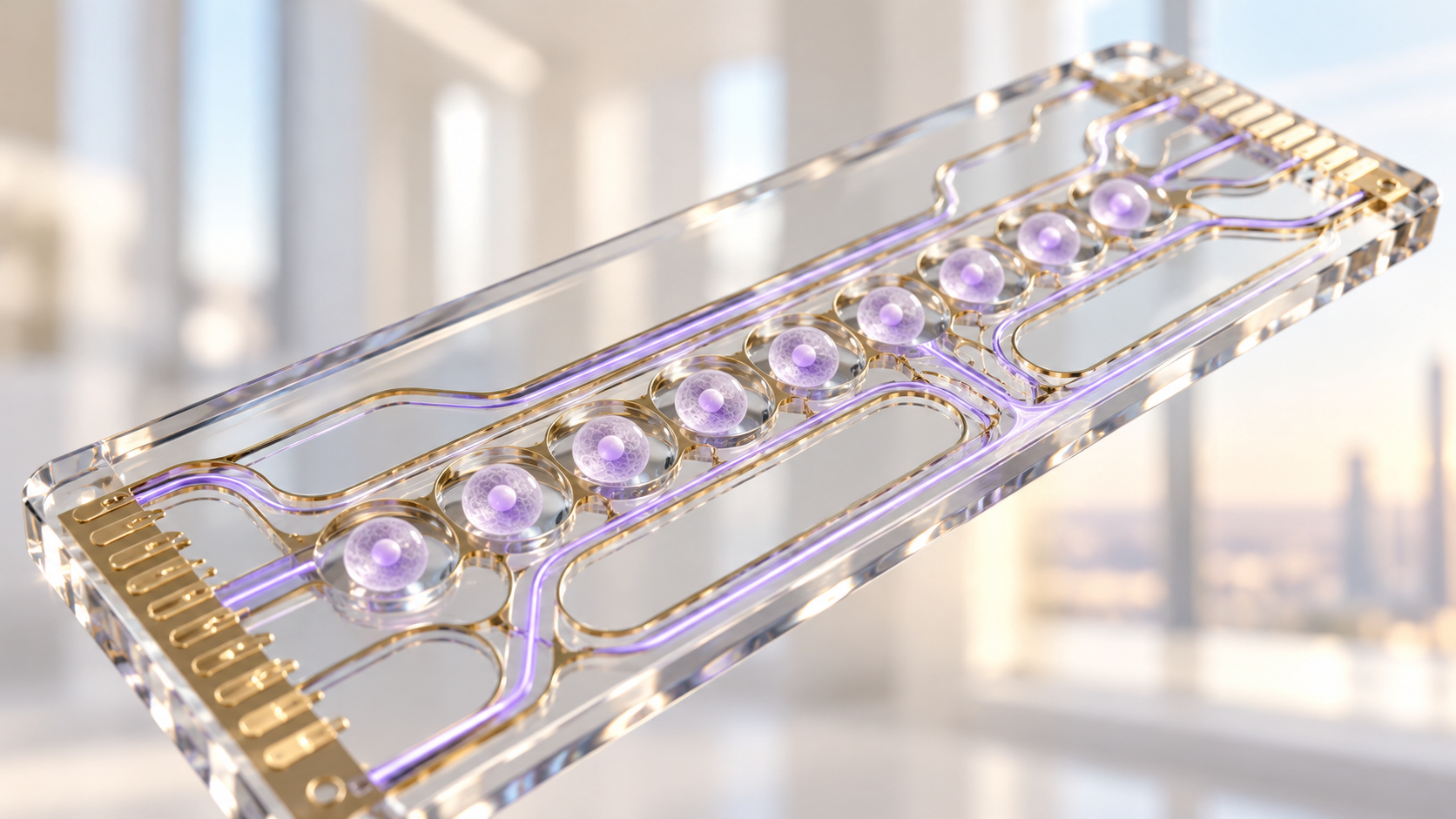
University of Michigan Quantum Hamiltonian Model Infers a 14-Gene Regulatory Network From 127,000 Glioblastoma Cells: The arXiv 2602.19496 Revision of 1 October 2026
A quantum model of glioblastoma gene regulation
Quentir Medicine Monitor
Evidence-based insights for quantum medicine.
Glioblastoma is the most common primary malignant brain tumor in adults, and one reason it resists treatment is that its cells keep changing what they are. A single tumor holds cells that resemble astrocytes, neural progenitors, oligodendrocyte precursors and mesenchymal cells, and they can move between those states.
Four researchers at the University of Michigan have now tried to model that movement with the mathematics of quantum mechanics. In a paper first posted to arXiv on 23 February 2026 and revised on 1 October 2026, Mohammad Aamir Sohail, Ranga R. Sudharshan, S. Sandeep Pradhan and Arvind Rao describe a quantum Hamiltonian-based gene expression model, which they call QHGM, and an algorithm that learns its parameters from single-cell RNA sequencing data. They apply it to about 127,000 cells from glioblastoma patients and report a network of activating and repressing links among 14 genes.
For oncologists and genomics groups, the paper is worth reading for what it attempts and for how far it still is from the clinic. The model runs as a simulation on conventional graphics processors, its biological results have been compared with published literature and not yet with laboratory experiments, and its strongest benchmark numbers come from synthetic data that the model itself generated.
A gene regulatory network describes which genes switch other genes on or off. Single-cell RNA sequencing measures how strongly thousands of genes are expressed in each of many thousands of cells, and a family of computational methods tries to read the network back out of those measurements. The authors compare their approach with four established classical methods, ARACNE, GeneNet, GENIE3 and SINCERITIES.
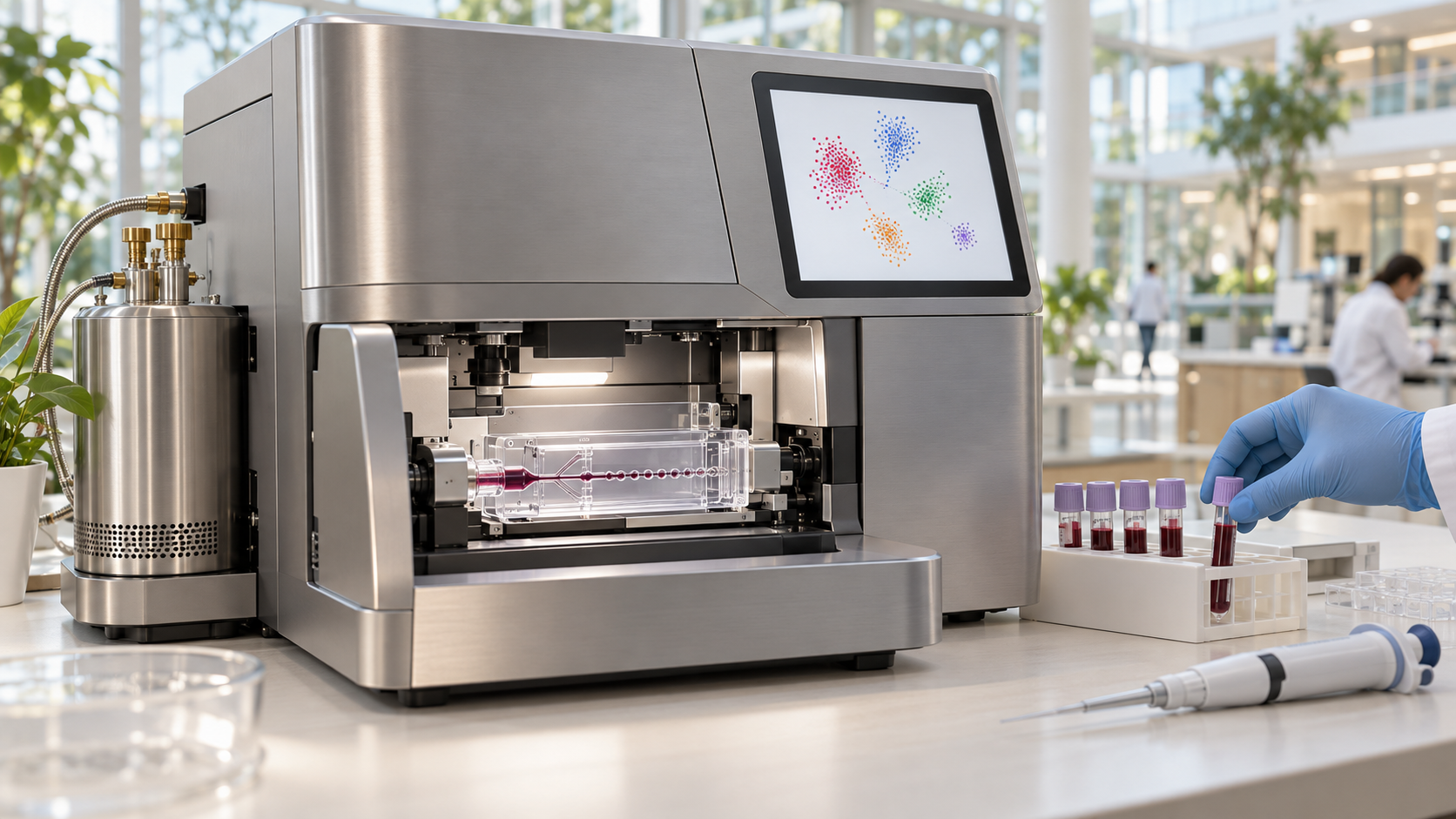
Zhao, Preskill and Huang's 8 April 2026 Paper Puts a 68,000-Cell Blood Dataset Benchmark Under 60 Logical Qubits: What a Quantum Memory Advantage Means for Hospital Genomics
Quentir Medicine Monitor
Evidence-based insights for quantum medicine.
On 8 April 2026 seven authors from Caltech, MIT, Google Quantum AI and the startup Oratomic, among them John Preskill and Hsin-Yuan Huang, posted a 144-page proof that, for a specified family of classification and dimension-reduction tasks under stated assumptions, a quantum computer of polylogarithmic size reaches a prediction performance that any classical machine would need exponentially more memory to match. The claim reached a wider readership on 11 September 2026, when WIRED Japan explained it to museum visitors as an advantage in size, not in speed.
The paper's medical test case is a genomics one. In a numerical benchmark on the expression profiles of 68,000 peripheral blood cells, the authors report that their method separates cell types and finds the main axis of variation with a calculated requirement of fewer than 60 logical qubits, where the classical methods chosen for comparison need four to six orders of magnitude more memory units. The proposed protocol draws random samples, processes each once and discards it; the benchmark reports performance and an estimated memory requirement, and it did not run that stream on a quantum machine. The advantage the authors prove is one of memory, not speed, and that distinction decides what a hospital genomics group should make of it.