In 1993 Stefan Brands and David Chaum published a short cryptographic idea called distance bounding. A verifier sends a challenge, the prover answers with a value only it can compute, and the verifier times the round trip. Because no signal outruns light, the time sets an upper limit on how far away the answering device can be. Thirty-three years later that idea sits at the center of an American export-control bill, and a paper posted this week tests how well it survives contact with real networks.
Practical takeaway. S.1705 would make location verification a condition of exporting advanced AI chips but leaves the method to whatever is "feasible and appropriate" when the law takes effect. The 10 November 2026 5G CATS paper narrows the distance an attacker can hide in, so far only in simulation, and it does not address cloud access by foreign users, which H.R. 2683 covers.
What Section 4 of S.1705 asks the Commerce Department to require
The Chip Security Act, introduced by Senator Tom Cotton on 8 May 2025 and referred to the Senate Committee on Banking, Housing, and Urban Affairs, covers integrated circuits classified under Export Control Classification Numbers 3A090 and 3A001.z and computers under 4A090 and 4A003.z. Section 4(a)(1) gives the Secretary of Commerce 180 days after enactment to require that each covered product be "outfitted with chip security mechanisms that implement location verification, using techniques that are feasible and appropriate on such date of enactment," before it is exported, reexported or transferred abroad. Section 4(a)(2) adds a reporting duty: a license holder that obtains credible information that a chip has moved, reached a different user, or been tampered with must promptly tell the Under Secretary for Industry and Security.
The phrase "feasible and appropriate on such date of enactment" carries most of the legal weight. It ties the primary requirement to the technical baseline of a single day. A method that exists only as a simulation on that day is a weak candidate; a method already shipping in firmware is a strong one. Section 4(b) then gives Commerce and the Defense Department one year to assess stronger secondary mechanisms, including workload verification, and requires that assessment to weigh performance costs and "the potential for the introduction of new vulnerabilities." The bill therefore anticipates exactly the engineering argument the 5G CATS authors are now making.
How the Texas A&M 5G CATS design measures where a chip is
The 5G CATS paper (arXiv 2611.13437), by Sreevikram Rajaraman, Derek Ladd, Nicholas Heinrich-Barna, Srinivas Shakkottai and Jeyavijayan Rajendran of Texas A&M University, starts from the weakness of ping-based checks. Any jitter in an honest chip's replies forces the verifier to loosen its timeout, and that slack is room for an attacker who relays traffic over fiber from a restricted country. Light in optical fiber covers roughly 200 kilometers per millisecond, so each millisecond of tolerated round-trip spread gives a relaying attacker about 100 kilometers of extra one-way distance.
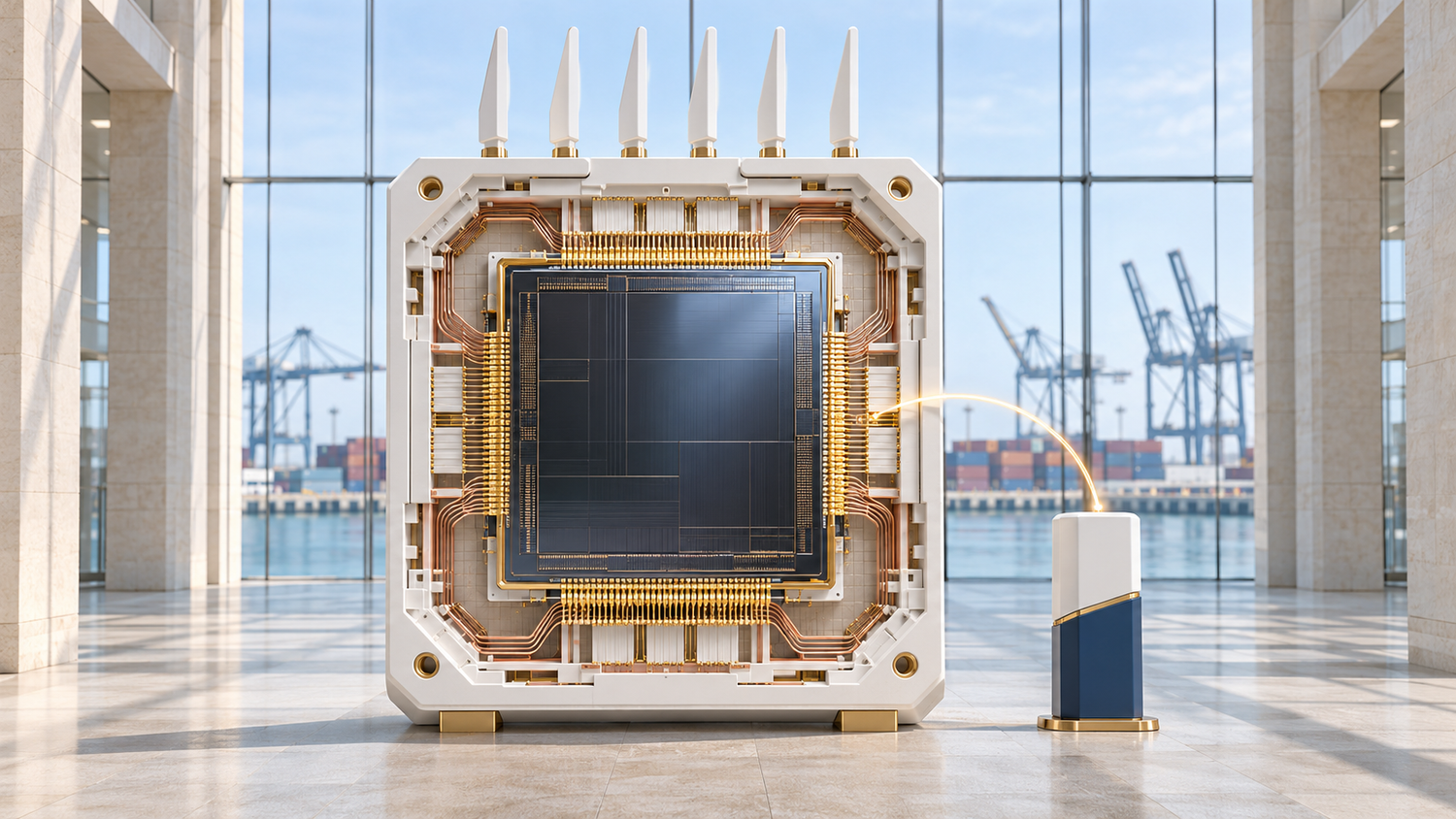
The authors' answer is to terminate the radio link inside the GPU package. A co-packaged 5G radio, a cryptographic engine and a hardware interlock talk directly to Ultra-Reliable Low-Latency Communication base stations, which removes the host operating system, the PCIe fabric and the baseboard management controller from the timed path. The protocol maps an authenticated challenge-response onto 5G's slot structure, replaces permanent key erasure with short-lived execution leases that lapse unless the chip keeps passing checks, and cross-checks the serving cell the chip reports against the carrier's own attachment records.
In ns-3 and 5G-LENA simulations of an unloaded cell, the design narrowed the 99.9th-percentile round-trip spread to 2.60 milliseconds, more than ten times tighter than default 5G. A checking station rejected every round of a fiber relay from 300 kilometers, against 2,000 kilometers for default 5G. Against an attacker 3,000 kilometers away, the checking station stayed safe at up to 1,410 kilometers from the chip, compared with at most 619 kilometers for the published model of PowerCATS, an earlier power-line approach; default 5G was never safe in that scenario.
What the simulation leaves open for a Commerce rulemaking
The paper is candid about its limits. The carrier cross-check is unsimulated, and the authors write that a delayed or missed carrier notification would postpone detection of a cell change. How many chips one cell can recertify, and how often the checks would preempt other traffic at sites with thousands of accelerators, "remain to be evaluated." No hardware prototype is reported. Measured against Section 4(a)(1), 5G CATS is a design that a later rulemaking could cite, but it is hard to call a technique feasible on an enactment date in 2026 when it has not left a simulator.
The design also changes who takes part in export enforcement. Mobile carriers would hold the attachment data that confirms a chip's cell, and chipmakers would ship a radio and an interlock that can withhold computation. Nvidia wrote on its corporate blog on 5 August 2025, in a post titled "No Backdoors. No Kill Switches. No Spyware.", that the company opposes hardware kill switches. An execution lease that lapses is technically different from a remote kill command, yet buyers in allied countries will ask how far the two differ in practice, and Section 4(b)'s duty to weigh new vulnerabilities gives that question a formal place in the assessment.
Why H.R. 2683 covers what location checks cannot
A chip that proves it sits in a licensed data center in Singapore can still serve a training run ordered from a restricted country through a cloud account. Location verification answers where the silicon is, while the user may sit anywhere. The Remote Access Security Act, H.R. 2683, introduced on 7 April 2025 by Representative Mike Lawler with five co-sponsors, amends the Export Control Reform Act of 2018 to reach "remote access" by a foreign person "through a network connection, including the internet or a cloud computing service," where the Secretary determines the use could pose a serious risk to national security or foreign policy. The House-passed text adds a mens rea element, covering access on a "purposeful, knowing, reckless, or negligent basis" while stating that nothing in the definition lowers the mens rea required for criminal liability, and the Senate received it and referred it to the Banking Committee on 13 January 2026, the same committee that holds S.1705.
Read together, the two bills cover different halves of the problem. Round-trip timing can bound distance between hardware endpoints. It cannot see the identity of a person behind a remote session, which is a question of accounts, contracts and know-your-customer duties. Quentir traced a similar move from goods to people in its earlier analysis of export controls that reach researchers' passports, where China and the United States each attached technology-control rules to individuals rather than shipments.
How Quentir Reads It
Because the Chip Security Act ties the required technique to what is feasible on the day of enactment, the timing of the vote shapes the security of every chip exported afterward. If Congress acts before designs such as 5G CATS reach silicon, Commerce could well start with software and firmware checks of the ping-based kind the paper criticizes, and the 300-kilometer result becomes material for the one-year Section 4(b) assessment.
The position-verification literature also explains why the authors anchor trust in the package. In 2009 Chandran, Goyal, Moriarty and Ostrovsky showed that purely classical position verification fails against colluding adversaries without further assumptions, which is why researchers turn either to keys held in tamper-resistant hardware, as 5G CATS does, or to quantum signals, as in the USTC demonstration of quantum position verification over two kilometers of fiber covered by the Quentir Defense Monitor. A hardware key raises the cost of cheating without making cheating impossible, which is why Section 4(a)(2)'s tampering report matters as much as the mechanism itself.
For exporters and cloud operators the practical question is which bill moves first. Location verification without a remote-access rule leaves the cloud channel open, and a remote-access rule without location verification leaves diversion of the physical chip to licensing and inspection. An All-access membership keeps this thread together with the Quentir archive on export controls, the outbound investment rules and the quantum security work it touches, under one organization-wide license. The next observable step is whether the Senate Banking Committee takes up either bill before the 119th Congress ends on 3 January 2027.
Sources: Sreevikram Rajaraman, Derek Ladd, Nicholas Heinrich-Barna, Srinivas Shakkottai and Jeyavijayan Rajendran (Texas A&M University), "5G CATS: 5G-Based Cryptographic Authorization Against Trafficking of Semiconductor Devices", arXiv 2611.13437, submitted 10 November 2026. U.S. Senate, S.1705, Chip Security Act, 119th Congress, introduced 8 May 2025 (text as introduced; also available through GovInfo). U.S. House of Representatives, H.R. 2683, Remote Access Security Act, 119th Congress, introduced 7 April 2025; engrossed text and Senate referral of 13 January 2026 via GovInfo. NVIDIA, "No Backdoors. No Kill Switches. No Spyware.", 5 August 2025. Stefan Brands and David Chaum, "Distance-Bounding Protocols," EUROCRYPT 1993. Nishanth Chandran, Vipul Goyal, Ryan Moriarty and Rafail Ostrovsky, "Position Based Cryptography," CRYPTO 2009. Sources checked 12 November 2026.
Published intelligence, built to inform your own decisions. Published: November 12, 2026.