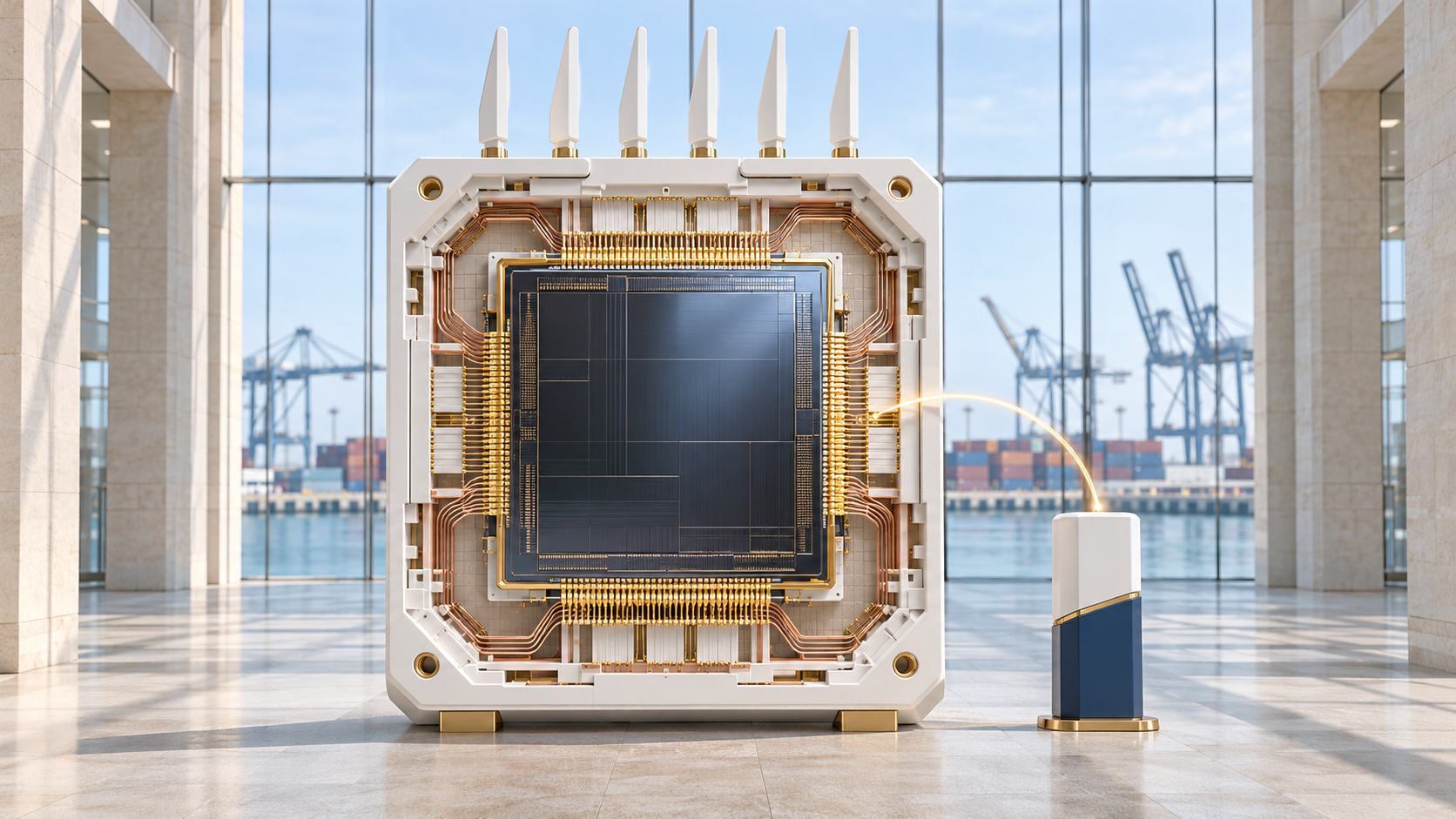
Could a 5G Radio Inside the GPU Package Meet the Chip Security Act? Texas A&M's 5G CATS Paper of 10 November 2026 and the Location Verification Rule in S.1705
What the Chip Security Act would require of exported AI chips
Senator Tom Cotton's Chip Security Act, S.1705, introduced on 8 May 2025, would direct the Secretary of Commerce, within 180 days of enactment, to require that advanced AI chips and the computers built around them carry security mechanisms that implement location verification before they are exported. The bill sets no technical method. It asks for techniques that are "feasible and appropriate" on the date the law is enacted, which makes the state of engineering at that moment part of the legal standard.
What the 5G CATS paper adds on 10 November 2026
A five-author team at Texas A&M University posted 5G CATS on arXiv on 10 November 2026. The design puts a 5G radio, a cryptographic engine and a hardware interlock on the GPU package itself and times an authenticated challenge against nearby low-latency base stations. In simulations of an unloaded cell, a checking station rejected every round of a fiber relay from 300 kilometers, against 2,000 kilometers for ordinary 5G. The authors state that the carrier cross-check is unsimulated and that capacity at large data centers remains to be evaluated.
Why the House remote access bill still matters
A chip that proves where it sits says nothing about who reaches it through a cloud account. The Remote Access Security Act, H.R. 2683, which passed the House and was referred to the Senate Banking Committee on 13 January 2026, addresses that second question. This post reads both bills against the paper and asks which technique a regulator could call feasible today.

Treasury's 22 October 2026 COINS Act Proposal Adds Quantum Algorithms and Applications to the Outbound Investment Prohibition: What Section 851.226(j) Says Before 7 December
What Treasury proposed on 22 October 2026
On 22 October 2026 the US Treasury issued a notice of proposed rulemaking to implement the Comprehensive Outbound Investment National Security Act, the COINS Act, which Congress passed in the Fiscal Year 2026 National Defense Authorization Act. The proposal rebuilds the Outbound Investment Security Program that has applied since 2 January 2025 under 31 C.F.R. Part 850. It covers six technology sectors, adds Cuba, Iran, North Korea, Russia and Maduro-era Venezuela to China as countries of concern, and keeps comments open until 7 December 2026.
Why the quantum line moves to software
The existing rule already prohibits US investment in covered companies that build quantum computers and their critical components, and in quantum sensing and networking limited by military, intelligence, mass-surveillance or other specified end uses. The proposal would add the development of quantum algorithms and applications; its preamble promises an end-use limitation for that clause, which the draft rule text does not visibly carry. In AI the notification tier disappears: any covered investment in a company developing what the proposal now calls a super intelligence system would be prohibited. The obligation to classify each deal sits with the investor, under a reasonable and diligent inquiry standard and without a Treasury list of covered companies. Nothing changes until a final rule sets an effective date. This post reads the proposal closely and asks where a quantum software company would fall.

How One Export-Control Table Opened a New AI Compute Route
A legal table changed the route
On July 10, 2026, the U.S. Bureau of Industry and Security moved the United Arab Emirates out of Export Administration Regulations Country Groups D:3 and D:4 and into A:5. The final rule, published July 14, expands access to License Exception Strategic Trade Authorization for the UAE government and approved commercial entities. It also creates license-free access to specified advanced computing items for named government, commercial and U.S.-headquartered AI entities. The change makes AI compute access depend on a country classification and an approved-entity list, not on geography alone.
The entity list carries the control
A:5 status does not create an open channel for every buyer. For STA and the rule's specified license-free advanced-computing treatment, the ultimate consignee and all end users must appear in Supplement No. 8, and the ordinary conditions and restrictions of the EAR still apply. That structure matters commercially. A cloud operator, chip supplier, data-center investor or customer can face a different licensing path when the destination, end user or approved status changes, even if the hardware and service contract stay in place.
Compute now sits beside physical infrastructure
The same rule addresses military items, commercial satellites and spacecraft, and dual-use systems used in oil and gas, desalination and civil nuclear power. Export-control country groups are becoming part of the industrial architecture for AI. They influence who can build capacity, which counterparties can receive controlled technology and how quickly a bilateral political framework becomes a commercial route.

The Machine Behind the Machine: ASML and America’s AI-Quantum Industrial Future
The chokepoint inside the chip race
ASML sits at the point where AI ambition, semiconductor capacity, quantum hardware, export controls and supply-chain diplomacy converge. Its EUV and High-NA EUV systems are not ordinary factory equipment. They are the physical instruments that make the most advanced logic and memory roadmaps manufacturable, and they depend on a dense international supplier base that cannot be rebuilt quickly by statute or slogan.
Why America should read ASML operationally
For the United States, the practical question is broader than whether new fabs are announced in Arizona, Ohio, Texas or New York. The harder question is whether the American semiconductor revival has enough lithography capacity, service depth, trained operators, metrology discipline, export-control coordination and upstream component resilience to turn capital expenditure into durable yield. ASML’s current record shows both the promise and the fragility: first High-NA installation in 2024, Q1 2026 net sales of €8.8 billion, and a 2025 supplier base of about 5,100 companies.
The strategic outlook
This special edition treats ASML as a strategic instrument. Control of advanced lithography shapes the pace of AI accelerators, high-bandwidth memory, advanced packaging roadmaps, silicon photonics, cryogenic control electronics and eventually scalable quantum devices. The United States does not need to own ASML to benefit from it. It does need a mature policy for the semiconductor supply chain in which tools, talent, export licenses, allies and service logistics are treated as one system.