
Five Days to Four Kelvin: Reading IBM's Modular Cryogenics Milestone
In 1908 a laboratory in Leiden became the coldest place on earth. Heike Kamerlingh Onnes had spent years building the compressors, heat exchangers and vacuum vessels needed to liquefy helium, and for about fifteen years afterward Leiden held the world’s only supply. The physics that made him famous came out of that plumbing: in 1911 he cooled a thread of mercury in that bath and watched its electrical resistance disappear at 4.2 kelvin. His 1913 Nobel Prize cited “the production of liquid helium.” The refrigerator was the achievement. The discovery was what it made visible.
That sequence is worth holding on to while reading what IBM published on 19 August 2026. The company has connected and cooled its first two modular cryogenic systems into a single environment, under a roadmap aimed at fault-tolerant quantum computing. It is a refrigerator result, announced as one, and specific enough to check line by line.
What the release establishes
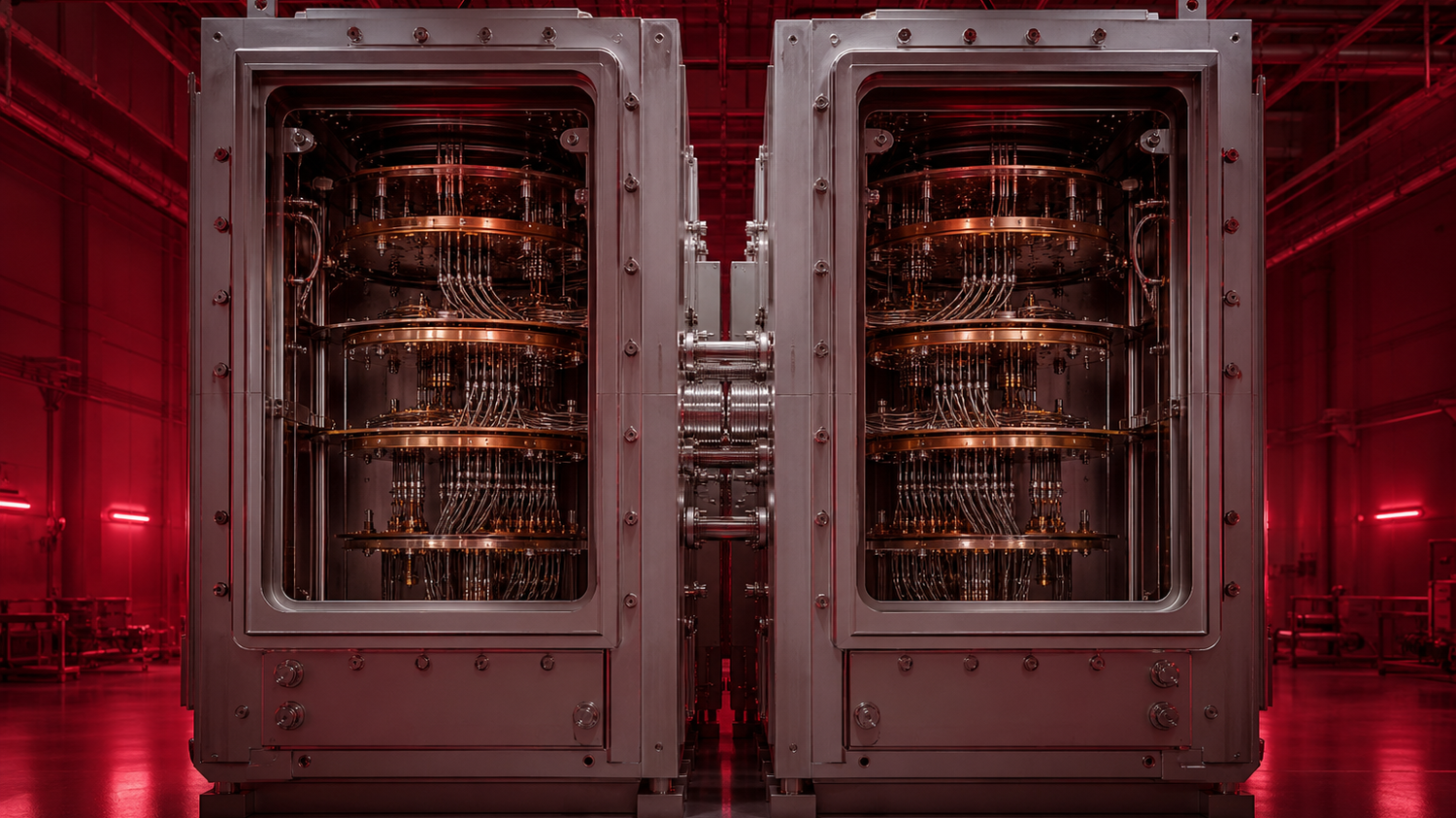
The measurable content is short. Two box-shaped cryogenic modules were joined and cooled as one environment, standing together more than eight feet tall and eight feet wide. They reached 4 kelvin in under five days, then went below 15 millikelvin, which IBM describes as more than 180 times colder than deep space. Each module’s vacuum enclosure offers up to twelve times more wiring space than the company’s most widely used quantum systems, sized for chip-to-chip connections through IBM’s L-coupler interconnect. Jay Gambetta, Director of IBM Research, called the result “a leap forward” that “will accelerate our progress.”
One of those numbers has a long memory. Four kelvin is where mercury’s resistance vanished in Leiden, and reaching it was once the work of a career. Here it is a five-day step in a cooldown schedule, reported as a logistics fact. That is what the industrialization of a physics result looks like.
What the release does not establish
IBM reports no installed processor and no qubit result for this test. The announcement carries no qubit counts, no fidelities, and no logical-qubit or error-correction demonstration for the coupled pair, and IBM Quantum Nighthawk processors are scheduled to go into these cells later in 2026 for operational testing. Each cell is built to house a processor; what has been shown is the environment around one. The trade coverage that carried the story the same day relayed the company’s account without independent measurement.
The distinction decides how the milestone should be filed. Cooling and packaging is infrastructure, and infrastructure claims are easier to test than performance claims: a temperature is reached or it is not, on a date, in a vessel of stated dimensions. Treating it as a capability result credits IBM with a claim it never made.
Practical takeaway. This is a cryogenics and packaging milestone with a date, a dimension and a temperature attached, carrying no claim about qubit counts or error correction. The next checkable event is Nighthawk processors entering these modules later in 2026.
Wiring is the constraint this addresses
The twelve-times figure is the one an engineer would circle. Superconducting quantum computing — the pillar this milestone belongs to — runs into a bottleneck unrelated to qubit quality. Processors need control and readout lines running from room temperature down through successive cold stages; multiplexing lets several qubits share a readout line, and the count still climbs as the machine grows. Every line carries heat into the coldest part of the refrigerator. IBM names the constraint in its own technical account of the architecture: single-chip scaling runs into spatial constraints, excessive heat generation and qubit crosstalk.
Two engineering answers exist, and this announcement uses both. A larger enclosure buys headroom: IBM puts each box-shaped aluminum cell at roughly three times the size of a kitchen fridge, with about 0.53 square meters of wiring area. Linking cells buys more, because quantum cables run through one cell’s opening into the next along a shielded cryogenic tunnel, letting a system grow sideways when one enclosure fills up. On maturity, this is early industrial engineering: two prototypes coupled at IBM’s Poughkeepsie facility, with nothing yet run with processors inside.
Two calendars, side by side
IBM states its plan as a plan: L-coupler-linked processors totaling at least 1,000 programmable qubits by 2027, and IBM Quantum Starling, billed as the first fault-tolerant quantum computer, in 2029, with each module eventually housing thousands of qubits. What makes this week’s announcement useful is the kind of target it is. Vessels get built or they do not, and a cooldown either meets its schedule or misses it — concrete, falsifiable claims with dates attached, even though for now the figures are IBM’s own and no outside party has measured them.
A second calendar runs beside it, and a standards body set that one. NIST’s transition report, IR 8547, went to public draft on 12 November 2024. Its tables deprecate classical public-key algorithms at 112-bit security strength after 2030 and disallow them after 2035 — RSA, ECDSA, and finite-field and elliptic-curve Diffie-Hellman alike. Those dates hold steady when a hardware milestone lands and when one slips. We made the point from the opposite direction earlier this month, reading a cryptanalysis preprint against that calendar: the deadlines encode a judgment about how long migration takes, never a forecast of the day a machine arrives.
A milestone that can be checked beats one that can only be believed, which is why a defense program that contracted for manufactured optical clocks told us more this month than a headline demonstration would have.
How Quentir Reads It
Fault tolerance is arriving as an infrastructure buildout, and buildouts are legible in a way that breakthroughs are not. Steel, refrigeration, cabling and floor space have delivery dates, and a missed one is hard to disguise for long. That legibility is the usable part: the roadmap can be marked against physical events — modules built, processors installed, qubit counts reported under stated conditions — each of which happens on its date or does not.
The corollary runs the other way. A cryogenics milestone is no reason to accelerate a cryptographic migration, and a slipped one is no reason to relax it: the migration clock was set on an estimate of how long inventory and replacement take. Hardware progress narrows the confidence interval around the threat. The work list underneath stays where it was, which is the part organizations underestimate.
Quentir’s Signature Report, the PQC Migration Roadmap, is where we hold that work list against the standards calendar: a fixed scope with a dated source spine and refresh triggers built for exactly this kind of week, when a vendor milestone lands and the live question is whether anything in the plan changes. This post gives the reading; the report survives being handed to someone else. How these milestones accumulate shows across our published posts, including the export-control shifts we covered yesterday.
The next checkable moment is not far off. When Nighthawk processors go into these cells later this year, the subject changes from refrigeration to computation, and the figures that follow — qubit counts, fidelities, the conditions they were measured under — will be the first numbers here anyone can argue with. Kamerlingh Onnes had to finish his refrigerator before anything inside it could surprise him. IBM has now built two and joined them. What they hold is still to be reported.
Sources: IBM Newsroom, “IBM Connects Its First Modular Cryogenic Systems in Milestone Toward Fault-Tolerant Quantum Computing”, 19 August 2026, for the joined-module dimensions, the under-five-days cooldown to 4 kelvin, the below-15-millikelvin figure, the comparison to deep space, the twelve-times wiring-space comparison, the L-coupler description, the Nighthawk testing schedule, the 2027 and 2029 targets, and the quoted remarks by Jay Gambetta. The Quantum Insider, 19 August 2026, for same-day trade coverage of the announcement; that report adds no independent measurement of its own. Catherine Dundon, Matthew Hollister and Allie Lindler, “IBM’s new modular architecture for cryogenic systems”, IBM Quantum Computing Blog, 19 August 2026, for the box-shaped aluminum cell format, the 0.53 square meters of wiring area and 2.75 cubic meters of chamber volume per cell, the comparison to roughly three kitchen fridges, the shielded cryogenic tunnel carrying quantum cables between adjacent cells, the statement that single-chip scaling runs into spatial constraints, excessive heat generation and qubit crosstalk, and the two coupled prototypes operating at Poughkeepsie, New York. National Institute of Standards and Technology, Internal Report 8547 (initial public draft), “Transition to Post-Quantum Cryptography Standards”, 12 November 2024, transition tables, for “deprecated after 2030” and “disallowed after 2035” at 112-bit classical security strength. On the Leiden history: The Nobel Prize in Physics 1913, Heike Kamerlingh Onnes, for the 1913 award and its citation wording, and “Milestones: Discovery of Superconductivity, 1911”, Engineering and Technology History Wiki, for the 1908 helium liquefaction at Leiden and the 1911 observation of vanishing resistance in mercury at 4.2 kelvin. All fast-moving claims above were checked against these sources on 21 August 2026.
Published intelligence, built to inform your own decisions. Published: August 21, 2026.