
DARPA Is Buying the Copies, Not the Discovery
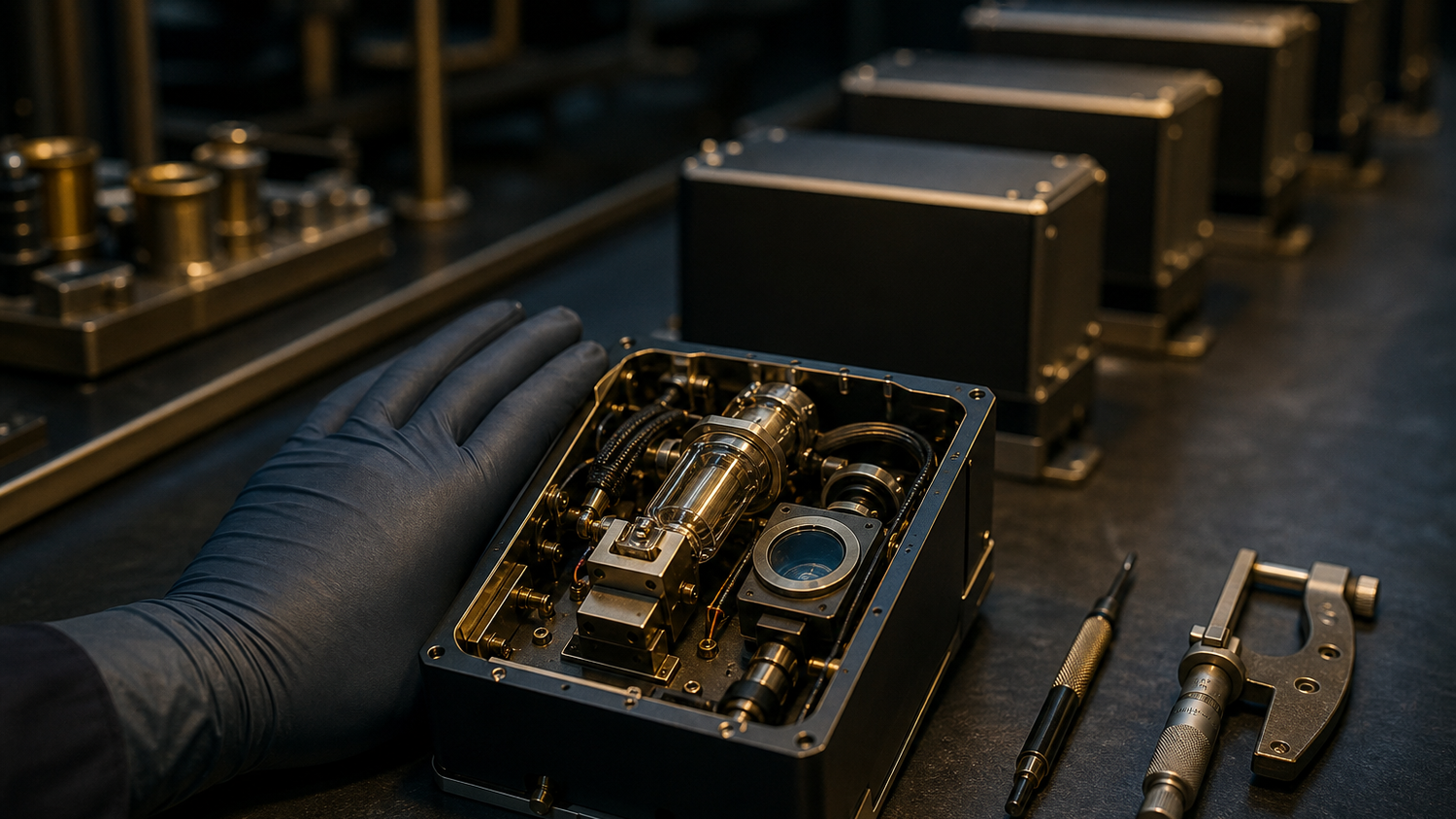
In 1714 the British Parliament offered a prize for a practical method of finding longitude at sea. John Harrison's fourth timekeeper, H4, met the standard on an Atlantic trial in 1761. The instrument worked. What followed was the harder problem. Larcum Kendall spent more than two years producing a single copy, K1, and it fell to John Arnold and Thomas Earnshaw in the 1780s to turn the marine chronometer into an article a workshop could make in numbers. Seventy years separated the prize from that workshop article; about twenty of them separated Harrison's proven timekeeper from it. For the Royal Navy the second interval was the expensive one.
On August 6, 2026 the Defense Advanced Research Projects Agency named that second interval as its target. Its new program, It's About Time, does not ask for a better optical clock. It asks for a line that can build them.
Practical takeaway. DARPA has funded a production line, not a demonstration: 25 optical atomic clocks on award, an option on 100 more, and a facility expected by mid-2027 with units following within a year. The announcements name the quantities and the physics. Neither names the qualification route for the delivered clocks.
2021 to 2026: five years of physics, indoors
The chronology is unusually legible for a defense program. DARPA's ROCkN effort — Robust Optical Clock Network — ran about five years, moving optical clocks from a proof-of-concept laboratory breadboard to compact prototypes tested in national laboratories and in field environments. A companion effort, OASIC (Optical-Atomic System Integration & Calibration), ran quantum testbeds to validate the enabling components and, in DARPA's own description, to determine the "requirements, component-level specifications, measurement protocols, packaging, and standardization procedures necessary to enable a larger manufacturing effort." Program manager Mukund Vengalattore framed the motivation bluntly in the August 6 announcement: "For too long, the quantum community has driven the state-of-the-art exclusively within the laboratory."
October 2025 to August 6, 2026: buying the maker, then the order
In October 2025 IonQ acquired Vector Atomic, one of the ROCkN performers. On July 31, 2026 it closed its acquisition of the semiconductor foundry SkyWater, a transaction Quentir read at the time as a supply-chain concentration that cleared without stated conditions. Six days later the timing division it had bought a year earlier became the vehicle for a production contract: $28 million for manufacturing development and 25 Evergreen-05 clocks, a $30 million option — not yet exercised — for a further 100, and $15 million of IonQ's own capital committed to production space, test equipment and staff. Marty Boyd, who co-founded Vector Atomic and now directs IonQ's timekeeping division, described DARPA as "a partner every step of the way."
Read as a sequence, this is a state agency doing what the Board of Longitude eventually had to do: paying for the copies, not the discovery.
August 6, 2026: what five liters buys
The Evergreen-05 is specified as a five-liter, shoebox-sized enclosure — about one seventy-fifth the volume of an active hydrogen maser — with 50 femtoseconds of stability at one second and nanosecond-level holdover across ten days. IonQ projects that as under a second of error in 30 million years, which is the sort of figure that travels well in headlines and explains very little.
The load-bearing number is the holdover. It describes how long a platform keeps time it can defend after the external reference disappears, and it is why the named applications are radar, secure communications and precision geolocation. A clock that drifts by a nanosecond over ten days without a satellite is an autonomy claim about the ten days.
That autonomy has a civilian shadow. European aviation regulators have spent four years documenting a rise in satellite-navigation interference: the European Union Aviation Safety Agency has revised its safety bulletin to warn that jamming and spoofing events are growing in severity and sophistication, with the affected corridors running through the Baltic, the Black Sea, the eastern Mediterranean, the Middle East and the Arctic, and IATA flight-data figures recording a 220 percent rise in GPS signal-loss events between 2021 and 2024. Power grids, financial timestamping regimes, telecommunications synchronization and emergency dispatch all sit downstream of the same satellite signal. Sovereign timekeeping is being rebuilt as a defense capability, and the households that depend on it will inherit it late, through infrastructure operators, if at all.
Mid-2027 to mid-2028: the undated step in the sequence
Neither August 6 document says how the delivered clocks will be qualified. DARPA's page names no national metrology institute, no international comparison campaign and no military specification for the units; IonQ's release names none either. A qualification surface does exist in the program's own design: OASIC is building fee-based testbeds open to any user in the technical community, and DARPA frames the aim in certification terms — what NIST and Underwriters Laboratories do for recognized standards, OASIC intends for the components in chip-scale quantum devices — with a later phase giving government laboratories a contracting route to independent verification and validation. The open question is narrower than an absence. It is whether Evergreen-05 will be measured there, or anywhere else, and neither announcement says.
One detail cuts both ways. DARPA's atomic-clock testbed team is Vector Atomic and the University of Colorado, in Pleasanton and Boulder — and Vector Atomic is the company IonQ bought in October 2025. The people who helped build the measuring instrument now sit inside the firm delivering the units. In a field this small that is ordinary, probably unavoidable, and exactly the condition under which a named, contract-specific qualification route stops being a formality.
Attribution matters here, so it is worth being exact. The company release establishes what IonQ says the contract covers. DARPA's page establishes what the agency says the program intends. Neither states which route will qualify these units, and silence in two press announcements is not silence in the contract.
The distinction is the same one Quentir applied to a lattice-cryptanalysis result earlier this month: a specification is a claim about an instrument, and it becomes a fact about a potential 125-unit fleet only through a comparison someone else can run. Field hardware has a way of making that gap concrete — as the constraint analysis in post-quantum security over narrow radio links showed, laboratory performance and deployed performance are separated by an environment nobody controls.
2026 to about 2030: a second calendar for the same physics
While the defense line is being tooled, the same physics is under assessment by the treaty system that stewards the definition of the second, in which the General Conference on Weights and Measures considers and ratifies SI definitions and sets the redefinition timetable, with the BIPM supporting the structure. The BIPM now lists eleven optical transitions as secondary representations of the second, alongside one microwave transition; being listed makes a standard eligible to be used, which is a different thing from the smaller set of clocks operationally steering International Atomic Time on any given month. Meanwhile the Consultative Committee for Time and Frequency has been working toward a published roadmap under which the General Conference on Weights and Measures could, in 2026, validate a path to redefining the second around 2030 — conditional on consensus about which option to adopt and on the mandatory criteria being achievable in time.
So there are two calendars running on one technology, and they do not reference each other. The procurement calendar opens a factory in mid-2027, with an option on 100 more units that neither announcement puts a date on. The metrology calendar, governed by a treaty structure older than any of the agencies involved, reaches its decision at the end of the decade. The redefinition would not create external metrology where none exists — the current SI second, the secondary optical representations, TAI comparisons and national calibration services already provide it. What the two calendars show is that the reference frame these clocks will be measured against is itself moving while the production line is being tooled, and neither announcement says which frame, or whose laboratory, will qualify the delivered units.
How Quentir Reads It
The finding is the ordering. DARPA has put its money on manufacturing, and it has done so through the same company whose foundry acquisition and whose utility-network research center in Chattanooga we have tracked through the summer. IonQ is assembling a position across quantum computing, fabrication and timing at once; this award makes the timekeeping division it bought in October 2025 the part with a funded production line behind it.
That makes the unnamed qualification route the most consequential open item, not a procedural quibble. A tactical clock is a trust anchor: radar returns, encrypted links and geolocation all inherit whatever error the clock carries, and every downstream system that assumes correct time inherits it silently. Whatever standard eventually governs the 25 contracted units, and any ordered under the option, will be doing work far outside the program that wrote it.
Quentir has followed the summer's quantum instruments as one continuous record — the sovereign programs, the foundry consolidation, the standards decisions and now this production order. Everything this analysis links to sits in that archive, and the All-access membership is the way to read it as a whole.
The tell to watch is the option. DARPA holds an unexercised $30 million for 100 further clocks. Whether it is exercised, and what the agency says it measured before exercising it, will reveal more about how the United States intends to qualify fielded quantum hardware than the original award did.
Published intelligence, built to inform your own decisions. Published: August 11, 2026.
Sources: DARPA, "It's about time for quantum manufacturing" and the It's About Time program page (darpa.mil, published August 6, 2026); IonQ, "UPDATED: DARPA Selects IonQ to Produce Next-Generation Atomic Clocks" (ionq.com, August 6, 2026); European Union Aviation Safety Agency, updated Safety Information Bulletin on GNSS outages and alterations (July 3, 2026) and the GNSS outages and alterations domain page; IATA and EASA, joint plan to mitigate the risks of GNSS interference (June 18, 2025), source of the 220 percent signal-loss figure for 2021 to 2024; DARPA, "Small business accelerates transition of quantum tech from lab to market" (darpa.mil, 2025), on the OASIC testbeds and the atomic-clock testbed team; Royal Museums Greenwich, Harrison's timekeepers and the longitude problem and the K1 collection record; Bureau International des Poids et Mesures, material on the redefinition of the second, the redefinition FAQ, and the mise en pratique list of recommended standard frequencies, and N. Dimarcq and others, "Roadmap towards the redefinition of the second", Metrologia 61 (January 22, 2024). Public sources checked August 11, 2026.
Published intelligence, built to inform your own decisions. Published: August 11, 2026.