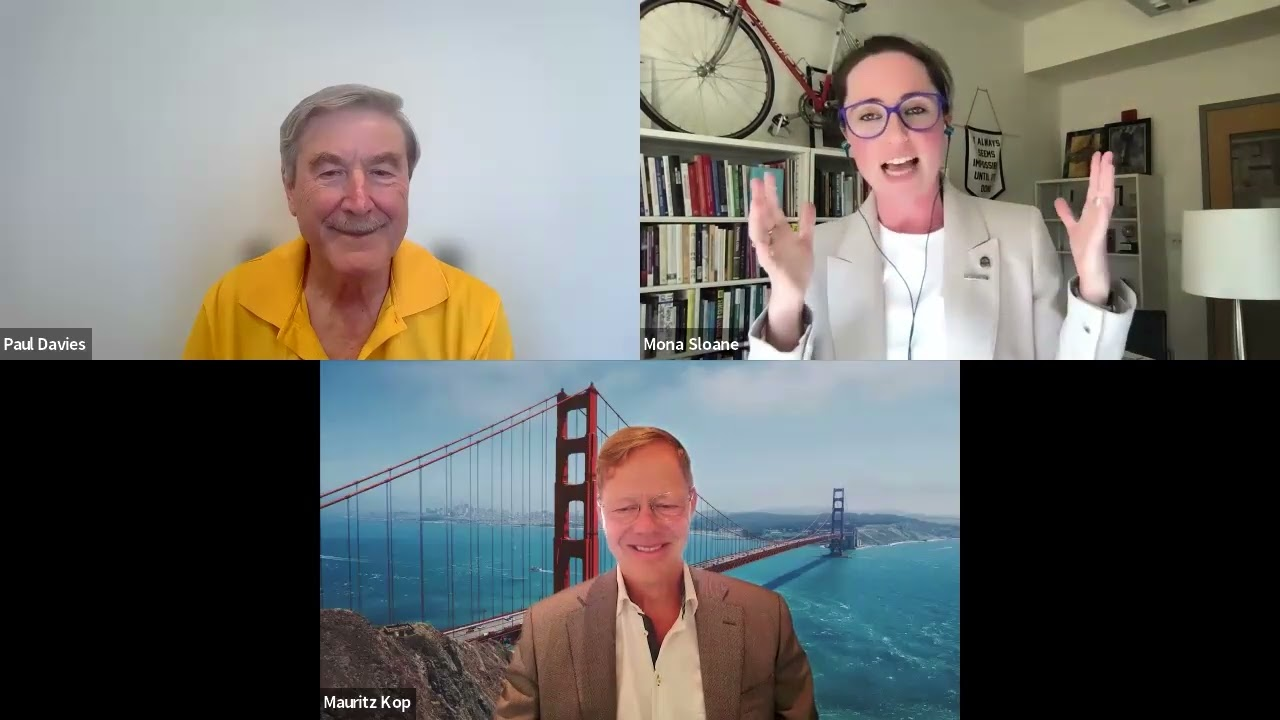
The University of Virginia has published the recording of Co-Opting AI: Quantum, the public conversation of Wednesday, October 28, 2026, in which our founder Prof. Mauritz Kop and the theoretical physicist Paul Davies discussed quantum technology and its entanglement with AI, with Professor Mona Sloane as host. The online session is the first episode on quantum technology in the Co-Opting AI series, which Sloane convenes with UVA's Digital Technology for Democracy Lab, NYU's Institute for Public Knowledge, and Sloane Lab. Quentir previewed the episode earlier this month. The full hour is below.
Mona Sloane Opens Co-Opting AI: Quantum With Einstein's Spooky Action at a Distance
Sloane opened with Einstein's 1947 objection to "spooky actions at a distance" and noted that entanglement now makes quantum engineering work, with quantum computers built on government and venture funding and plugged into AI infrastructure. She set out the questions the hour would take up: governments racing toward quantum advantage, the risk to the world's encrypted data, the verification of results that no one can reproduce, and the gap between promise and reality, which shapes funding, policy, and public expectations as it did for AI.
Paul Davies: a Century of Quantum Mechanics and the Quantum Apocalypse
Davies, Regents' Professor and director of the Beyond Center for Fundamental Concepts in Science at Arizona State University, began with the centenary of quantum mechanics, which "started in earnest in 1926" and which he called "the most successful scientific theory in history." The electronics on which AI runs already rest on what he calls quantum 1.0. Quantum 2.0, the subject of his book Quantum 2.0: The Weird Physics Driving a New Revolution in Technology, combines superposition with entanglement and encodes information in the quantum states of a system itself.
His provocation concerned data already in the hands of an adversary. Banking, credit cards, and email depend on encryption that a large quantum computer could break, and information already "vacuumed up by a bad actor" cannot be recalled. "If they get a quantum computer, they can break into it and then I think all hell will break loose," Davies said. "We may be on the verge of a quantum apocalypse." Later in the hour he described a quantum AI as potentially "a truly alien supermind in our midst," and pointed to a helmet that measures the magnetic fields of the brain's electrical activity: "If even our thoughts are not confidential, what sort of world have we got coming down the track?"
Prof. Mauritz Kop on the Digital Operating System and the Quantum Event Horizon
Kop opened his provocation with the question of access: "Decisions about access to quantum technologies will shape who can benefit from them and who controls their use." "Leadership in quantum technology could give states enduring power over what I call the world's digital operating system," he said, and he described the prospect of a lasting shift in strategic power as a quantum event horizon, "a tipping point beyond which developments and their impacts become hard to foresee." Early choices in standards, infrastructure, and supply chains can entrench that power for decades. The Collingridge dilemma concerns the difficulty of influencing a technology before its full consequences are known. Governments can respond by testing rules in regulatory sandboxes and adjusting them as evidence comes in. "Competing with China requires investment and rapid development alongside safeguards for people using these technologies."
He then turned to security. Preparing systems with post-quantum cryptography "can deny an adversary the benefit of a quantum attack, which is a form of deterrence by denial." He added a point for practitioners: post-quantum cryptography is itself dual use, because "any adversary, whether it is a lone wolf, a terrorist, a hacker, an authoritarian regime, a competitor or a rogue AI, can now use PQC to protect its own communications against future quantum attacks." His example was a hospital that must replace classical RSA without interrupting care while its patients have little say in its preparations; a genome encrypted in 2026 and decrypted in 2040 may still belong to a living patient. Kop also set out the Ten Principles for Responsible Quantum Innovation, which he wrote with Mateo Aboy, Urs Gasser, Luciano Floridi, the late Raymond Laflamme, and others, and the LSI test (least trade-restrictive, security-sufficient, innovation-preserving), which selects the least trade-restrictive measure that meets the security objective and then assesses its effects on research, competition, and the diffusion of knowledge. In legal terms, the LSI test is a proportionality test with a built-in subsidiarity check that places legal friction at the layer of the quantum stack where it can affect the targeted capability. Broad trade controls, he warned, "risk building a Silicon Curtain and weakening scientific relationships on which democracies also depend." He closed: "I want democratic institutions to protect scientific freedom and give citizens a say in how quantum technologies are used."
Harvest Now, Decrypt Later and the State of Quantum Computing in October 2026
Answering Sloane's question on the quantum apocalypse and AI, Kop called quantum "the language of Mother Nature" and said of the technology: "the tech works and is real." On data harvested now for decryption later, he said: "it's already too late, and it's happening at scale by many countries in the world who see this coming." On the relationship between AI and quantum, he said: "I would avoid treating equal transformative power as an already established fact." He added: "The more immediate social question is whether common providers and shared infrastructure concentrate influence over both fields." Asked later by Sloane where workable quantum computing stands, he noted that much of the work is secret, in companies and in the national laboratories, and gave the audience a method for reading the headlines: "I want to separate a demonstrated result, a resource estimate and a commercial forecast or a marketing talk, because each supports a different kind of conclusion." Physical qubit counts, he said, "tell us little on their own"; reliable logical operations and the resources needed for a useful computation matter. Google's AlphaQubit work on decoding shows how AI can assist quantum development, while proposed quantum advantages for AI, such as quantum machine learning, "need to be demonstrated against strong classical alternatives, which also are evolving very rapidly."
Learning From the AI Governance Cycle and Building the Quantum Workforce
Sloane asked what quantum should learn from the way AI was handled. Kop answered that "we're still in the middle of the AI governance cycle" and that policymakers "should always try to learn from previous governance cycles," including nanotechnology, biotechnology, and nuclear safeguards; a planetary non-proliferation body for quantum AI "would be something to think about," although many states are reluctant to give an international body much authority. Davies, who said he is not a governance expert, added: "I agree with everything he said." Kop then argued for restraint in design: "We need to always let innovation breathe, especially when you are in a race dynamic, and here in America we want to be quantum first before this power gets into the hands of authoritarian regimes." Those aims have to be balanced, he said: "I would be very surgical and sensible about the governance interventions that I would design."
Asked by an audience member about value, privacy, and security, Kop turned to the audience. "We need to build a values-based American quantum ecosystem ourselves, and for that we need you, the audience, to become the quantum workforce." He pointed to clean-tech applications that can become companies: quantum sensors that measure tiny changes in magnetic fields and gravity to detect oil, molecular simulation, and quantum computers that simulate how new materials interact at the atomic level to accelerate the invention of filters and materials capable of capturing CO2 directly from the air or the ocean. Asked whether classical computers solve most problems more efficiently, he said: "Many quantum use cases and how this will all work out are still unknown," and added that "we should also take highly developed AI models as our peers" in discussing these interdisciplinary questions. His advice to citizens was to start young: "make sure their children become quantum aware and literate."
How Quentir Reads It
For executives, three messages from the hour carry over directly. Kop said harvest-now, decrypt-later collection is already under way at scale, so the confidentiality life of sensitive data, such as patient records, decides how early migration to post-quantum cryptography must start. Vendor roadmaps and headlines mix demonstrated results, resource estimates, and commercial forecasts, and each supports a different decision. Shared cloud providers and infrastructure may concentrate influence over both AI and quantum, which makes access and supplier choice a strategic question. Quentir applied the same reasoning in its analysis of the 2026 federal post-quantum mandate.
We thank Mona Sloane, the Digital Technology for Democracy Lab, NYU's Institute for Public Knowledge, and Sloane Lab for the conversation, and Paul Davies for a provocation that set its terms. The next Co-Opting AI episode, on film, takes place on November 18.
Sources and Further Reading
- Co-Opting AI: Quantum, recording, UVA Digital Technology for Democracy Lab (October 28, 2026)
- University of Virginia DTD Lab, Co-Opting AI: Quantum, event page
- Co-Opting AI series, Sloane Lab
- Paul Davies, Quantum 2.0 (University of Chicago Press, 2026)
- Kop et al., Ten Principles for Responsible Quantum Innovation, Quantum Science and Technology (2024)
- Aboy, Gasser, Cohen and Kop, Quantum technology governance: A standards-first approach, Science (2025)
- Kop and Federici, Before Q-Day: The Race to Quantum First, War on the Rocks (July 20, 2026)
Published intelligence, built to inform your own decisions. Published: October 29, 2026.