
Prof. Mauritz Kop Invited to Co-Opting AI: Quantum at the University of Virginia, on Quantum, AI, and Geopolitics With Paul Davies and Shohini Ghose
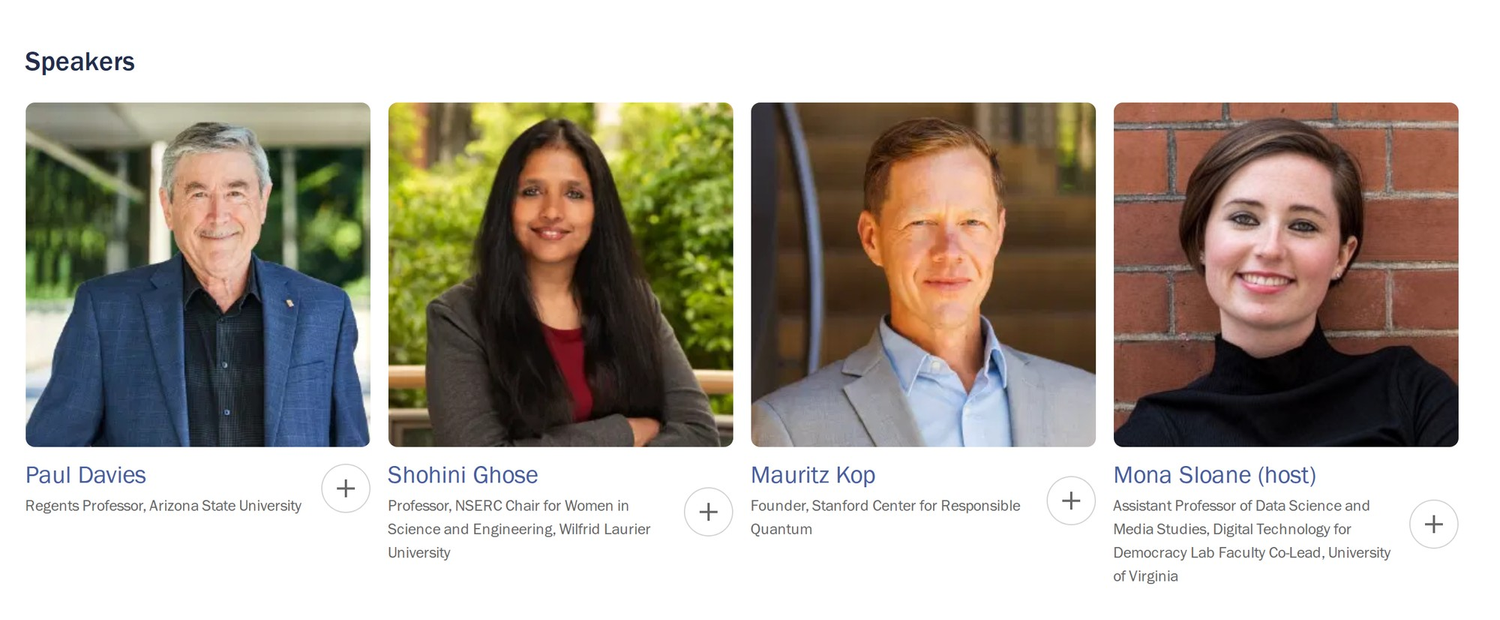
On Wednesday, October 28, 2026, the University of Virginia brings quantum technology into a public conversation series on artificial intelligence that has run since 2019. Prof. Mauritz Kop, Founder of the Stanford Center for Responsible Quantum Technology (Stanford RQT) and of Quentir, has been invited to speak at Co-Opting AI: Quantum, hosted online by UVA's Digital Technology for Democracy Lab, NYU's Institute for Public Knowledge, and Sloane Lab. He joins the theoretical physicist Paul Davies of Arizona State University and the quantum physicist Shohini Ghose of Wilfrid Laurier University, with Professor Mona Sloane of the University of Virginia as host.
The organizers have framed the episode around a geopolitical observation: quantum computing is arriving into institutions, supply chains, and geopolitical formations already shaped by AI. That is the terrain where Kop's work on the race to quantum first operates, and where decisions taken in the next few years will set the terms for decades.
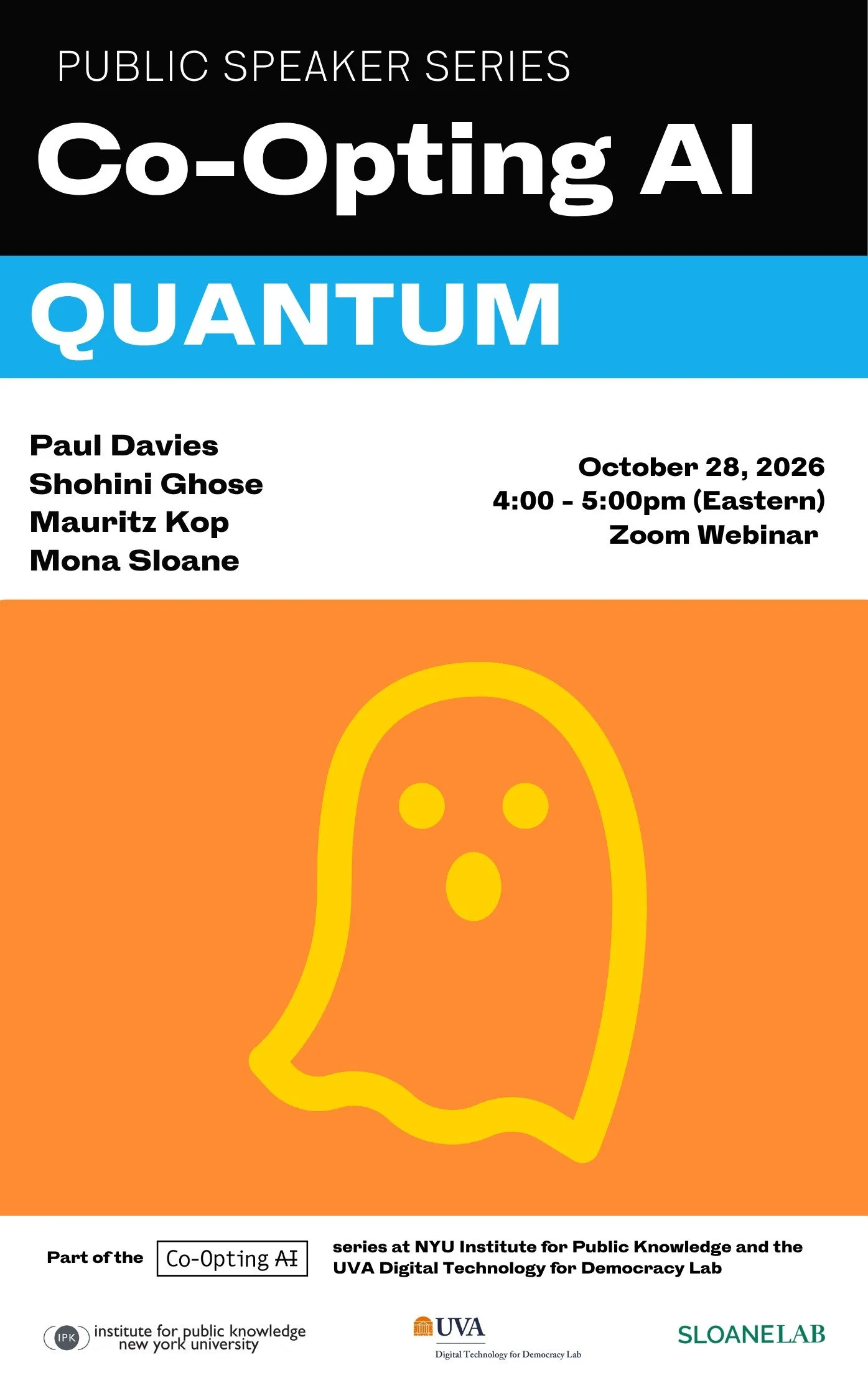
Co-Opting AI: Quantum on October 28, 2026: Hosts, Speakers, and How to Join
The session runs from 4:00 to 5:15 PM Eastern Time on Zoom and is open to the public on registration. It will be recorded, and everyone who registers for the webinar receives a notice when the video is available. The event page lists Kop as Founder of the Stanford Center for Responsible Quantum Technology and carries his full biography: Senior Fellow and Principal Investigator at the Centre for International Governance Innovation (CIGI), Guest Professor at the U.S. Air Force Academy, quantum ecosystem expert on the von Neumann Commission, Subject Matter Expert at NATO StratCom, and adviser to the U.S. Government, including the Pentagon and the Department of State, on quantum strategy and policy.
Mona Sloane launched Co-Opting AI at NYU's Institute for Public Knowledge in April 2019, and the series has run online since April 2020, now with the University of Virginia as co-host. Its archive includes Alondra Nelson on Justice, Meredith Whittaker on Conflict, and, in April 2026, a Geopolitics episode with Pablo Chavez, Chinasa T. Okolo, and Nick Srnicek. The quantum conversation is the fifty-fifth episode and the first to take on quantum technology. Sloane, Assistant Professor of Data Science and Media Studies at UVA and author of Predicted: How AI Is Restructuring Social Life (University of California Press, 2026), has built the series into a public forum where technology is discussed alongside inequality, law, and democracy.
Quantum Inherits AI's Infrastructure: Chips, Cloud Platforms, Supply Chains, and Export Controls
Quantum computers already reach users through the major cloud platforms that also serve AI, both technologies draw on the same capital markets, and export-control regimes increasingly treat them as strategic. Quantum machines also depend on narrow inputs such as helium-3, enriched isotopes, dilution refrigeration, and single-photon detectors, several of which only a handful of suppliers worldwide can provide, as Kop and Joseph Federici note in Before Q-Day. The AI era has already shown how quickly such dependencies turn into instruments of power.
The two technologies also accelerate each other. Machine learning already helps calibrate quantum devices and decode their errors, and quantum processors may in time speed up parts of AI training, optimization, and simulation. In his August 2026 interview with The Prode, Kop pointed to these feedback effects as a reason the timeline for a cryptographically relevant quantum computer could compress, and in Before Q-Day he and Federici argue that cryptography, quantum networks, sensing, AI, and supply chains belong in one quantum strategy. The organizations that set AI's rules on data access, compute, and model security will therefore help set quantum's rules as well.
Kop has described this convergence as a contest for the keys to the world's digital operating system. In his talks at CIGI and in his scholarship he frames the prospect of an enduring shift in strategic power as a quantum event horizon: a point after which the ability to steer advanced quantum technology and AI toward beneficial outcomes may be lost. His answer is a governance agenda for democracies that treats responsible innovation as an instrument of strategic leadership. Quentir's earlier analysis of what quantum technologies mean for American values follows the same line: liberty, the rule of law, free enterprise, and strategic scientific openness are assets in this competition, and allies bring their own democratic traditions to it.
The research behind that agenda includes the Quantum Nexus project at CIGI, which builds on Kop's LSI test for selecting security measures that are least trade-restrictive, security-sufficient, and innovation-preserving, set out in his Nexus paper and indexed in the NASA Astrophysics Data System at the Center for Astrophysics | Harvard & Smithsonian. It offers export-control and research-security policy a way to protect allied advantage while keeping the scientific openness that makes the advantage possible. Quentir summarized the strategic picture in Quantum First: One Race, Five Fronts, One 2030 Goal.
Paul Davies, Shohini Ghose, and Mona Sloane: Cosmology, Quantum Strategy, and the Sociology of AI
The program brings together three fields that rarely share a stage. Paul Davies, Regents' Professor at Arizona State University and director of the Beyond Center for Fundamental Concepts in Science, works on the origin of the universe, the quantum properties of black holes, and the nature of time. His latest book, Quantum 2.0: The Weird Physics Driving a New Revolution in Technology, explains the quantum technology revolution in information, sensing, and biology. His honors include the Templeton Prize.
Shohini Ghose, Professor of Physics and Computer Science and NSERC Chair for Women in Science and Engineering at Wilfrid Laurier University, served on the inaugural Advisory Council for Canada's National Quantum Strategy and as Chief Technology Officer of the Quantum Algorithms Institute. UNESCO named her among its Quantum 100 global innovators in 2025. Her experience with national strategy in Canada, a close ally in the quantum race, adds a coalition perspective that Kop's work also emphasizes.
Sloane completes the picture as a sociologist of technology. Her research at UVA and in Sloane Lab studies AI as a social phenomenon tied to wider cultural, economic, material, and political conditions. With physics, strategy, law, and sociology in one conversation, the episode can treat quantum technology as a question of national power and of everyday life.
From Stanford RQT to Washington: the Scholarship and Advisory Work Kop Brings
Kop's contribution draws on the foundational work of Stanford RQT, which he led as Executive Director from 2023 to 2025 and which was inaugurated by Mark Rutte, now Secretary General of NATO. The Ten Principles for Responsible Quantum Innovation (IOP, 2024), written with colleagues including Urs Gasser, I. Glenn Cohen, Luciano Floridi, and Raymond Laflamme, carry the safeguarding, engaging, and advancing framework that the OECD Recommendation on Quantum Technologies built on in 2026. The agenda began with his 2021 Yale Journal of Law and Technology article Establishing a Legal-Ethical Framework for Quantum Technology, and Stanford University Libraries preserves the group's scholarship in a permanent Stanford RQT repository.
The national security community knows Kop through two essays in War on the Rocks. A Bletchley Park for the Quantum Age (November 6, 2025) called for a White House lead for the post-quantum transition, a federal testing network, and validated-only purchasing by the General Services Administration, the Office of Management and Budget, and agency acquisition chiefs. In August 2026 GSA announced that it leads the transition to quantum-resistant technology under OMB memorandum M-26-15. The follow-up essay, Before Q-Day: The Race to Quantum First (July 20, 2026), widened the lens to the whole strategy. Kop teaches quantum governance as a Guest Professor at the U.S. Air Force Academy and advises the U.S. Government, including the Pentagon and the Department of State, on quantum strategy and policy.
The Virginia invitation follows a series of earlier platforms: a panel at the University of Oxford on quantum strategy and international order, the CNAS Quantum Roundtable on research security, a governance seminar at CIGI, the keynote at the International Quantum Forum at TU Munich, advice to Yale Law School on quantum technology and human rights, a 2024 consultation with the U.S. Department of State, and the chair of the Stanford Responsible Quantum Technology Conferences at Stanford Law School. The Quentir Q4 2026 quarterly places these threads in the wider calendar of NATO, Genesis Q, and the U.S. Department of Energy.
How Quentir Reads It
An invitation to Co-Opting AI signals that quantum technology has entered the mainstream conversation about technology and society. The audience of this series includes scholars, journalists, policymakers, and technologists who shaped the AI governance debate of the past seven years. When that audience turns to quantum, the strategic questions Quentir follows every day reach a wider public: who builds the machines, who controls the supply chains, how fast critical infrastructure migrates to post-quantum cryptography, and which democratic values set the rules.
For executives and public leaders, the practical message is timing. The choices made between now and 2030 on procurement, standards, research security, and allied industrial capacity will shape the quantum order for decades. Quentir's Insights translate those choices into evidence-based briefings with the lead time to act. We congratulate Mona Sloane and her colleagues at the University of Virginia, NYU, and Sloane Lab on this episode, and we look forward to the conversation on October 28.
Sources and Further Reading
- University of Virginia DTD Lab, Co-Opting AI: Quantum, event page (October 28, 2026)
- Co-Opting AI series archive, Sloane Lab
- Webinar registration, University of Virginia
- Mona Sloane, Predicted: How AI Is Restructuring Social Life (University of California Press, 2026)
- Paul Davies, Quantum 2.0 (University of Chicago Press, 2026)
- Shohini Ghose, faculty profile, Wilfrid Laurier University
- Kop, A Bletchley Park for the Quantum Age, War on the Rocks (November 6, 2025)
- Kop and Federici, Before Q-Day: The Race to Quantum First, War on the Rocks (July 20, 2026)
- Kop, Establishing a Legal-Ethical Framework for Quantum Technology, Yale Journal of Law and Technology (2021)
- Kop et al., Ten Principles for Responsible Quantum Innovation, Quantum Science and Technology (2024)
- Gasser, De Jong and Kop, A call for responsible quantum technology, Nature Physics (2024)
- Aboy, Gasser, Cohen and Kop, Quantum technology governance: A standards-first approach, Science (2025)
- Kop, The Nexus of Quantum Technology, Intellectual Property, and National Security (arXiv, 2026)
- Stanford RQT collection, Stanford Digital Repository
- GSA, GSA Leads the Transition to Quantum-Resistant Technology (August 24, 2026)
Published intelligence, built to inform your own decisions. Published: October 9, 2026.