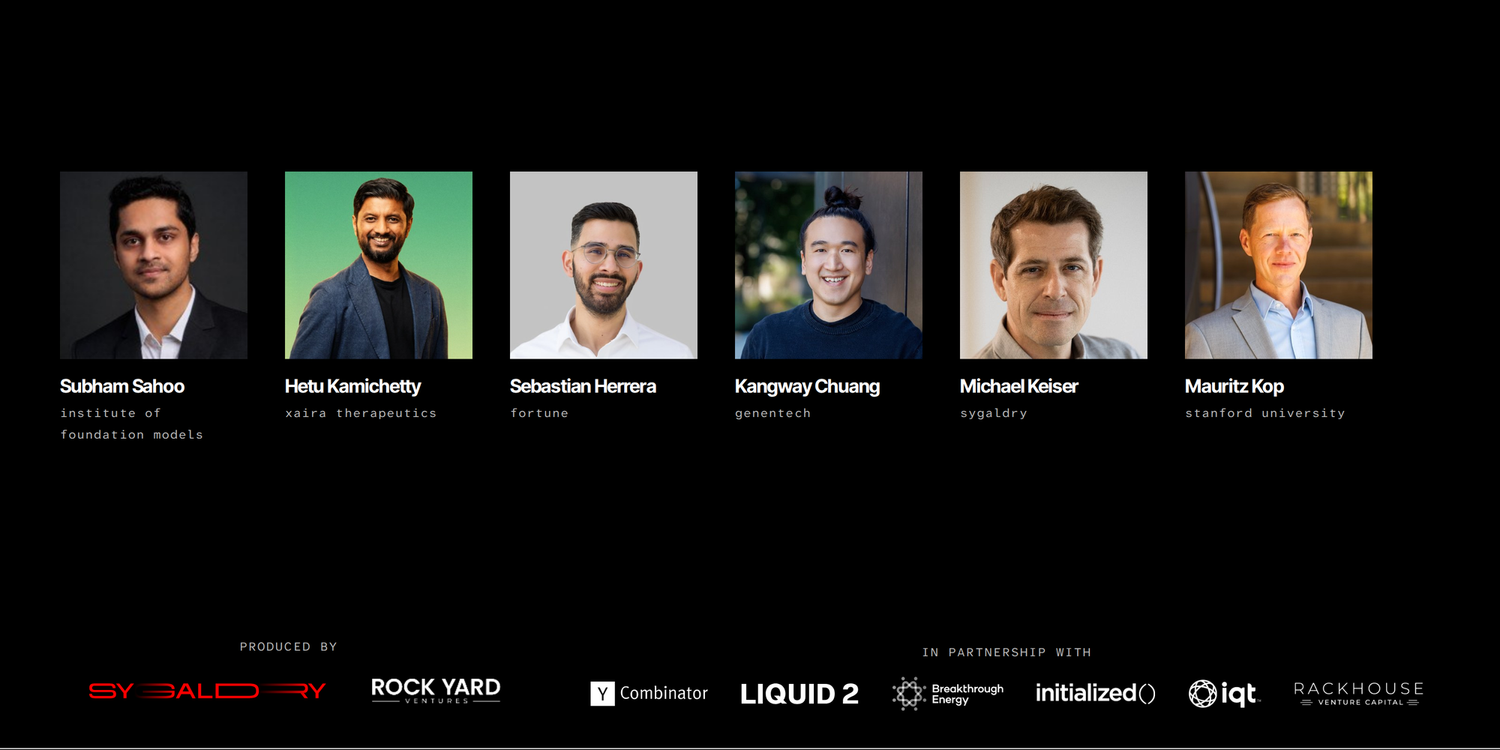
On Monday, December 14, 2026, researchers, founders and investors will meet in San Francisco for Jagged Horizon, which its organizers describe as "an invitation-only research gathering at the intersection of quantum, AI, and what comes next." Mauritz Kop, founder of the Stanford Center for Responsible Quantum Technology and of Quentir, is one of the six select speakers listed on the event page. The gathering is produced by Sygaldry and Rock Yard Ventures, in partnership with Y Combinator, Liquid 2 Ventures, Breakthrough Energy Ventures, Initialized Capital, IQT and Rackhouse Venture Capital.
The program shows where research budgets and venture capital are heading. AI and quantum technology are converging, and each accelerates the other. Its eight themes are substrates, scaling limits, autoresearch, AI for science, sovereign capability, compute economics, the energy wall and evals. On several of these themes AI is still getting better quickly.
Where Capital and Research Are Moving
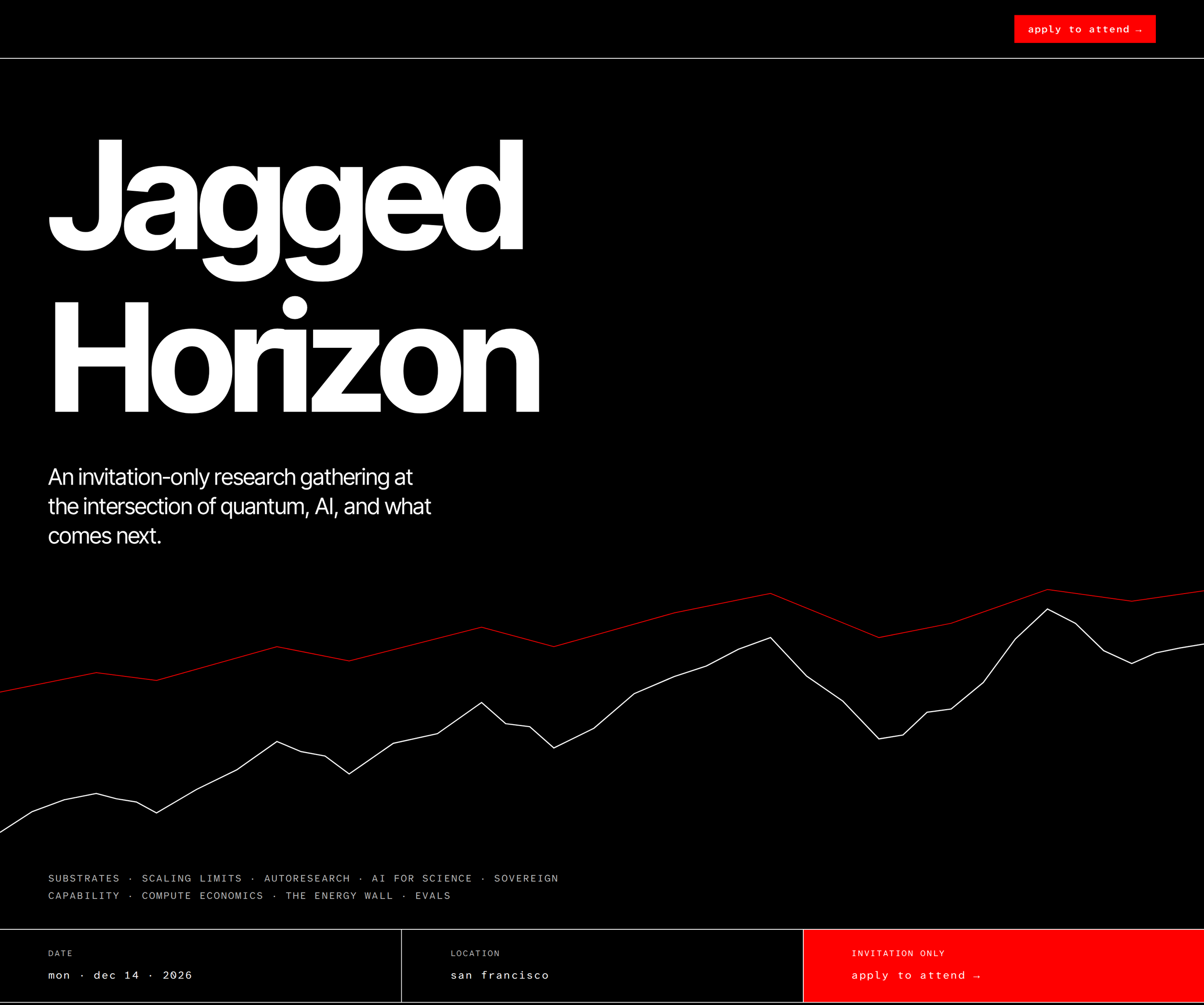
The word "jagged" describes uneven progress, and the numbers behind the energy wall explain why investors care about it. Sygaldry's funding announcement of April 2026 cites an estimated $5.2 trillion in capital expenditure needed by 2030 to meet global demand for AI, including approximately 125 GW of new power generation capacity. Those two figures explain why "compute economics" and "the energy wall" stand on the program next to "substrates." Investors now fund the search for hardware that turns a megawatt into more intelligence than a GPU cluster delivers today.
Quantum technology is uneven in the same way. Quantum sensors already work in hospitals, utility-scale quantum computers are under construction, and AI speeds up the development of both. For an investor this unevenness is useful information, because it shows which parts of the quantum stack can reach customers now and which parts need patient capital. The themes "autoresearch," "AI for science" and "evals" point to a second movement. Research groups are building systems that carry out parts of the research themselves, and they need reliable ways to measure whether the results hold. "Sovereign capability" brings governments into the picture, since states want quantum and AI capacity under their own control.
Produced by Sygaldry and Rock Yard Ventures

Sygaldry was founded in 2024 by Chad Rigetti, Idalia Friedson and Michael Keiser, and has offices in Ann Arbor, Michigan, and San Francisco. Rigetti had founded Rigetti Computing in 2013. On April 14, 2026, the company announced that it had raised $139 million, in a $34 million seed round led by Initialized Capital and a $105 million Series A led by Breakthrough Energy Ventures. In its own words, Sygaldry is "building quantum-accelerated AI servers to exponentially speed up training and inference," with servers that "combine multiple qubit types within a single, fault-tolerant architecture." Rigetti states the goal as "enabling a fundamentally more efficient way of converting megawatts into intelligence."
The company's name comes from Patrick Rothfuss's novel The Name of the Wind, where sygaldry is the craft of inscribing runes on objects to direct heat and light, as Rigetti told Fortune. With Jagged Horizon the founders bring AI researchers, drug discovery scientists, a technology journalist and a legal scholar into one room. A hardware company that convenes such a group places its own program inside a wider conversation about what AI needs next.
Rock Yard Ventures is a seed-stage venture capital firm founded and led by general partner Daniel Dart. The firm invests across the industrial base, which it describes as everything from construction, supply chain, manufacturing and energy to frontier technology such as quantum and chip design. It invests exclusively in companies based in the United States and usually writes pre-seed and seed checks. Dart holds degrees from the Massachusetts Institute of Technology and the London School of Economics, and worked at Dynamo Ventures and Alpaca VC before he started the firm. Rock Yard Ventures is one of Sygaldry's investors.
In Partnership with Six Investors
The event page lists six partners. Together they cover the road from a founder's earliest months to the customers a deep technology company eventually serves, including government.
- Y Combinator runs a three-month program for startups four times a year. Its inaugural batch in the summer of 2005 included Sam Altman, and Airbnb, Stripe and Coinbase came through later batches.
- Liquid 2 Ventures is a San Francisco seed firm with Joe Montana as managing partner. Montana moved into venture capital after his football career, and the firm reports more than 40 seeded unicorns.
- Breakthrough Energy Ventures is the venture arm of Breakthrough Energy, the platform Bill Gates founded to accelerate clean energy innovation. It led Sygaldry's Series A.
- Initialized Capital is an early-stage firm in San Francisco. Y Combinator partners, among them Garry Tan, founded it to write follow-on checks into the companies they worked with, and it became a standalone firm in 2016. It led Sygaldry's seed round.
- IQT, also known as In-Q-Tel, was set up in 1999 by the CIA as an independent, not-for-profit strategic investment firm. It now works with more than a dozen United States government partners and with the United Kingdom and Australia.
- Rackhouse Venture Capital is an early-stage firm in San Francisco that backs founders at the intersection of AI and the real world. Its founder, Kevin Novak, was Uber's first head of data science.
Five of the eight organizations on the page appear in Sygaldry's investor list: Rock Yard Ventures, Y Combinator, Breakthrough Energy Ventures, Initialized Capital and IQT. A startup program, an energy investor and a national security investor back the same hardware company. That combination tells founders that quantum hardware for AI is now financed as an energy question and a security question alongside a computing one.
The Speakers
Subham Sahoo leads a team at the Institute of Foundation Models of MBZUAI. His research laid foundations for diffusion language models, which generate text by refining a whole sequence in steps where conventional models write one token after another. His paper "Simple and Effective Masked Diffusion Language Models" appeared at NeurIPS 2024, and one week before Jagged Horizon he gives a tutorial on discrete diffusion at NeurIPS 2026 in Sydney.
Hetu Kamichetty is co-founder and Chief Technology Officer of Xaira Therapeutics. Xaira emerged from stealth in April 2024 and builds one AI platform for the path from disease biology to a medicine, under chairman and chief executive Marc Tessier-Lavigne.
Sebastian Herrera is a San Francisco-based tech correspondent at Fortune, where he covers major companies such as Amazon and Microsoft. He has covered technology for a decade and was a longtime reporter at the Wall Street Journal before he joined Fortune.
Kangway Chuang is Senior Director of Machine Learning in Computational Sciences at Genentech. A Caltech-trained chemist, he joined Genentech in 2021 and since 2025 has led the team that develops scientific reasoning models and agents for drug discovery, with a focus on autonomous design.
Michael Keiser is co-founder of Sygaldry. For eleven years his laboratory at UCSF built machine learning for drug discovery, neurodegeneration and molecular design. Chuang did his postdoctoral work in that laboratory, so the program reunites two scientists who worked together on machine learning for chemistry.
The sixth speaker is Mauritz Kop, listed for Stanford University.
What Professor Kop Brings to Builders and Investors
Mauritz Kop is the Founder of the Stanford Center for Responsible Quantum Technology (Stanford RQT) and the Stanford Quantum Incubator, and a Senior Fellow and Principal Investigator at the Centre for International Governance Innovation (CIGI). A technology lawyer, legal scholar and AI patent holder, he founded Quentir and AIRecht and co-founded Daiki. He is a Guest Professor at the U.S. Air Force Academy, a quantum ecosystem expert on the von Neumann Commission, and a Subject Matter Expert at NATO StratCom. He advises the U.S. Government, including the Pentagon and the Department of State, on quantum strategy and policy, and he teaches and conducts research at the Technical University of Munich.
Since 2018 he has argued that quantum technology needs its own law, ethics and policy before the machines are finished, and that this work belongs in a golden triangle of academia, industry and policy. He founded Stanford RQT in 2023. It was inaugurated by Mark Rutte, then Prime Minister of the Netherlands and now Secretary General of NATO, and its work informed the G7 Kananaskis quantum policy agenda. In March 2024 he started the Stanford Quantum Incubator at Stanford Law School to bring startups, spin-offs and investors to one table. He leads a Stanford initiative on quantum sensing for clinical imaging.
His publications give founders a practical vocabulary. In Science in 2025, Kop and his co-authors proposed a standards-first approach to quantum governance, with a certifiable quality management system for quantum technology that companies can adopt as they bring products to market. In War on the Rocks in July 2026, he and Joseph Federici set out the race to quantum first, which treats cryptography, quantum-AI, networks, sensing and the supply chain as one strategic effort. For the health and drug discovery scientists in the room there is Hippocratic Quantum: The Ethics of Biomedical Discovery in the Quantum Age, which Kop published at Harvard Law School's Petrie-Flom Center in February 2026.
How Quentir Reads It
Quentir reads the program as a statement about financing. A startup program, an energy investor and a national security investor stand behind one day on quantum and AI, and the eight themes list the limits that capital is now asked to move: energy, scale and time. Founders who can show how their hardware or software moves one of those limits will find investors for it in this room.
Jagged Horizon is invitation-only, and applications to attend run through the event page. Kop looks forward to meeting the builders and investors in the room, and Quentir will follow the themes of the day in its daily Insights.
Sources: Jagged Horizon event page; Sygaldry Raises $139M to Build Quantum Computers for AI (GlobeNewswire, April 14, 2026; text verified via the HPCwire reprint); HPCwire reprint of the Sygaldry release; Sygaldry company site; Rock Yard Ventures (home and team pages); Y Combinator; Liquid 2 Ventures team page; Breakthrough Energy; Initialized Capital, About; IQT, About; Rackhouse Venture Capital, About; Subham Sahoo, personal site; Xaira Therapeutics, Our Team; Sebastian Herrera, Fortune author page; Kangway Chuang, Genentech scientist profile; Keiser Lab at UCSF; Quantum technology governance: A standards-first approach, Science (2025); Before Q-Day: The Race to Quantum First, War on the Rocks (July 20, 2026); Fortune, Exclusive: Chad Rigetti's Sygaldry raises $139 million (April 14, 2026); UCSF, Training computers to think more like scientists (2019).
Published intelligence, built to inform your own decisions. Published: November 24, 2026.