
Quantum Networking Found a Utility Door in Chattanooga
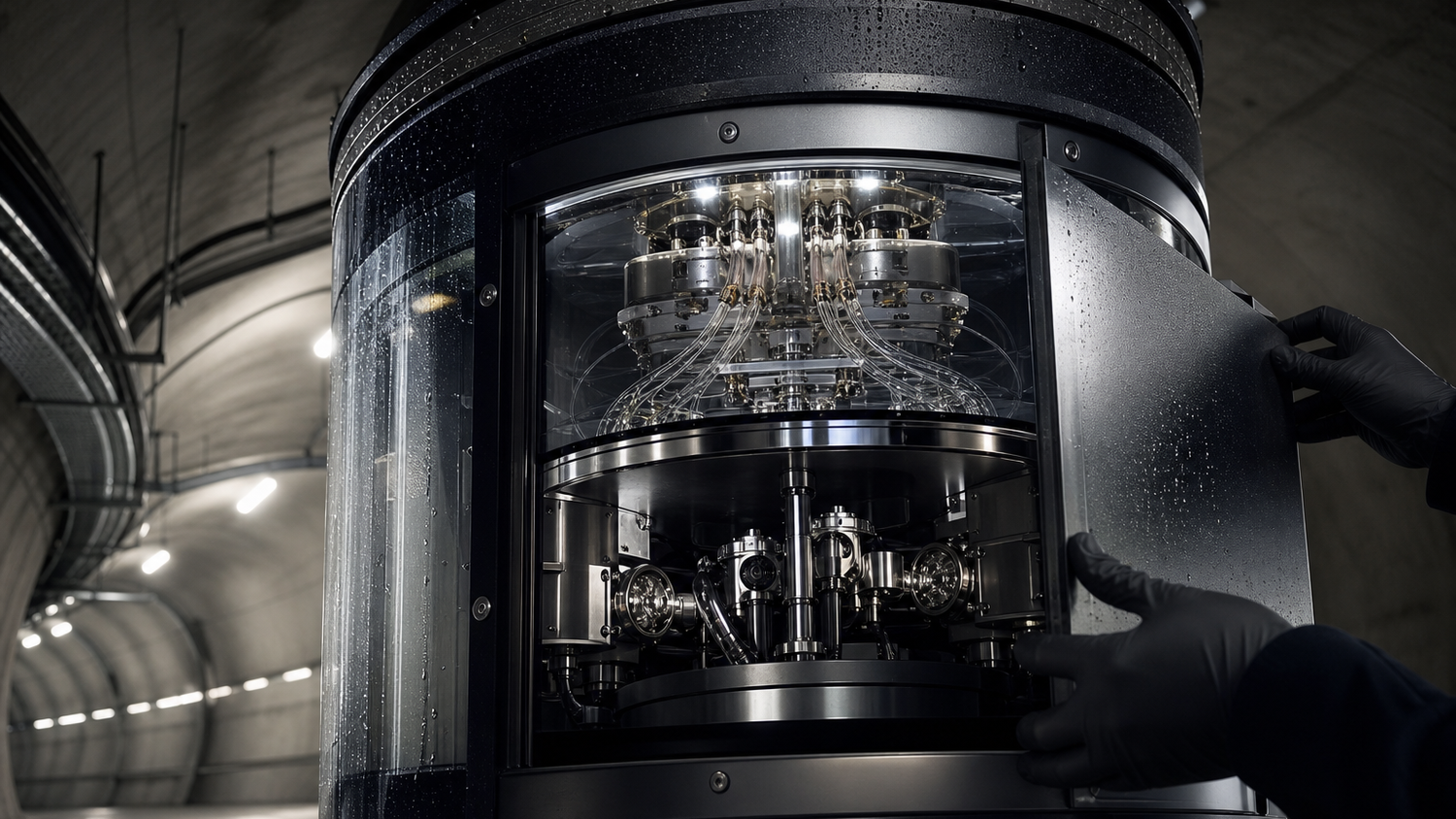
A photon crosses optical fiber badly. Distance eats the signal, temperature shifts disturb its phase, and ordinary telecom traffic can overwhelm the quantum channel. A future network needs a place to hold the quantum state while another segment catches up. That is the job of quantum memory, and it is still largely a laboratory job.
On August 3, IonQ and Chattanooga utility EPB announced an attempt to move that component into daily infrastructure. Their Tennessee Quantum Communications Research Center will sit directly on an operational fiber network. IonQ says it will commit $15 million over five years. EPB will supply the live-network test bed and act as the primary commercialization partner. The centerpiece is a commercial quantum-memory unit embedded in the network.
The announcement lands beside two research results that expose the engineering problem from opposite ends. A University of Science and Technology of China team entangled two atomic memories across 420 kilometers of fiber. Another Chinese collaboration used soliton microcombs to demonstrate the core link in an architecture designed to enable a fully connected, measurement-device-independent quantum-key-distribution network for 200 users over 200 kilometers. One result stretches a quantum link. The other attacks the number of connections. Chattanooga adds the institutional layer: a utility willing to host, operate and commercialize what comes next.
Practical takeaway. Quantum networks are leaving the laboratory through existing fiber owners. Technical performance will matter alongside access to rights-of-way, maintenance crews, customers and institutions that can carry a test into daily service.
Memory changes what distance means
Ordinary optical communication can amplify a weak classical signal. Quantum information cannot be copied and boosted in the same way. Loss therefore compounds with distance, and a direct optical link eventually becomes a poor way to distribute entanglement. Quantum memories offer another architecture: store a quantum state long enough to connect shorter segments through repeater-like operations.
The 420-kilometer experiment, accepted by Physical Review Letters, used laser-cooled rubidium memories at the two ends and single-photon interference at a middle node. The photons were converted to telecom wavelengths, while a phase-stabilization system kept the long optical paths coherent. The paper places the crossover with the PLOB bound at loss corresponding to roughly 230 kilometers; its measured 320- and 420-kilometer points exceeded that repeaterless capacity. The PLOB bound remains intact. The result shows that memory-assisted architecture can beat direct transmission once distance becomes severe.
The field portion used a pair of 10.1-kilometer deployed fibers, with laboratory fiber spools extending both paths to the longer distances. The distinction matters. The physics result is substantial, yet road works, seasonal temperature changes, network maintenance and commercial traffic remain outside its scope. EPB’s role begins where that paper stops. Its network supplies the disorder of the real world.
Two hundred users change what scale means
Distance is only one bottleneck. A network that connects every user with every other user can become unmanageable as the user count rises. Conventional designs may require precise frequency locking across a number of laser pairs that grows roughly with the square of the user population. That is tolerable for a small demonstration and punishing for a metropolitan system.
The microcomb preprint addresses that scaling burden with integrated soliton microcombs. Each user needs one frequency-locked seed laser, while the microcomb supplies many parallel frequency channels. The researchers paired that approach with measurement-device-independent QKD, which is designed so an untrusted measurement provider cannot learn the shared key through detector attacks. They experimentally tested an Alice–Bob subsystem and report an average secure key rate of 62 bits per second for that connection. The 200 frequency channels underpin the paper’s claim that the architecture can enable a 200-user fully connected network over 200 kilometers; 200 simultaneous deployed users were outside the experiment.
The number is modest beside classical broadband, but bandwidth is the wrong comparison. Key distribution carries small cryptographic secrets; movies and medical scans travel through the classical network. The more useful question is whether the optical hardware can support many independent relationships without multiplying delicate control systems beyond reason. Here, integrated photonics becomes a governance technology: it shapes who can connect, where trust sits and whether the network can grow beyond a few privileged nodes.
A utility supplies more than fiber
IonQ’s announcement describes the Chattanooga center as the first dedicated next-generation quantum-communications research laboratory connected directly to a real-world network. Company claims about “firsts” deserve attribution, especially before the facility has produced operating results. The harder fact is EPB’s institutional position. It runs energy and communications services across a 600-square-mile area, owns fiber, has local operating staff and already hosts the EPB Quantum Network and an IonQ Forte Enterprise system being prepared for commercial deployment.
That combination supplies assets a physics laboratory usually lacks: maintenance windows, service obligations, customer relationships and a reason to measure reliability over time. A fiber cut becomes an operational incident. A component that requires specialist intervention for every fault becomes a cost problem. A network that works only during a carefully staged demonstration remains research equipment.
Public-utility involvement also changes the social question. Infrastructure built around municipal rights-of-way can spread capability beyond one corporate campus, but it brings duties of transparency, resilience and fair access. The people whose streets carry the fiber will reasonably ask what the investment returns to the region. IonQ and EPB project roughly two dozen jobs and an economic effect of two to three times IonQ’s commitment; a separate University of Tennessee at Chattanooga estimate cited by the companies places the ten-year community benefit of EPB’s broader quantum assets as high as $1.1 billion. Those are forward-looking estimates, not realized outcomes.
The commercialization instrument is a place
Quantum-industry roadmaps often move from component to prototype to market as if commercialization were a final technical stage. Chattanooga suggests a less tidy sequence. The place itself is part of the instrument. EPB’s fiber, utility mandate, training relationships and public identity help determine which applications can be tried and which users can reach them.
This resembles the deployment pattern in yesterday’s Quentir analysis, where a shared web platform moved post-quantum key exchange across many domains through one upstream setting. Quantum networking depends on physical assets, yet concentration may still accelerate it. A small number of carriers, utilities and exchange points could decide which memory hardware, wavelengths, interfaces and security assumptions become operational defaults.
That prospect joins science to competition policy. A host network can lower entry costs by exposing common infrastructure to researchers and suppliers. It can also become a gatekeeper if access terms, interfaces or procurement choices favor one architecture. EPB’s commercialization role therefore deserves attention equal to the memory’s technical performance. The host can shape the market before standards settle.
How Quentir Reads It
Three simultaneous developments now form a useful sequence. The 420-kilometer result shows that stored quantum states can change the economics of loss. The 200-user microcomb architecture shows one path around the connection-management problem. The Tennessee center puts memory hardware on an operational utility network where reliability, maintenance and access can be tested.
The original connection is institutional: quantum networking may mature as electric and telecom utility infrastructure. Its decisive assets are distributed and local. Fiber routes, trusted sites, timing systems, repair capacity and permissions cannot be packaged into one machine. That makes municipal utilities, carriers, data exchanges and public research networks part of the technical stack.
For readers following this transition over time, Quentir’s All-access membership carries the archive argument: the research milestones, infrastructure deals, standards and governance consequences linked in this analysis remain available in one subscription. The public post establishes the connection; the membership adds the dated archive and refresh path.
What the next milestone will reveal
The next consequential Chattanooga announcement will probably be less dramatic than “quantum internet.” It may concern memory lifetime under field conditions, uptime across maintenance cycles, interoperability with another supplier or a service tested by an institution outside the partnership. That would be progress. Commercial infrastructure becomes credible when its ordinary operating facts are legible.
The 420-kilometer coil proved something about distance. The 200-user network proved something about connection scale. EPB now has a chance to prove something about place: whether a quantum memory can belong to a living network whose cables already serve a city. If it can, the utility door may matter more than the laboratory record.
Sources: IonQ, “IonQ and EPB Partner to Launch the Tennessee Quantum Communications Research Center” (August 3, 2026); Xi-Yu Luo, Chao-Yang Wang, Ming-Yang Zheng et al., “Entangling quantum memories over 420 km in fiber” (arXiv:2504.05660, submitted April 8, 2025), accepted by Physical Review Letters as “Entangling quantum memories through a 420 km long fiber”; Fang-Xiang Wang, Sheng-Teng Zheng, Long Huang et al., “Microcomb-driven large-scale fully connected quantum network” (arXiv:2512.17318 preprint, submitted December 19, 2025). Public-source snapshot: August 4, 2026. Company firsts and economic projections remain attributed to IonQ and EPB.
Published intelligence, built to inform your own decisions. Published: August 4, 2026.