
Science: A New Golden Age: The White House, Quantum, and the Genesis Mission
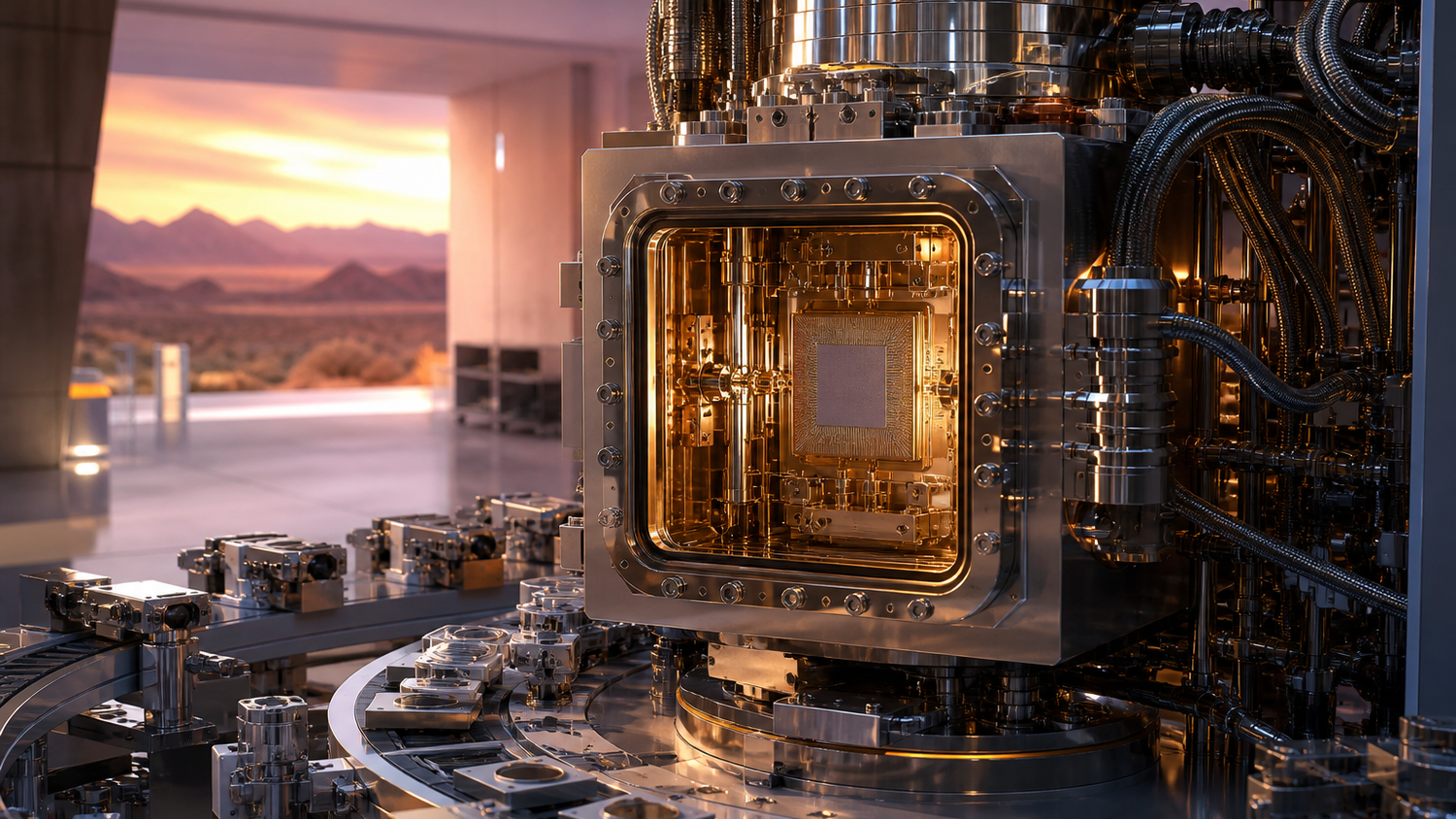
In 1969, Apollo 11’s descent computer carried less computing power than a modern pocket calculator. Its importance came from the institution around it: laboratories, contractors, test ranges, procurement authority, shared schedules and a public mission strong enough to make thousands of technical decisions point in one direction. Scientific capacity became national capability through design.
The White House Office of Science and Technology Policy returns to that tradition in Michael Kratsios’s July 2026 report, Science: A New Golden Age. The title names an aspiration. The report’s substance is institutional. As Quentir’s recent analysis of quantum verification showed, scientific speed has value only when the challenge process can keep pace. The report asks how the United States can organize science when private research budgets have grown, AI can search scientific possibility at machine speed and older funding incentives can reward incumbency more reliably than discovery.
Quantum information science is threaded through the answer. It appears as a critical technology, as a beneficiary of long-horizon public research, as a user of shared fabrication infrastructure and as a field in which academic and venture incentives pull researchers in different directions. The report’s flagship response, the Genesis Mission, may become a powerful discovery engine for quantum materials and devices. Its harder contribution could be a national method for deciding which machine-generated scientific claims deserve trust.
Practical takeaway. The Genesis Mission gives quantum a credible institutional path from AI-assisted discovery to shared facilities and national laboratories. Its durability will depend on verification capacity and coordination across the several domains that now move on the same quantum timetable.
Arena design after the linear model
The OSTP report opens with a blunt diagnosis: the linear model of public research flowing predictably into private innovation no longer describes the system. In AI and quantum, individual companies can command research resources on a scale that rivals major public instruments. Federal institutions still possess assets the market cannot readily reproduce, including national laboratories, long scientific time horizons, trusted datasets and facilities whose cost would defeat most startups.
Kratsios assigns government the role of shaping the arena while discovery remains distributed. Quantum makes that idea concrete. A young company may have a strong device idea and no cleanroom. A university group may hold a promising materials result and lack a path to repeat it at manufacturing tolerances. The report points to the National Science Foundation’s quantum and nanotechnology infrastructure, with more than 2,000 shared tools, as a way for researchers and firms to prototype semiconductor, photonic and quantum devices without building a fabrication plant first.
This is public capacity acting as a multiplier. Shared infrastructure widens the range of people who can test an idea, while private firms retain room to compete on architecture, integration and service. Quantum research infrastructure also preserves optionality. A country that sustains materials science, atomic physics, superconductivity and information theory has more routes into computing, sensing and networking than one that backs a single device forecast.
The Genesis Mission turns AI toward instruments
Executive Order 14363 launched the Genesis Mission in November 2025. The order directs the Department of Energy to build the American Science and Security Platform, connecting supercomputers, AI systems, scientific instruments and datasets. The report describes a foundation of 17 national laboratories, roughly 40,000 staff and about $20 billion in annual funding. It also records agreements with 24 private organizations announced in December 2025. Who carries the electricity cost of that platform's data centers, and how DOE's July 2026 Genesis project selections met the White House ratepayer pledge a day later, is read in Who pays for AI's electricity?
The physical connection matters. AI-for-science becomes more useful when a model can propose a material, an instrument can make or measure it, and the result can return to the model. The report points to autonomous laboratories such as Berkeley’s A-Lab and Argonne’s Polybot, along with 14 Genesis robotics and autonomy projects. These systems turn scientific search into a closed experimental loop.
Quantum has several problems suited to that loop. Materials discovery can search for better superconductors, lower-loss dielectrics and more stable interfaces. Device characterization can examine fabrication variation across many samples. Error-correction research can search large code spaces while experiments expose the noise models that matter on actual hardware. Each gain can open downstream branches across computing and sensing. AI-assisted quantum discovery is therefore a plausible early measure of whether Genesis can make instruments, models and institutions work as one system.
A generator changes the price of doubt
The report is unusually clear about the weakness inside AI-enabled science. Models learn from a literature that contains errors, irreproducible results and incentives that favor novelty. Faster hypothesis generation increases the number of claims requiring scrutiny. The cost of producing an answer can fall while the cost of establishing its reliability stays stubbornly human and physical.
OSTP describes Genesis as a “science generator” and calls for “a verifier equal in rigor and scale.” Quantum gives that sentence immediate force. Recent IBM-led experiments included statistical confidence bounds, cross-platform replication and an open-sourced classical method designed to attack one of the claimed advantages. As Quentir’s earlier analysis of those experiments argued, skepticism becomes productive when it is built into the experiment and given access to the same technical contest.
Verification at this scale is more than peer review after publication. It includes replication resources, machine-auditable packages, classical baselines strong enough to expose weak claims and rewards for disproof. In quantum computing, a classical algorithm published next month can narrow a result announced today. In quantum materials, a promising sample can fail when another laboratory repeats the fabrication. Verification capacity determines whether speed creates knowledge or a larger queue of unresolved claims.
Quantum extends the coordination problem
The National Quantum Initiative, enacted in 2018 with bipartisan support, supplies an important continuity line. The report credits it with establishing a national foundation for quantum science. Genesis adds a newer organizational form, built around AI, laboratories, data and industrial partners. The two programs meet where discovery becomes strategic infrastructure.
Mauritz Kop and Joe Federici’s “Before Q-Day: The Race to Quantum First” identifies the coordination burden outside the laboratory. Cryptography, AI, quantum networks, sensing and supply chains often sit in separate policy and procurement channels even though they increasingly share deadlines and dependencies. Genesis demonstrates how national capabilities can be joined around a mission. Quantum asks whether that method can extend across domains whose budgets, owners and measures of progress remain dispersed.
Public-private partnership is central to that extension. Quantum hardware is capital intensive, component supply is specialized and useful systems often require years of iteration. Public laboratories and shared facilities can absorb some early technical risk; private firms bring engineering speed, product discipline and routes to deployment. Procurement can create an early customer where commercial demand remains uncertain. The tradeoff is real: concentrated programs can favor familiar institutions, while fragmented markets can underprovide expensive common infrastructure. The report’s own concern about an “incumbency tax” should remain active during implementation.
How Quentir Reads It
Science: A New Golden Age is strongest when it treats institutional design as a scientific instrument. The Genesis Mission joins compute, data, laboratories and private capability around a public goal. For quantum, that architecture can shorten the distance between a materials hypothesis and a fabricated device, between a claimed advantage and an independent challenge, and between a laboratory component and an industrial supply chain.
The unresolved question is how Genesis will choose quantum problems and publish measures of progress. A mission optimized for rapid generation may favor results that are easy to count. Quantum’s most valuable advances may instead appear as lower error rates, more reproducible fabrication, stronger classical comparisons or infrastructure that lets many teams test competing architectures. Those gains need room in the scorecard.
The report also suggests a durable democratic bargain. Public institutions provide facilities, patient time and security responsibilities accumulated across decades. Markets preserve plurality and pressure ideas toward use. Open criticism protects the scientific record from the authority of the mission itself. Institutional pluralism is part of the technical design because no single actor can discover, verify, manufacture and govern the quantum stack alone.
Quentir’s Signature Brief follows this implementation layer with fixed scope, a dated source spine, an executive synthesis and refresh triggers as public programs move from announcement to operating choices. The free post keeps its focus on the central institutional connection and does not reproduce the paid edition’s decision materials.
The open test for a golden age
Genesis will be consequential if it makes the national laboratories easier to combine with frontier models, private engineering and rigorous replication. Quantum is a demanding proving ground because its science is hard, its equipment is expensive and its strategic consequences cross institutional boundaries.
The next signal will come from problem selection. If the Mission funds quantum work that joins discovery to repeatable measurement and shared access, it will create capacity that survives individual hardware forecasts. If it also gives independent verification status, resources and time, faster science may become more trustworthy science.
That would give the report’s historical analogy real weight. Apollo’s computer mattered because the surrounding institution could test it, challenge it and integrate it into a mission. The Genesis Mission now has an opportunity to build the same relationship between AI and quantum science, with the verifier present from the first experiment.
Published intelligence, built to inform your own decisions. Published: August 5, 2026.
Sources: Michael Kratsios, White House Office of Science and Technology Policy, Science: A New Golden Age — A Report to the President (July 2026); Exec. Order No. 14363, “Launching the Genesis Mission,” 90 Fed. Reg. 55035 (November 28, 2025); Mauritz Kop and Joe Federici, “Before Q-Day: The Race to Quantum First,” War on the Rocks, Cogs of War (July 20, 2026). Public-source snapshot: August 5, 2026.
Published intelligence, built to inform your own decisions. Published: August 5, 2026.