
Hospital Mortality Fell. Was It the Score or the Response Team?
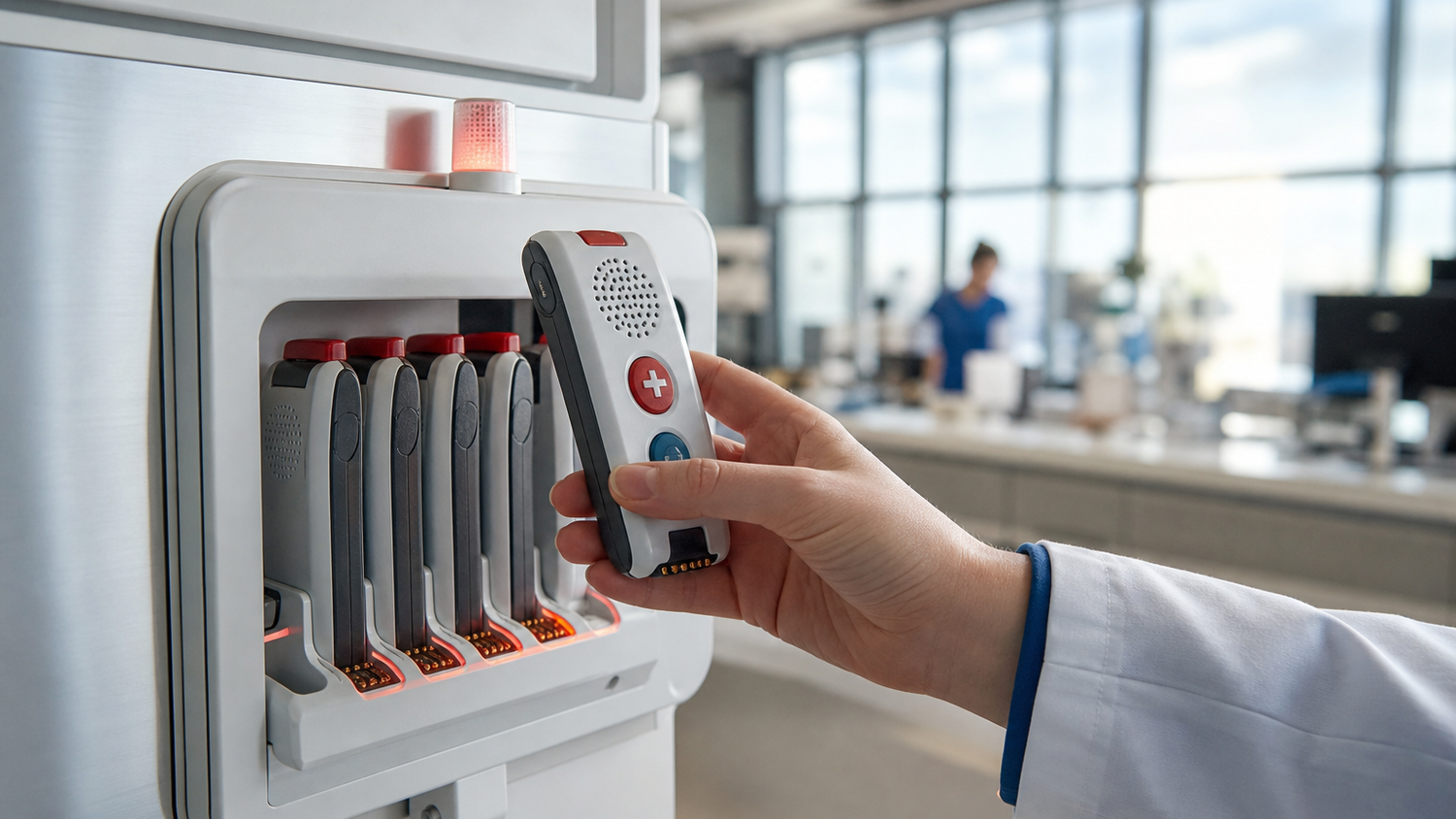
On a hospital ward, an alarm has to cross several boundaries before it can help anyone. A patient’s vital signs enter the electronic record. Software assigns a risk score. A message reaches a clinician who is already carrying other patients. Someone decides whether to examine the patient, call for help or wait for the next observation. The final decision happens at a bedside, where delay has a human cost.
A new NEJM AI study published July 24, 2026 reports a striking result from that chain. Across 11 New Jersey hospitals, a program built around the Epic Deterioration Index was associated with lower in-hospital mortality among adult medical-surgical patients whose score reached 60. The number that should hold our attention, however, is not only the model output. The alert only mattered because the hospital changed what happened next.
Practical takeaway. A hospital AI outcome belongs to the full clinical system: model, threshold, routing rule, response team, staffing, training and bedside judgment. A favorable before-and-after result can justify attention without proving that the underlying score is the best available predictor.
What did the intervention actually change?
The study followed 23,132 patients with an Epic Deterioration Index score of at least 60 during a staged pre-post program from October 2022 through August 2024. In the intervention period, crossing the threshold automatically paged a rapid-response team. Hospitals also tuned alerts during the pilot, educated clinicians and maintained a standing critical-care response capability. Rapid-response activations among eligible patients rose from 25.3% to 37.5%.
Unadjusted in-hospital mortality fell from 23.1% to 18.6%. After adjustment, the reported odds ratio was 0.82. Transfers to higher-acuity care stayed close to 1% in both periods, which argues against a simple story of indiscriminate ICU escalation. The authors are careful about design: this was a quasi-experimental before-and-after study, not a randomized trial. Patient mix, practice and other conditions may have changed over time. The result supports the response-team intervention as a promising bundle. It cannot assign the outcome to the score alone.
A weaker score can still anchor a better system
That distinction becomes sharper when the NEJM result is read beside a 2024 JAMA Network Open comparison. Dana Edelson and colleagues tested six early-warning scores across 362,926 encounters at seven Yale New Haven Health hospitals. eCART had the highest area under the receiver operating characteristic curve, 0.895. The publicly available National Early Warning Score reached 0.829. Epic’s index reached 0.808, ahead of only the Modified Early Warning Score in that six-model comparison. The disclosure matters: Edelson reported an equity interest in AgileMD and an eCART patent with royalties paid by the University of Chicago; coauthor Matthew Churpek reported an eCART patent with royalties from the university.
Timing also differed. At matched high-risk thresholds, eCART gave a median 11 hours of lead time, NEWS eight hours and the Epic index one hour. Those figures do not invalidate the New Jersey outcome. The studies asked different questions in different health systems. One compared predictive performance retrospectively; the other observed what happened after a hospital network linked one threshold to a named response. A model score is one component in a care pathway. Better discrimination may create more useful warning time, while better routing may convert a less impressive score into action.
The regulator sees software; the patient meets an institution
The Food and Drug Administration’s January 2026 final guidance on clinical decision support software clarifies when software intended for health professionals falls under device oversight. The JAMA authors wrote that systems which identify deterioration and alert a clinician fit that regulated class, while noting in 2024 that only a small number of such products had obtained clearance. FDA classification turns on intended use and statutory criteria; a journal outcome study does not itself settle a product’s regulatory status.
Patients encounter a wider institution than the regulated software object. They encounter the nurse who receives the page, the rapid-response team’s availability, local staffing levels, the threshold chosen by the hospital and the possibility of alert fatigue. They also bear the cost of missed deterioration and false alarms. This is where medicine, software law and organizational design converge. The workflow efficacy and model discrimination questions have to remain separate long enough to understand both.
What performance tables miss
Area under the curve is useful because it permits comparison over many thresholds. It does not reveal whether a page reaches the right person during a crowded shift, whether clinicians trust it or whether the response team has authority to intervene. A before-and-after mortality result captures the deployed pathway, yet it may hide which element carried the improvement. Each study sees something the other cannot.
There is also a market question. Hospitals often buy models inside larger electronic-record relationships, where integration may outweigh a small performance difference. A familiar score can be easier to route, maintain and teach. That convenience has value, but it can harden a local choice before independent comparative research arrives. The public JAMA benchmark appeared years after early-warning systems had become common. Procurement cycles, clinical habits and technical interfaces do not pause while the literature catches up.
How Quentir Reads It
Quentir reads the two studies as a warning against awarding the full result to either software or people. The New Jersey program deserves serious attention because mortality moved in the favorable direction across a large hospital network. The Yale comparison deserves equal attention because it shows large differences in discrimination, false alarms and warning time. The governance object is the deployed clinical system. Its performance includes the algorithm, the handoff and the institution that receives it.
This is the same institutional pattern visible when a brain implant entered the insurance system: a technical object acquires practical meaning through approval, hospital capability, payment and continuing care. Quentir’s All-access membership carries the archive surrounding that question across AI deployment, medical governance and technical assurance in one subscription. The current post stays at the level of the public studies; it does not reproduce a paid product’s fixed scope, checklist, refresh triggers or internal-use license.
The next study has two jobs
The unresolved comparison is now unusually concrete. A strong future study would need to preserve the New Jersey program’s operational realism while comparing alternative scores inside the same response design. That would separate the value of the paging pathway from the predictive value of the model more cleanly than either current paper can.
Until then, the honest conclusion is double-sided. The intervention appears to have helped patients, and the underlying score performed weakly against several alternatives in a different hospital system. Local success does not erase comparative weakness. Comparative weakness does not erase a favorable clinical outcome. The tension is the finding, and it will shape how hospitals, regulators and vendors describe the next generation of bedside AI.
Sources: Thomas A. Nahass et al., “Implementation of an AI-Triggered Rapid Response — Association with Mortality”, NEJM AI (July 24, 2026); Dana P. Edelson et al., “Early Warning Scores With and Without Artificial Intelligence”, JAMA Network Open (October 15, 2024); U.S. Food and Drug Administration, “Clinical Decision Support Software”, final guidance (January 29, 2026). Public-source snapshot: July 31, 2026.
Published intelligence, built to inform your own decisions. Published: July 31, 2026.