An Author of D-Wave's 2025 Advantage Paper Simulated All Four of Its Graph Topologies Classically: What Roeland Wiersema Published on 1 September 2026, and the GPU Hours It Took
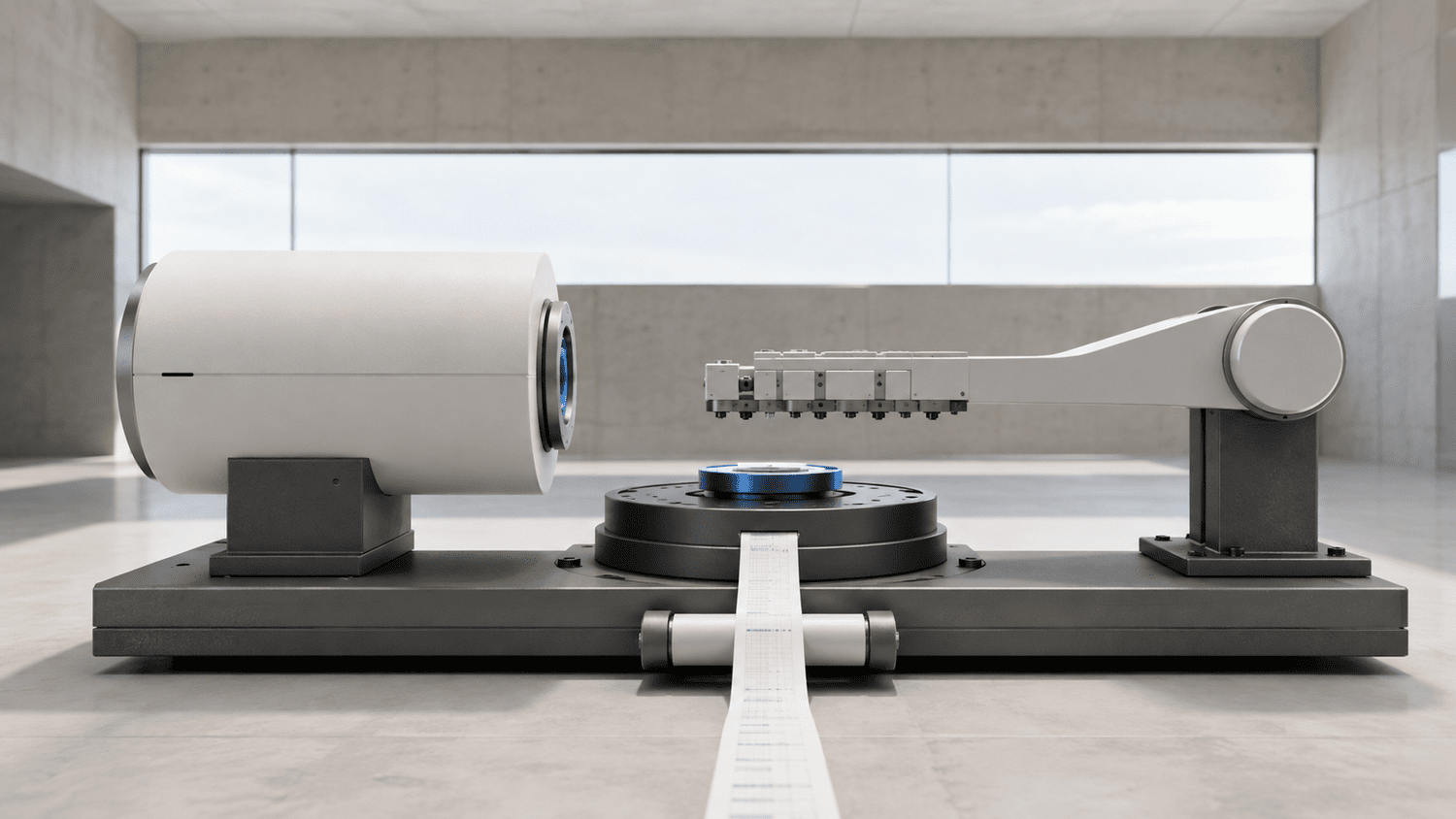
The first tide-predicting machine was designed by Sir William Thomson, later Lord Kelvin, and made in 1873. It summed ten of the principal tidal constituents by turning a crank. The United States Coast and Geodetic Survey finished its own machine number two in 1910, designed for thirty-seven constituents, and the National Oceanic and Atmospheric Administration records that American tide predictions have been made by electronic computer since 1966. Special-purpose hardware held the tide problem for most of a century. General-purpose computation took it back, and the machines were never shown to have been wrong about a single tide.
Quantum computing is running a version of that argument on a much shorter clock, and this week it produced an unusual document. On 1 September 2026 Roeland Wiersema, working at the Flatiron Institute's Center for Computational Quantum Physics, published a classical simulation covering all four problem graphs of D-Wave's 2025 quantum advantage experiment. Wiersema is the fifth of the sixty-two authors on that original experiment. One of the people who made the claim has now published the classical work that narrows it, and has priced his own result while doing so.
Practical takeaway. A quantum advantage claim is a claim about the state of everyone else's methods, so its shelf life depends on how fast those methods move. Ask which classical baseline a vendor measured against, on what date, who has published against it since, and what those answers cost to run. In this case the baseline has moved repeatedly over eighteen months, and part of the movement came from inside the original author list.
What D-Wave Published in March 2025, and What the Press Release Estimated
The science was a simulation of quantum dynamics in disordered magnets. Andrew King and sixty-one coauthors ran quench dynamics of spin glasses on an Advantage2 annealing processor and compared the machine's samples against classical methods, reporting that tensor-network and neural-network approaches could not reach the same accuracy in a reasonable time. The paper, Beyond-classical computation in quantum simulation, was posted to arXiv in March 2024 and published in Science 388, 199 to 204, on 12 March 2025.
The company's announcement the same day translated the result into numbers a board could repeat. D-Wave estimated that the simulation took minutes on the quantum processor and would have taken the Frontier supercomputer at Oak Ridge nearly a million years, and that running it classically would have consumed more than the world's annual electricity. Both figures are the company's estimates, and the release does not publish the calculation behind them. Chief executive Alan Baratz set the terms plainly: "All other claims of quantum systems outperforming classical computers have been disputed or involved random number generation of no practical value."
Who Answered, and When: Two Preprints in the Same Week, One From D-Wave, Two in 2026
Because the experiment had been on arXiv for a year, classical groups were already working when the Science version appeared. On 7 March 2025 Joseph Tindall, Antonio Mello, Matt Fishman, Miles Stoudenmire and Dries Sels posted lattice-specific tensor network simulations of the same spin-glass models, using belief propagation to carry the entanglement generated during the evolution, and reported state-of-the-art accuracy with modest computational resources in two and three dimensions. That paper was published in Science 392, 868 to 872, in 2026. On 11 March 2025 Linda Mauron and Giuseppe Carleo posted a variational Monte Carlo simulation reporting correlation errors below seven percent for systems up to 128 spins on the diamond lattice, with polynomially scaling resources.
Two further papers followed. In August 2025 Alberto Nocera, Jack Raymond, William Bernoudy, Mohammad Amin and Andrew King, working from D-Wave, published an evaluation of classical simulations using the processor itself. In 2026 Dries Sels published a truncated Wigner treatment of biclique spin glasses, the topology the tensor-network methods handle least well. Counting the vendor's own evaluation separately, four external papers have now worked the same ground.
What Wiersema Reports for the 72-Spin Biclique, and Where the Method Still Stops
The original experiment ran on four problem graphs. Three are geometrically local: a two-dimensional cylinder, a three-dimensional dimer lattice, and a diamond lattice. Tensor networks are built for that kind of locality. The biclique graph is a different animal, since every spin on one side connects to every spin on the other.
Wiersema's paper covers all four topologies at anneal times of 7 and 20 nanoseconds, using time-dependent variational Monte Carlo with a path-factorized correlator state. For the system sizes where converged matrix-product-state reference data exists, he reports final two-spin correlation errors on par with the processor. On a 72-spin biclique instance he reports a relative two-spin correlation error of about 7.6 percent against the processor's own data, which he calls reasonable given the noise of the processor, and he notes that no other variational method is known to produce a correct state at that scale. He also runs a 128-spin diamond instance in the harder 20 nanosecond regime to show the approach scales.
The technical content is a set of numerical repairs, and it is the reason the result exists. Wiersema identifies three failure modes that had been degrading simulations of this kind: Markov chains that mix too slowly once the system enters the glassy regime, local-energy estimators whose variance swamps the signal, and error estimates from the stochastic integrator that dominate the embedded error. He addresses them with parallel tempering, blurred sampling, and an importance-weighted adaptive integrator.
What the Simulation Cost: Hundreds of GPU Hours Against Seconds on the Processor
The paper prices its own result. "Our calculations show that the correlations of selected two-spin observables can be reproduced classically at an error level of on par with the QPU, albeit at significant computational costs," Wiersema writes. "In particular, our simulations took hundreds of GPU hours, whereas the QPU obtains the same results in seconds."
He is equally direct about the ceiling. The dominant expense is solving a dense linear system whose parameter count grows with the square of the number of spins, so the total cost climbs steeply, and extrapolating the present implementation to the largest instances of the original experiment stays prohibitively expensive. An entire class of instances is left untouched, and he says so. His summary sentence is worth quoting exactly: "These findings sharpen, rather than settle, the question of quantum advantage."
The acknowledgments carry the detail that gives the paper its character. Wiersema thanks Wladislaw Krinitsin and Markus Schmitt for identifying a methodological flaw in an earlier version of the simulations, Andrew King and Jack Raymond of D-Wave for discussions during the completion of the work, and Joey Tindall for comments on the final draft. Everyone with a stake in the answer is named in the same paragraph.
How Quentir Reads It
The governance question underneath this is who is qualified to test a performance claim, and the answer here is uncomfortable for the usual model. No regulator examined this claim. No procurement body commissioned a bake-off. The correction came from the published literature, and one of its sources was an author of the original paper who had moved to a research institute and kept working on the problem. A field organized this way corrects itself on a timescale of months, and a buyer who waits for an external authority to arbitrate will wait longer than the technology takes to change.
The procurement consequence is narrower than the physics debate. Nothing here shows that the annealer stopped working or that its samples were wrong. The machine still returns in seconds what a well-equipped classical group needs hundreds of GPU hours to approach, and Wiersema's own comparison covers selected two-spin observables at tested sizes, so it does not settle the broader cost question, which would also have to account for hardware, queueing, calibration, sampling volume and energy. What has narrowed is the strongest reading of the 2025 claim. For the observables and instances tested, the classical side is expensive and possible.
The same discipline shows up across the field. It is what we saw when a claimed quantum attack on the lattice mathematics under ML-KEM was refuted within weeks of being posted, and when IBM built the skeptics into the design of its own experiment. Claims in this field arrive with their correction already in motion, and the useful diligence question is how far that motion has run for the specific claim in front of you.
Our Signature Report No. 3: Quantum-AI Convergence 2026 holds this in a form a committee can use: the advantage claims of the past two years with their published answers attached, each with its date and its authors, so a reader can see which claims have been tested and which have not been looked at yet. The public analysis on this site stays open to anyone starting from scratch.
The next checkable item is narrow. Wiersema left the plus-or-minus-one instances of the original experiment open and said so, and the largest instances remain out of reach of his implementation. The question to ask in March 2027 is whether either boundary moved, and who moved it.
Published intelligence, built to inform your own decisions. Published: 3 September 2026.
Sources: Roeland Wiersema, "Numerical simulation of D-Wave's quantum advantage experiment with time-dependent variational Monte Carlo", arXiv:2609.01719, Center for Computational Quantum Physics, Flatiron Institute, 1 September 2026, for the four topologies, the 7 and 20 nanosecond anneal times, the relative two-spin correlation error of about 7.6 percent on the 72-spin biclique instance, the 128-spin diamond instance, the three numerical failure modes and their repairs, the cost of hundreds of GPU hours against seconds on the processor, the instances left open, and the acknowledgments. Andrew D. King and sixty-one coauthors, "Beyond-classical computation in quantum simulation", arXiv:2403.00910, March 2024, published in Science 388, 199-204 on 12 March 2025; Wiersema is the fifth author of that paper. D-Wave Quantum Inc., "Beyond Classical: D-Wave First to Demonstrate Quantum Supremacy on Useful, Real-World Problem", 12 March 2025, for the company's Frontier and electricity estimates and the quotation from Alan Baratz; both figures are company estimates and the release publishes no calculation for them. Joseph Tindall, Antonio Mello, Matt Fishman, Miles Stoudenmire and Dries Sels, "Dynamics of disordered quantum systems with two- and three-dimensional tensor networks", arXiv:2503.05693, submitted 7 March 2025, published in Science 392, 868-872 (2026). Linda Mauron and Giuseppe Carleo, "Challenging the Quantum Advantage Frontier with Large-Scale Classical Simulations of Annealing Dynamics", arXiv:2503.08247, 11 March 2025. Alberto Nocera, Jack Raymond, William Bernoudy, Mohammad H. Amin and Andrew D. King, "Evaluating classical simulations with a quantum processor", arXiv:2508.15759, August 2025, the evaluation published from D-Wave. Dries Sels, "Truncated Wigner dynamics of biclique quantum spin glasses", arXiv:2606.20187, 2026. The tide-predicting machine dates, constituent counts and the 1966 transition to electronic computers come from the National Oceanic and Atmospheric Administration, "Tide Predicting Machines". Public pages checked 3 September 2026.
Published intelligence, built to inform your own decisions. Published: September 3, 2026.