A Hybrid Quantum Classifier Learns to Vouch for Radar Satellites
Quentir Defense Monitor
Evidence-based insights for quantum defense and security. Published by Quentir Systems LLC · August 21, 2026.
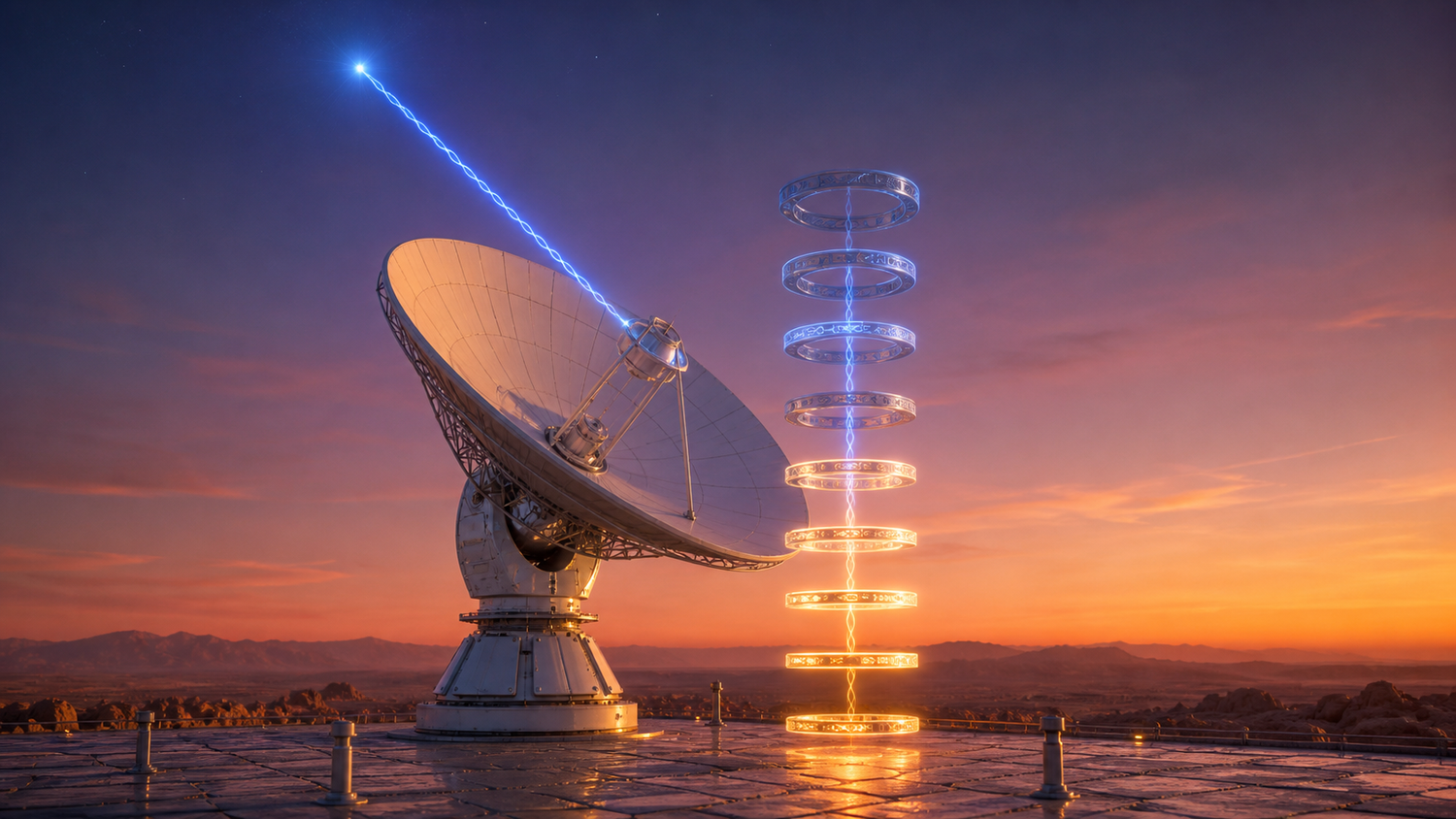
A radar imaging satellite illuminates the world with microwave pulses, and a receiver has remarkably few independent ways to confirm that a given pulse train really came from the spacecraft it claims. A research team spanning King Abdullah University of Science and Technology and the University of Pisa has now shown that a hybrid quantum-classical neural network can authenticate the illumination emissions of commercial radar satellites from their hardware imperfections alone, and can reject the majority of spoofed emissions thrown at it. The system listens to the illumination waveform the way a bank teller studies a signature: the involuntary quirks of the hand that wrote it matter more than any payload, because these pulses carry no imagery data.
In a paper posted to arXiv on August 20 and submitted to the NDSS 2027 security symposium, Vincenzo Sammartino, Nathanael Denis and Roberto Di Pietro describe QUASAR, a classifier developed from a 3.76-terabyte corpus of raw X-band SAR illumination-pulse recordings captured from 37 operational ICEYE synthetic aperture radar satellites over 28 days. The experiments used a representative 10 percent subset yielding 2,021 balanced instances per classifier. The architecture pairs a conventional convolutional encoder with a simulated eight-qubit variational quantum circuit. On held-out test data the hybrid reached 96.9 percent authentication accuracy against 89.4 percent for the CNN-only architectural ablation, and it matched the classical baseline while training on a tenth of the data.
The task the paper mechanizes has a long lineage in military radio: deciding, from the physics of a received waveform, which transmitter produced it. That craft is called radio-frequency fingerprinting, and it sits inside the electronic warfare tradition of emitter identification. What is new here is the band, the platform and the machinery: an X-band spaceborne emitter, vetted by a quantum circuit, at accuracies that begin to look operationally interesting.
A satellite's word, taken on trust
Synthetic aperture radar builds images by emitting microwave pulses and processing the echoes, which lets it see through cloud and darkness alike; NASA's Earthdata program maintains a clear technical backgrounder on the technique and its frequency bands. The X-band around 9.65 gigahertz, where ICEYE transmits its illumination pulses, delivers the fine resolution that makes commercial SAR militarily relevant. ICEYE's own constellation documentation advertises persistent surveillance of military sites, border monitoring and maritime domain awareness among its government applications, alongside insurance and disaster response work. The resulting imagery can flow directly into decisions: where a flood relief convoy goes, which port a navy watches, what a targeting cell believes about a contested coastline. QUASAR, however, authenticates the illumination pulses rather than the separate data downlink that carries that imagery.
The paper addresses a physical attribution question: is the source of a received illumination waveform the spacecraft it claims to be, or a repeater, a drone or a hostile emitter imitating it? Physical-layer authentication answers from the waveform itself. Every amplifier chain and oscillator leaves involuntary distortions in the transmitted signal, stable enough to identify the individual radio and hard for an impostor to reproduce faithfully. The approach matured at terrestrial frequencies below 6 gigahertz, on Wi-Fi and internet-of-things hardware. The authors argue that existing deep learning fingerprinting models capture the phase nonlinearities of high-frequency satellite hardware poorly, leaving X-band SAR illumination emissions without a demonstrated guard. Those emissions and the satellite's X-band data downlink use fundamentally different waveforms, so a fingerprint learned from one cannot authenticate the other.
The defensive stake is narrower than imagery-chain protection but still concrete. A receiver that checks an emitter's illumination-pulse fingerprint can flag an attempted imitation of a learned satellite signal. It does not authenticate the imagery downlink, validate an image's contents or stop fabricated pixels before they reach an analyst.
Quantum pillar: computing (electronic warfare processing). Use posture: defensive. Technology readiness: TRL 4 of 9. The classifier was validated retrospectively on 28 days of real recorded satellite illumination pulses in a laboratory setting, while its quantum circuit still runs in classical simulation and no live operational receiver has fielded it.
Eight qubits in the receiver chain
QUASAR's front end is familiar. Raw in-phase and quadrature samples are converted into 224 by 224 pixel spectrograms, and a stack of convolutional blocks compresses each into a 256-value latent vector. That representation is then projected into eight complex components for qubit encoding. The quantum circuit uses eight qubits arranged in four strongly entangling layers, each layer applying parameterized rotations to every qubit followed by a ring of CNOT gates. The circuit follows the standard template documented in the PennyLane library, the framework the authors used to build it. Their design choice with the most measurable payoff is the encoding: the projected components preserve amplitude and phase information for the circuit, a scheme the paper calls IQ-native and credits with 2.2 percentage points of accuracy over conventional angle embedding. The resulting features fuse into a 72-value vector, and a linear head renders the verdict.
The evidence behind the verdict is unusually physical for a quantum machine learning paper. The team fielded two physically separate USRP X310 software-defined receiver units, with a directional antenna and a microwave mixer downconverting the 9.65 gigahertz carrier to an intermediate frequency their digitizers could swallow. Twenty-eight days of collection across 37 satellites of a working commercial constellation produced the 3.76-terabyte corpus, and a representative tenth of it supplied 2,021 balanced instances per classifier for the reported experiments.
The adversarial results are the ones a program office should read twice. Against replayed recordings of genuine illumination pulses the system rejected 89.7 percent of attempts; against adversarially crafted IQ injections, 94.1 percent; against a simulated spaceborne spoofer matched in orbit and power, 81.3 percent. Those rejection rates were produced with the more conservative angle-encoding variant, so the authors expect IQ-native encoding to make them a floor rather than a ceiling; attack detection was not rerun with that encoding.
What stands between this result and a program office
The honest caveats begin with the word quantum. The eight-qubit circuit ran in classical simulation on ordinary hardware, as the paper states plainly, and a circuit of that size can be simulated exactly. Today QUASAR is therefore best read as an unusually structured neural network whose quantum-inspired branch demonstrably earns its place, rather than as evidence that a quantum processor adds value to signal authentication. Whether the architecture keeps its edge when the circuit grows past classical simulability, or when it runs on noisy physical qubits, is exactly the question the current result cannot answer. The venue matters too: the paper is under submission, so the numbers have yet to survive peer review.
The scope caveats are just as concrete. The published system trains one binary one-vs-rest classifier for each of all 37 satellites. Twenty-eight satellites achieve a 1.00 hit rate, while nine perform worse and X14 falls to 0.25, variation obscured by the aggregate 96.9 percent result. Satellite hardware also drifts over a mission lifetime, so any fielded version needs periodic re-enrollment, which the authors plan to address with transfer learning. And the capture campaign, thorough as it was, recorded one polarization channel from one constellation in one location; geographic robustness and transfer across satellite families remain open.
Who gains is nonetheless clear. This is a defensive capability in the plain sense: it helps establish the physical identity of a satellite producing observed SAR illumination pulses, and the operators best placed to adopt it are commercial SAR constellations and government receivers monitoring their emissions. The same fingerprinting craft pointed outward becomes emitter identification of an adversary's platforms, which is why this publication files the work under electronic warfare processing, yet nothing in the published system performs that offensive task. The readiness picture is equally plain: retrospective validation on real recorded illumination pulses places the work at the laboratory validation rung, with three visible steps ahead of it. Watch for consistently strong identification across every satellite in a constellation, for a version executed on physical quantum hardware, and for trials across operating receiver sites. Any one of those would move satellite illumination-pulse authentication from a strong paper toward a procurable capability, and the first operator to field it buys a quiet advantage: a receiver that can distinguish learned satellite emitters from a well-equipped impostor before false attribution reaches a decision maker.
Sources
Primary source: Vincenzo Sammartino, Nathanael Denis and Roberto Di Pietro of King Abdullah University of Science and Technology and the University of Pisa, "QUASAR: A Quantum-Classical Neural Network for SAR Satellite Physical-Layer Authentication," arXiv:2608.20240, August 20, 2026. Other material from NASA Earthdata's synthetic aperture radar backgrounder, ICEYE's constellation documentation and the PennyLane library documentation of the strongly entangling layers template.