A Numerical Model Maps Spectral-Phase Correlation in a Xenon-Filled Fiber from Telecom to Ultraviolet
Quentir Defense Monitor
Evidence-based insights for quantum defense and security. Published by Quentir Systems LLC · August 27, 2026.
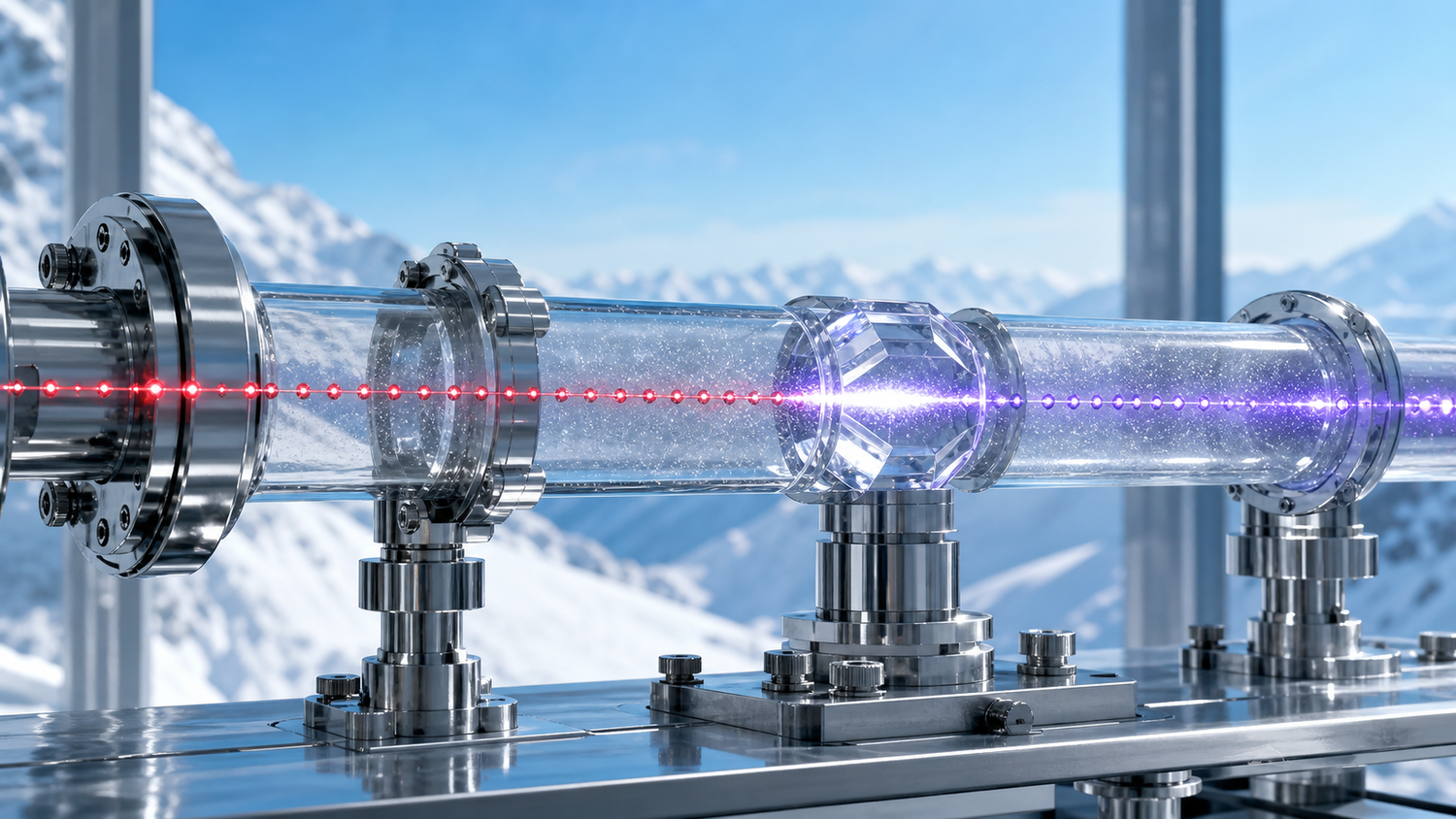
The quantum devices a military network planner would most like to connect often refuse to speak one another's colors. Trapped ions, atomic quantum memories, optical clocks and Rydberg-atom receivers absorb and emit light in the visible and ultraviolet bands, while the fiber that would carry their signals across a base, a fleet or a continent transmits best near 1550 nanometers, the telecom band where loss is lowest and the installed infrastructure already exists. Quantum-network architectures that connect devices operating at mismatched wavelengths therefore need translators at selected interfaces: devices that take light at one wavelength and re-emit it at another without corrupting the quantum information it carries.
A team from UCLA, SLAC National Accelerator Laboratory, the University of Rochester and the University of Ottawa has now mapped, in detail, how one candidate translator behaves in a classical numerical model. Their study, published in Advanced Photonics Nexus as "Tunable phase-coherent FWM for quantum wavelength interconnects" and first posted to arXiv in December 2025 by Hao Zhang, Yang Xu, Linshan Sun, Wei Cui, Robert W. Boyd and Sergio Carbajo, simulates four-wave mixing inside a xenon-filled hollow-core capillary fiber at room temperature. In the scheme, an incoming signal pulse rides through the gas-filled core together with a strong intermediary laser pulse, and the nonlinear response of the xenon converts the signal to a new wavelength. The headline result is that the calculated spectral phase of the output can correlate with that of the input above 0.99 under favorable operating conditions. This is indirect evidence of phase-coherent conversion in the model, not a demonstrated quantum-state conversion or measurement of quantum-state fidelity.
Phase is one of the quantities that matter when moving quantum information rather than light alone. A photon's phase structure carries coherence on which superposition and entanglement can depend, and a converter that scrambles phase unpredictably can destroy encoded information. Preserving phase is therefore a necessary test for quantum wavelength conversion hardware that hopes to sit inside a network, but it is not sufficient validation: amplitude and mode mapping, added noise, loss and preservation of the encoded degree of freedom must also be measured. This study subjects its simulated fiber to the phase test across wavelength gaps that separate today's quantum devices from today's installed fiber.
Three Conversion Paths Through One Gas-Filled Fiber: What Zhang, Boyd and Carbajo Simulated
The team modeled three conversion scenarios, each chosen because it bridges real hardware to the telecom band. The first converts infrared light at 1030 nanometers to ultraviolet light at 343 nanometers. The second takes telecom-band light at 1550 nanometers to deep ultraviolet at 308 nanometers. The third takes the same telecom-band input to visible light at 516 nanometers. These pairings matter because they connect fiber-compatible wavelengths to the bands where optical clocks, trapped-ion processors, Rydberg-atom platforms and rare-earth quantum memories actually operate.
Rather than optimizing conversion efficiency alone, the authors tracked how faithfully the phase profile of the input pulse survived translation to the output. They imposed known phase structures on the simulated input, including linear patterns and two forms of quadratic modulation, then computed the correlation between input and output phase after conversion. Across a wide range of operating conditions those correlations exceeded 0.95, and in favorable regimes they rose above 0.99. Spectral-phase correlation peaked when the intermediary pump pulse carried relatively low energy and narrow bandwidth, conditions under which the nonlinear medium translated the modeled signal with very little phase distortion.
The study also quantified what a network engineer would call the cost side of the ledger. Conversion efficiencies varied with the imposed phase profile and reached 28 percent for the infrared-to-ultraviolet path, 8.4 percent for telecom-to-ultraviolet, and 11.3 percent for telecom-to-visible under negative-quadratic modulation, compared with 10.8 percent under linear modulation for that third path. Efficiency generally rose as pump energy and bandwidth grew. The catch is that the same increases strengthen nonlinear effects inside the fiber, which broaden the spectrum and reshape the phase of the light, degrading exactly the property the converter is intended to protect. The telecom-to-visible path proved the most forgiving, holding high phase correlations across much of the tested parameter range, while the telecom-to-ultraviolet path lost correlation quickly as energies climbed. The tradeoff is now mapped: a designer can read off the pump settings that balance how much light gets through against how well the modeled phase structure is retained.
Quantum pillar: networking (entanglement distribution and repeaters). Use posture: dual-use. Technology readiness: TRL 2 of 9. The conversion stage exists as a validated numerical model rather than as bench hardware, and no quantum-state measurement has been performed, so every spectral-phase correlation and efficiency figure is a simulation result that a laboratory demonstration still has to confirm.
Why Phase-Preserving Conversion Decides Whether Entanglement Crosses a Long Fiber Network
The reason a defense reader should care about a fiber simulation sits in quantum-network architectures that connect visible- or ultraviolet-wavelength memories to telecom fiber. Photons cannot be amplified the way classical signals can, so long-haul entanglement distribution can rely on repeater nodes that store quantum states in memories while entanglement is established segment by segment. Many candidate memories are atoms and solids that work at visible or ultraviolet wavelengths, while the segments between them may use telecom fiber. Nodes at those boundaries therefore require a wavelength interface, and if that interface leaks phase, it can damage the entanglement the chain exists to deliver. The U.S. Department of Energy's quantum internet blueprint makes the dependency explicit: its fourth and furthest milestone, extending entangled networks between states, is the one it hangs on quantum repeaters, and repeaters coupling such memories to telecom fiber may require the kind of translation this study models.
What would a working interconnect let a force do or stop? On the defensive side, entanglement-based quantum key distribution can establish keys for use by a separate authenticated encryption system, with eavesdropping attempts detected statistically through the protocol's checks. A phase-faithful converter could let such links use existing fiber between command sites instead of requiring exotic point-to-point links. DARPA's QuANET program is already probing the near end of this space, asking whether quantum links can be blended into classical network infrastructure at metropolitan scale, precisely because hybrid networks are the form in which any of this reaches an operator first.
The posture is dual-use in the plain sense of the capability map. The identical converter could serve a civilian quantum internet testbed and a military key-distribution backbone, and it could enable secure communication for whoever installs it. Nothing in the physics favors the attacker or the defender; ownership of the infrastructure decides who gains.
The Distance Between a Simulation Study and Hardware a Program Office Could Buy
The honest reading of this work starts with what it is. The results are numerical simulations of classical pulse propagation, validated against the known physics of gas-filled fibers, and the authors state that direct quantum-state measurements were not performed. The gap between the two matters at the single-photon level, where a converter must add almost no noise of its own. Pump lasers in nonlinear media generate stray photons through processes the classical model does not penalize, and a converter whose noise floor swamps a single-photon signal is useless for entanglement regardless of its phase correlation. Measuring that noise floor on a real xenon-filled fiber, with attenuated light approaching the single-photon regime, is the experiment that would move this design from TRL 2 toward the bench-validation rungs of the ladder.
The efficiency figures set the second checkpoint. A repeater chain compounds losses at every interface, so 8 to 28 percent conversion, workable for a first demonstration, would need substantial improvement, or architectures tolerant of loss, before a fielded network could carry it. The study's own tradeoff map shows efficiency and phase correlation pulling against each other, which means engineering margin has to come from somewhere else: optimizing fiber length while managing loss, dispersion and nonlinear distortion, improving mode matching, or using pump shaping that the paper's parameter sweeps now make it possible to plan. These are engineering questions, and the value of the work is that it turns them from guesses into calculations.
For a capability watcher, the sequence to track is concrete. First, a bench demonstration of phase-preserving conversion in this fiber with quantum-limited light. Second, a measurement showing an entangled state surviving the interface. Third, integration with an actual memory platform on one of the wavelength pairs the study already scoped. Each step has a published baseline to beat, which is what a good simulation study contributes. Quantum networking remains years from an operational backbone, and this paper shortens none of the physics, but it hands the community a tuned design map for a component that architectures connecting mismatched wavelengths may require, and it does so at wavelengths chosen for the hardware that exists rather than the hardware we wish existed.
Sources
Primary source: Hao Zhang, Yang Xu, Linshan Sun, Wei Cui, Robert W. Boyd and Sergio Carbajo, 'Tunable phase-coherent FWM for quantum wavelength interconnects,' Advanced Photonics Nexus 5(6), 066002; arXiv:2512.04312. Other material: U.S. Department of Energy quantum internet blueprint announcement, July 23, 2020; DARPA Quantum-Augmented Network (QuANET) program description.