Airbus Quantum-Secure Tactical Communications Trial in Malta, 10 and 11 September 2026: Agnet, Telsy QKD, Stormshield Encryptors and Merqury Key Management, and What a Program Office Still Needs
Quentir Defense Monitor
Evidence-based insights for quantum defense and security. Published by Quentir Systems LLC · October 5, 2026.
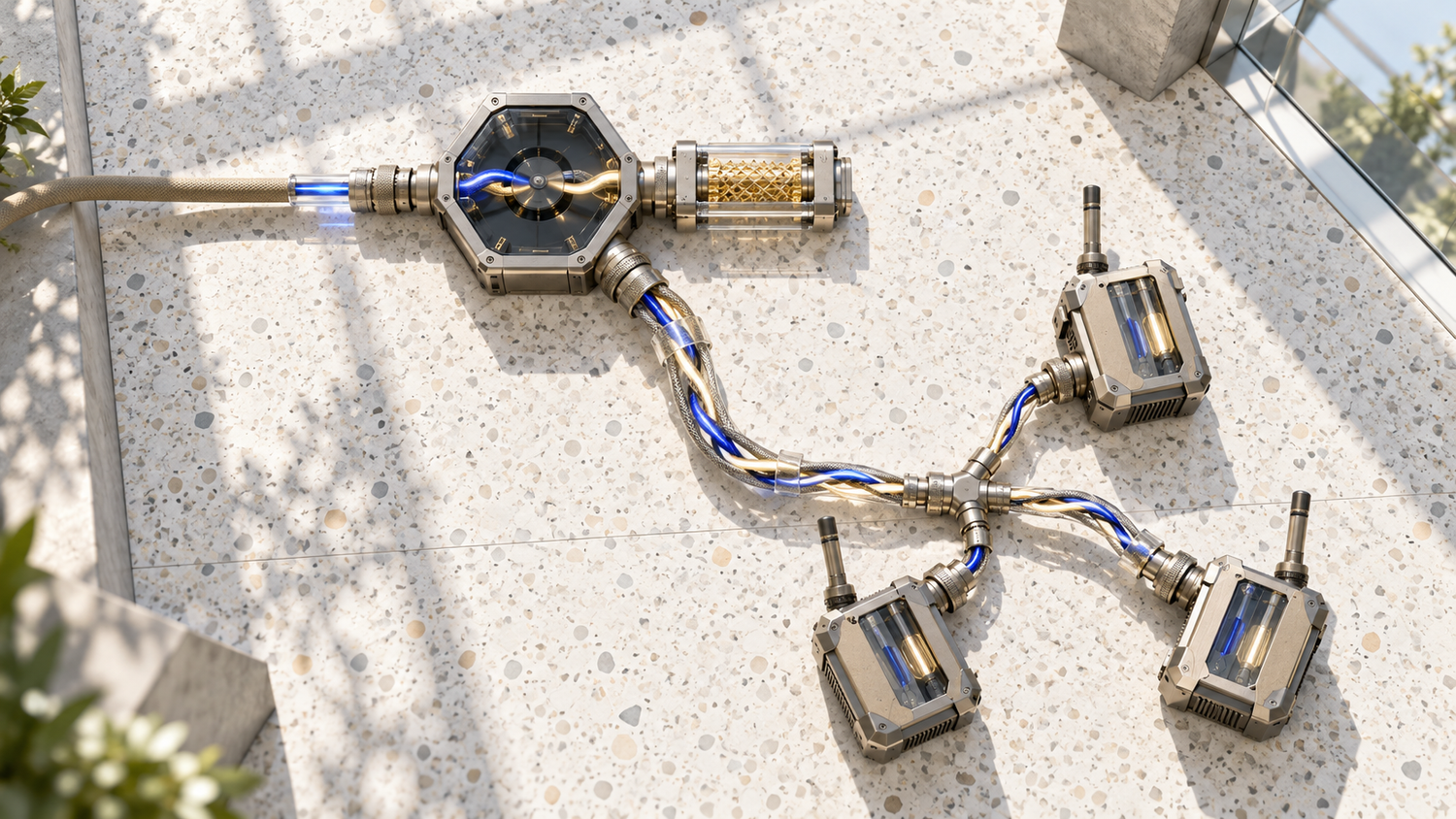
On September 10 and 11, 2026, Airbus's defense and space division ran a self-funded live trial in Malta in which military and law enforcement users on different operational networks exchanged traffic over a network it describes as quantum-secure. The company's statement, carried in full by EDR Magazine on October 5, 2026, says the architecture combined post-quantum cryptography with quantum key distribution across multiple nodes, and that a key management system and software-defined networking changed encryption and routing as mission conditions changed. Airbus calls it the first time its tactical users have been connected this way. For a defense reader the interesting part is the orchestration layer, and the honest part is how much the statement leaves out.
The roles are clear. Agnet, Airbus's broadband communication and collaboration platform for public safety and defense users, sat at the center. Merqury Cybersecurity of Malta supplied the key management system and the software-defined networking that coordinated keys and routes. Stormshield supplied the network encryptors that protected the traffic. Telsy, a brand of TIM Enterprise, supplied the quantum key distribution through Quantum Telecommunications Italy, QTI. Melita, the Maltese operator, supplied the telecommunications infrastructure the whole arrangement ran on. Airbus states that the trial counters the harvest now, decrypt later threat, in which traffic intercepted today is stored until a quantum computer can read it.
What Airbus says happened in Malta on 10 and 11 September 2026: Agnet users on separate networks, two kinds of key across several nodes and routing that changed with the mission
Read closely, the statement makes three distinct claims. The first is integration: an established Airbus product took keys and encryption from third-party quantum-resistant components without being rebuilt. The second is orchestration: as conditions in the exercise changed, the key management system and the software-defined network selected keys and routes on their own, so that the users kept talking while the plumbing beneath them moved. The third is scope: the users belonged to both a military and a law enforcement network, and traffic crossed between them. Each is a real engineering result if it held under live traffic.
What the statement does not say matters as much. It gives no number of nodes, no link distances, no key rates, no list of the post-quantum algorithms used, no account of how the quantum channel was authenticated, no description of what happened when a link was removed, and no identification of the forces whose users took part. It names no independent observer and reports no measurement. The phrase live tactical operations describes an exercise the company funded itself on a commercial operator's network. A buyer is reading a capability announcement, and the Monitor reads it as one.
Why Malta: Melita and Merqury demonstrated a quantum key link between two data centers in January 2024 under the PRISM EuroQCI project, with a deployment announced in May 2026
Melita announced on January 30, 2024 that it had demonstrated quantum key distribution between its two data centers with Merqury, under the PRISM project co-funded by the European Union's Digital Europe funding program, and said at the time that it planned to extend the network across Malta and later to Sicily over an undersea cable. The project page for PRISM EuroQCI lists Merqury, the University of Malta, Melita, RSM Malta, Malta's critical infrastructure protection directorate and the national IT agency as the consortium, and places the work inside the European quantum communication infrastructure effort due to complete in 2030.
In May 2026, Melita announced a deployment with Terra Quantum and Merqury. As TelecomTV reported on May 8, 2026, Melita, Terra Quantum and Merqury had a quantum key link running between Melita's two main data centers over existing dense wavelength division multiplexed fiber, with Merqury's management suite handling tens of thousands of key requests and no unplanned customer-impacting events. Melita's technical head, Matthew Farrugia, and Merqury's chief technology officer, Noel Farrugia, both spoke of the link as a production service rather than a laboratory. These announcements document a January 2024 demonstration and a May 2026 deployment, but do not establish continuous operation between them or the addition of a second link.
The September trial involved Telsy through QTI for quantum key distribution, Stormshield encryptors, and a tactical user population on Agnet whose traffic the orchestration had to keep moving. Attribution of the post-quantum layer to Stormshield remains an inference from its catalog, because the statement does not identify the products or profiles used. Reuse of the earlier infrastructure and replacement of Terra Quantum hardware remain unverified, because the full Airbus statement was inaccessible to the independent review. The orchestration and the user layer are the reported result; their relationship to the earlier quantum link is not established.
Quantum pillar: post-quantum cryptography (migration and crypto-agility). Use posture: defensive. Technology readiness: TRL 6 of 9. A working hybrid of post-quantum encryptors, a quantum key link and a key management system carried live tactical traffic between military and law enforcement users on a commercial operator's network during a two-day exercise, which is an end-to-end demonstration in a realistic setting, while the absence of published node counts, key rates, algorithm lists and fail-over timings keeps it below a prototype in its intended operational environment.
What a hybrid post-quantum and quantum-key tactical network would let a force do, who gains from it, and why the posture reads defensive
The capability on offer is specific. A force running Agnet or a similar platform could keep command, coordination and sensitive operational traffic protected against an adversary who stores ciphertext now and expects to decrypt it later. Continued protection and communication when a link fails or a key source drops out are intended capabilities requiring failure-injection evidence: adaptive key and route selection alone does not establish uninterrupted service or secure fallback. The Monitor set out the shelf-life problem that drives this in its post on a task force for the ciphertext already on deposit, and the Malta design is a direct answer to it for traffic in motion. The gain sits with the defender, and with two kinds of defender at once: the trial connected a military network and a law enforcement network, which is the situation a coast guard, a border force or a civil protection authority lives in every day.
The sub-branch is crypto-agility, and that is the point of the exercise. A program office rarely gets to replace every radio and server at once. What it can buy is an architecture in which the key source and the algorithm can be changed under a management layer without rebuilding the user platform. The Airbus statement describes exactly that: physics-based keys where a quantum link exists, post-quantum algorithms where it does not, and a controller deciding which applies. Stormshield's published release notes for its SNS 5.0 firewalls show the component side of this, listing ML-KEM-512, ML-KEM-768 and ML-KEM-1024 in hybrid mode with two IPsec profiles, one for peers that all run the hybrid scheme and one for networks still in transition. The Airbus statement does not say which Stormshield products or profiles ran in Malta, so that remains an inference about the vendor's catalog rather than a fact about the trial.
Nothing in the architecture finds a target, degrades an opponent's sensing or breaks anyone else's cryptography, so the panel reads defensive rather than dual-use, and the first buyers are likely to be the agencies whose data has the longest shelf life: personnel, investigations, logistics and planning.
What still stands between the Malta trial and a program office relying on it: authentication of the quantum channel, published figures, divided national doctrine on QKD and the self-funded status
The first gap is authentication. A quantum key link can bound an adversary's information about the key under protocol and implementation assumptions, but deployed equipment can leak secrets or suffer implementation attacks; it cannot by itself prove who sits at the far end, so every deployed system authenticates its classical channel with a pre-shared secret or a signature, and the choice of signature decides whether the chain resists a quantum computer. France's ANSSI made this the center of its 2020 position, writing in its note on quantum key distribution that each peer must be sure it is talking to its intended peer, that deployment constraints hinder large-scale use with high practical security, that post-quantum algorithms are the recommended path, and that QKD may find a niche as a defense-in-depth measure on point-to-point links. The Airbus design is compatible with that reading if the post-quantum layer carries the authentication and the quantum link adds depth on the fixed segments, and the statement does not say whether it does.
The second gap is evidence. A buyer evaluating this architecture needs the node count and the distances, the key rate the Telsy link delivered against the key consumption of Agnet traffic, the time the controller took to switch key source or route when a link was pulled, the post-quantum algorithm set, and the behavior of the system when the quantum channel was unavailable for an hour. None of these are published.
The third gap is doctrine, and it is divided along national lines. France and the United Kingdom have both declined to endorse quantum key distribution for government use and put their weight behind post-quantum algorithms. Italy, through TIM and Telsy, and Malta, through PRISM, have invested in quantum links as national infrastructure, and the European quantum communication infrastructure program funds both. A program office in Paris or London will read the Malta trial as a post-quantum tactical network with a quantum link as an optional extra; one in Rome or Valletta may read it the other way round.
The fourth gap is the customer. The trial was self-funded. The statement identifies no buyer acceptance criteria or program-office sign-off. The next useful document is a short technical note with the figures above and the name of an operator willing to run the architecture on its own network for a season. Until then the honest reading is favorable and modest: an established tactical platform, two quantum-resistant key sources and a controller that switches between them ran together for two days under live traffic in a country whose quantum plumbing was already in service.
Sources
Primary source: Airbus (defense and space division) statement on the Malta quantum-secure tactical communications trial of September 10 and 11, 2026, as published in full by EDR Magazine (Jules Roukoz) on October 5, 2026. Other material: PRISM EuroQCI project page; TelecomTV, "Quantum-secure comms arrives in Malta," May 8, 2026; Stormshield SNS 5.0.2 release notes (hybrid ML-KEM IPsec profiles); ANSSI, "Should Quantum Key Distribution be Used for Secure Communications?", May 26, 2020.