Université de Sherbrooke Plans Five Drone Surveillance Tours Over Quebec With Wildfire Risk Maps and a Neutral-Atom Quantum Heuristic, arXiv 2 October 2026: 31 Valid Plans on an Emulator, TRL 3
Quentir Defense Monitor
Evidence-based insights for quantum defense and security. Published by Quentir Systems LLC · October 6, 2026.
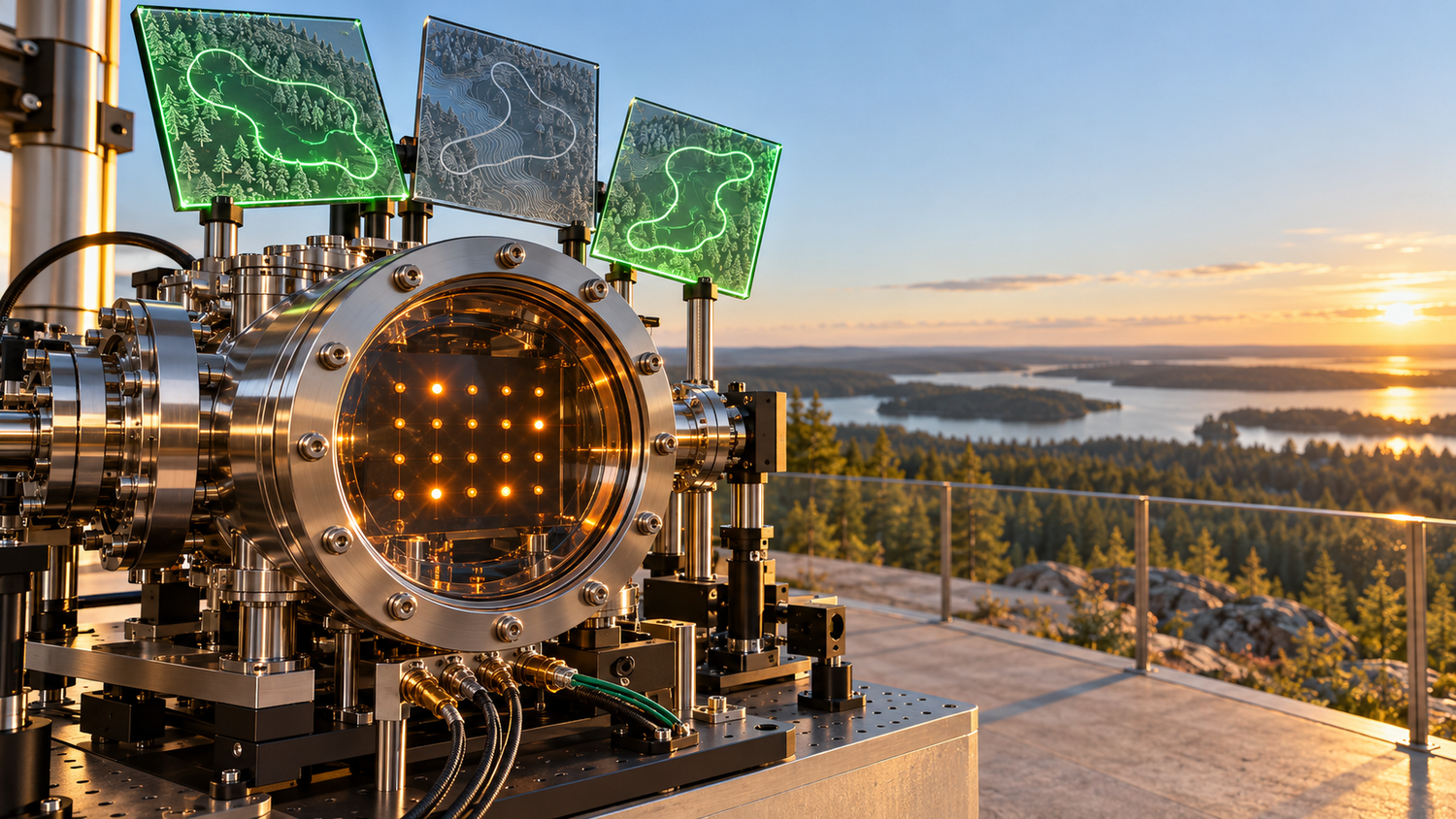
On October 2, 2026 four researchers at the Université de Sherbrooke posted a 26-page paper that plans the daily routes of five surveillance drones over Quebec by feeding machine-learned wildfire risk maps into a heuristic whose central step runs on an emulated neutral-atom quantum computer. Their pipeline returned a valid five-tour plan on all 31 days of July 2021 in about two minutes per day, while an open-source exact solver given one hour per day returned a valid plan on 10 of those days.
The paper never mentions a military user. It does not have to. The problem it solves, choosing a set of non-overlapping aerial tours that together cover the most probable locations of an event you want to see first, is the same problem an intelligence, surveillance and reconnaissance cell faces when it allocates a small fleet of unmanned aircraft over a wide area each morning. This post reads the Sherbrooke paper as a mission-planning result, sets it next to a vendor claim from the same week about quantum logistics in a US Army test complex, and says what still separates both from a program office.
What Dorian Lauwerier, Alexis Vieloszynski, Yves Bérubé-Lauzière and Victor Drouin-Touchette built from 11 years of Canadian fire and ERA5 weather data
The authors are Dorian Lauwerier, Alexis Vieloszynski, Yves Bérubé-Lauzière and Victor Drouin-Touchette of the Université de Sherbrooke's electrical, computer and computer-science departments. The work was funded by a Natural Sciences and Engineering Research Council of Canada Alliance grant together with Pasqal Canada, and the paper discloses that Drouin-Touchette was a part-time Pasqal Canada employee during the initial write-up. That matters for a buyer because Pasqal builds the neutral-atom quantum computer the heuristic is designed for, and the quantum step in this paper ran on Pasqal's own emulator, not on a physical machine.
The first half of the pipeline is classical and conventional. The team took ignition points from the Canadian National Fire Database and weather fields from the ECMWF's ERA5 reanalysis, covering Quebec between 45°15' and 52°00' north and 79°30' and 64°00' west on a 0.25-degree grid, for the years 2010 through 2021. Nine midday weather variables plus daily precipitation feed an XGBoost classifier that predicts whether a fire starts in a cell the next day. The dataset is severely imbalanced: 5,486 positive rows among 4,560,732. Trained on a balanced subset and tested on 2021, the model reaches a precision of 0.77 and a recall of 0.83 on the fire class. On the full, imbalanced 2021 data it keeps the 0.83 recall but its precision collapses under false positives, which the authors report plainly. The output is a daily risk map, and the risk map is the terrain the optimizer works on.
The second half is the decision problem. Each day, five drones with a 500-kilometer range must fly tours that together maximize the summed ignition probability of the cells they overfly, and no two tours may share more than 30 percent of their path. The authors formalize this as a Team Orienteering Problem with an overlap constraint. Orienteering problems are hard in the formal sense, and the overlap constraint makes the exact formulation heavy. That difficulty is the opening the quantum heuristic exploits.
How the quantum step works: candidate tours become a conflict graph, and the atoms pick a non-overlapping set
The heuristic has five stages. Spatial preprocessing reduces the map to candidate cells. Candidate tour generation samples sets of high-risk cells and closes each set into a tour with the Christofides algorithm. Conflict graph construction turns every candidate tour into a node and draws an edge between any two tours whose paths overlap beyond the 30 percent threshold. The quantum stage then finds a maximum independent set of that graph, which is a set of tours with no edge between them, and therefore a set of tours that can fly together without violating the overlap rule. A final selection step picks the five tours from that independent set that cover the most risk, and reconstructs the full flight plan.
The maximum independent set is the native problem of a neutral-atom array. When Rydberg atoms are placed at the node positions of a graph, the physics forbids two neighboring atoms from being excited at the same time, so the lowest-energy configuration of the array is an independent set of the graph. The Sherbrooke team used analog quantum annealing on that array to sample large independent sets. Every run in the paper was performed on Pasqal's EMU-SV, a classical state-vector emulator that, according to Pasqal's documentation, keeps the full state vector for registers up to about 25 qubits. The emulator ran on two AMD EPYC 7643 processors with 96 cores and 500 gigabytes of memory, and the conflict graphs held 10, 15 or 20 nodes, one qubit per candidate tour.
Quantum pillar: computing (optimization and logistics). Use posture: dual-use. Technology readiness: TRL 3 of 9. The full planning pipeline ran as working software on eleven years of real Canadian fire and weather data, while the quantum stage ran on a classical emulator of a neutral-atom processor rather than on physical hardware, which places the result on the third rung of the shared ladder and nowhere higher.
What the numbers show against the HiGHS solver: 31 valid plans in 120 seconds, 10 valid plans in an hour, and a 53 percent gap to the linear bound
Table 2 of the paper compares the heuristic with HiGHS, an open-source mixed-integer solver, over the 31 days of July 2021. HiGHS was given 3,600 seconds per day and returned a valid plan on 10 days, a 63 percent failure rate at that budget; where it did return a plan, the objective averaged 0.53 and never exceeded 3.84. The quantum-assisted heuristic returned a valid plan on all 31 days in 120 seconds each, with objectives between 32 and 68 and an average of 47.19. The comparison is honest about what it is: a reliability test against an exact method under a realistic time budget, on a formulation the exact method finds hard. It is not evidence that a quantum computer beat a tuned classical heuristic, because no tuned classical heuristic was in the table.
Two further results frame the claim. The authors varied the emulated register from 10 to 15 to 20 qubits and saw the average objective rise from 47.97 to 48.19 to 51.94, so more candidate tours in the quantum stage produced better plans, in a small and smooth way. They also measured the distance to the linear-programming upper bound for a 10-node instance on September 30, 2021: the quantum-assisted routine reached 20.74 with a gap of 53.42 percent, and a brute-force exact selection over the same candidate pool reached 21.18 with a gap of 52.43 percent. The quantum stage is therefore selecting nearly as well as exhaustive search over the candidates it is given. The large remaining gap sits in the candidate pool and in the bound itself, which the authors acknowledge when they write that improving the plan requires either better candidate tours or a larger pool.
The authors also state the hardware reality without decoration. At the scale of 20 qubits, competing classical techniques are faster than currently available quantum computers. At an effective shot rate of about 1 hertz on a real neutral-atom processor, the quantum stage alone would take roughly one minute and thirty seconds per day. The reason to build the pipeline anyway is that the independent-set step is exactly the step whose classical cost grows fastest with the number of candidate tours, and a register of hundreds to thousands of coherently controlled atoms would let a single processor weigh a far larger candidate pool.
Why this is a dual-use mission-planning result, and what SuperQ's 1 October Bush Combat Development Complex claim does and does not add
Read as mission planning, the paper describes a capability a force would want in either direction. A defender with five long-endurance aircraft and a machine-learned map of where an incursion, a launch or a fire is most likely tomorrow gets a daily plan that covers the most probable cells without wasting two aircraft on the same ground. An attacker with the same tools gets a plan for finding what the other side wants to hide. The same team orienteering mathematics served the Huntsville mission-planning demonstrations covered earlier in this Monitor, where quantum optimization reported for mission planning duty, and it serves a provincial fire agency here. The posture is dual-use because nothing in the method prefers one user over another; the risk map decides the mission.
The same week carried a louder claim on the same pillar. On October 1, 2026 SuperQ Quantum of Calgary announced that its Super Edge hybrid quantum-classical platform had completed a live exercise at the Bush Combat Development Complex in Texas, meeting 100 percent of its primary performance objectives for real-time logistics optimization and routing under simulated network degradation, with one-click integration into legacy command systems and no reported latency or downtime. The complex itself is a 200 million dollar Texas A&M University System facility in Bryan, Texas, run in partnership with US Army Futures Command, with venues for autonomy and networks, test and evaluation, and modeling and simulation. That is a credible place to test edge software.
What the SuperQ release does not contain is any of what the Sherbrooke paper contains: the size of the routing problem, the quantum hardware or emulator involved, the share of the computation that was quantum, the classical baseline, or a single objective value. A program office cannot place a claim of flawless performance on a readiness ladder without those numbers. The two documents together illustrate the lane's standing lesson. A 26-page preprint with a 53 percent optimality gap and an emulator in the method section is more useful to a buyer than a press release with a perfect score, because the preprint can be checked and the release cannot.
What stands between the paper and a program office: hardware access after Pasqal's exit from Proqcima, the shot rate and weighted encodings
Three things separate this result from something a planner could rely on. The first is hardware. The heuristic is written for a neutral-atom machine, and the week's other news on that hardware is political. On October 6 BFM Business, citing an investigation by La Tribune, reported that the French Ministry of the Armed Forces removed Pasqal from the Proqcima sovereign quantum computer program after the company listed on the Nasdaq at the end of August, judging that a Wall Street listing put French control of the technology and its intellectual property at risk; several ministries had offered new public financing on condition that Pasqal drop the listing, and the company declined. Pasqal framed its departure on October 5 as a commercial refocus. Alice&Bob, C12, Quandela and Quobly remain in the program, which aims at two prototypes by 2032 on a first envelope of 60 million euros. For a European defense buyer, the message is that the vendor whose architecture this paper targets has just been judged insufficiently sovereign by one allied ministry, and that access to the hardware is now a procurement question as much as a physics one.
The second barrier is the one the authors measure. At one shot per second and 20 qubits, the quantum stage is slower than a laptop. The pipeline earns its place only once registers of hundreds of atoms are routinely available with the coherence to anneal a conflict graph of that size, and the paper's own scaling curve, three points rising by about four objective units, is the only evidence so far that bigger registers help.
The third is encoding. The paper solves an unweighted independent set and defers the weights, meaning the risk values themselves, to a classical selection step, because weighted encodings on neutral atoms require normalization and local calibration choices that depend on the specific machine. Until the weights live inside the quantum stage, the atoms choose which tours can coexist and a classical routine still chooses which of those are worth flying. A buyer evaluating a quantum mission-planning tool should ask where the weights live, how large a conflict graph the vendor has actually annealed on hardware, and what classical heuristic the vendor has beaten. On all three questions the Sherbrooke paper gives a precise and modest answer, which is what makes it worth reading.
Sources
Primary source: Dorian Lauwerier, Alexis Vieloszynski, Yves Bérubé-Lauzière and Victor Drouin-Touchette (Université de Sherbrooke), "Quantum-Assisted Optimization Guided by Machine-Learned Risk Maps for Aerial Surveillance Routing," arXiv:2610.03890v1, posted October 2, 2026. Other material: Pasqal QPU emulator documentation (EMU-SV); SuperQ Quantum press release of October 1, 2026; Bush Combat Development Complex, Texas A&M University System; BFM Business, October 6, 2026, citing La Tribune (Michel Cabirol) on Pasqal and Proqcima.