Two Cold-Atom Clocks Hold a Radar Network Together Without Satellites
Quentir Defense Monitor
Evidence-based insights for quantum defense and security. Published by Quentir Systems LLC · August 12, 2026.
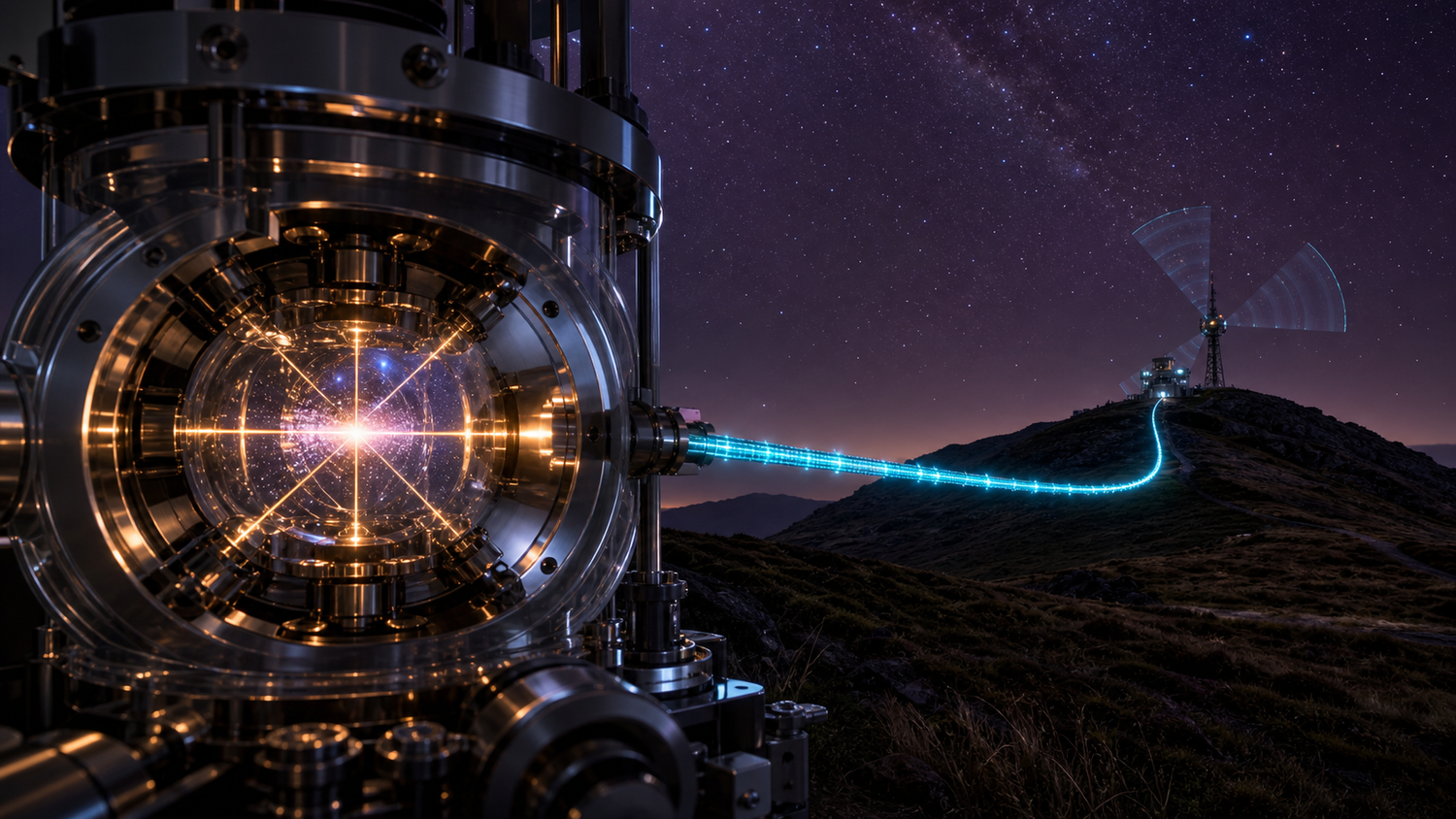
In June 2026, at two radar sites in the United Kingdom, a pair of prototype atomic clocks did a job normally delegated to a constellation of satellites. Aquark Technologies, working with the Royal Navy, Saab UK, QinetiQ and Dstl, ran a trial in which two networked military radars built and held a single coherent air picture while drawing their timing from two AQlock 2.0 cold-atom clocks instead of from satellite navigation signals. The announcement, published August 12, describes it as the first known demonstration of a distributed, high-performance military radar network keeping a coherent operational picture on timing sources fully independent of global navigation satellite systems.
The trial is the third that Aquark has run with the Royal Navy, this time under a project called Quantum Optimised Radar for the Navy's Disruptive Capabilities and Technologies Office. The two clocks at its center did not exist at the start of the year: work began in December 2025, and both prototypes were built from scratch by the end of June 2026. Radars at Saab and QinetiQ sites carried the sensing load, while the Royal Navy's experimentation ship XV Patrick Blackett and Dstl, the UK government's military research laboratory, acted as network rebroadcast nodes.
For a defense reader the story sits at an unusual intersection. It is a quantum hardware result, a prototype clock performing outside the laboratory. It is also a networking result, because the capability being demonstrated belongs to the network rather than to any single instrument. And it is a procurement signal, because a navy customer paid for three successive trials of the same technology against the same operational problem, which is how capabilities move from interesting to funded.
What two clocks and two radars actually showed
The trial architecture was deliberately simple. Each of the two radar sites received one AQlock 2.0, a compact cold-atom clock whose accuracy derives from the quantum mechanical behavior of laser-cooled atoms rather than from a machined crystal. Aquark reports that both units started from cold to an acceptable timing signal in under thirty minutes, a figure that matters because legacy cold-atom instruments have historically needed long, carefully supervised warm-up procedures that make them awkward for expeditionary use.
The radars themselves were operational equipment rather than laboratory stand-ins. Saab's Giraffe 1X is a lightweight three-dimensional surveillance radar, under 150 kilograms in total, used for air surveillance and ground-based air defense tasks including the detection of small, low and slow targets such as hobby-class drones out to roughly four kilometers. Two of these systems, geographically separated, were asked to merge their individual tracks into one shared air picture under conditions that mimicked denial and spoofing of satellite timing.
Merging tracks from separated radars is where timing stops being an accessory and becomes the load-bearing wall. A networked radar picture combines tracks that each site forms locally, whose state estimates are time-stamped against a common reference and then aligned to the same epoch before they can be associated. When that reference drifts between sites, the estimates no longer line up in time, track correlation degrades, and the combined picture can split one aircraft into two or merge two into one. Ordinarily each site disciplines a local oscillator to the timing signal carried by satellite navigation, which means the entire network quietly inherits a dependency on signals that an adversary can jam from a truck or spoof from a software-defined radio. The trial cut that dependency: the network ran solely on AQlock timing, degraded predictably when the timing feed was deliberately disrupted, and recovered quickly once synchronization was restored. Predictable degradation is an underrated property. An operator who knows how the picture decays, and how fast it returns, can keep making decisions through a disruption instead of distrusting the whole display.
Quantum pillar: networking (network time synchronization). Use posture: defensive. Technology readiness: TRL 6 of 9. Prototype clocks drove operational radar systems at real sites under mimicked satellite-denial conditions, a demonstration in a relevant environment that still stands short of a qualified system fielded at sea.
Timing is the quiet dependency of every networked sensor
The reason a navy pays for this sits in the threat picture around satellite navigation. The UK government's own economic impact study puts the cost of a nationwide satellite-navigation outage at 1.42 billion pounds over twenty-four hours and 7.64 billion pounds across seven days, with emergency services, maritime and road transport carrying most of the loss. That study counts civilian harm only. Military exposure is sharper, because interference near conflict zones is no longer occasional. A recent investigation by researchers at the University of Texas at Austin, posted to arXiv, traced years of powerful wide-area satellite-navigation interference events across Europe, Greenland and Canada to a constellation of Russian early-warning satellites in Molniya orbits, an interference source that operates from space and therefore reaches receivers over enormous areas at once.
Against that backdrop, network time synchronization without satellites is a defensive capability in the plainest sense: it protects a force's own sensing and decision-making when an adversary attacks the timing layer. What it lets a force do is concrete. An air-defense battery whose radars keep a fused picture through jamming keeps its engagement quality when it matters most. Separated sensors that share a clock can operate as pieces of one larger instrument, which is the architectural direction most Western air-surveillance thinking is heading as cheap drones force defenders to knit many small radars into wide coverage. A ship that carries its own timing reference stops radiating predictable dependence on a signal everyone knows how to deny.
The choice of a cold-atom clock, rather than the quartz or rubidium holdover oscillators that already exist, is a bet on the shape of the problem. A holdover oscillator drifts, and its drift accelerates with temperature swings and vibration, so the operational question with holdover is always how many hours of denial it can ride out before the picture falls apart. A cold-atom reference ties its stability to atomic physics and in principle rides out a denial measured in weeks. Aquark's instrument is built around a trapping approach the company calls the super-molasses trap, chosen to shrink the vacuum and laser package, and the firm states the design has already operated on land platforms, on naval surface vessels and on an uncrewed air platform. Matthew Aldous, Aquark's timing lead, called the trial a milestone for UK sovereign quantum technology and the first known occasion a pair of British-built cold-atom systems has been deployed against a genuine operational problem rather than a laboratory benchmark.
Between a trial and a fielded network
A program office reading this result should note what the published record establishes and what it leaves open. It establishes that two prototype quantum timing references, built in about six months, drove two operational radars into one air picture under simulated denial, with graceful degradation and fast recovery, and that a navy customer has now funded three iterations of the technology. That is a real and checkable claim, and it lands in a relevant environment rather than on a bench.
What the record does not yet carry is equally instructive. The release publishes no stability numbers, no figure for how long the network holds coherence during a total timing blackout and no error budget comparing AQlock-disciplined tracking against the satellite-disciplined baseline. Those numbers exist somewhere in the trial data, and until a program office sees them the capability claim stays qualitative. The trial linked two nodes; an operationally interesting network has ten or fifty, and time distribution across many nodes brings its own engineering, from asymmetric link delays to failure of the distribution path itself. The clocks ran at fixed shore sites with a ship as a relay, so qualification for shock, vibration and long unattended duty at sea remains ahead, and that environment is precisely where cold-atom instruments have historically surrendered their laboratory performance. Manufacturing is the final open question: two hand-built prototypes prove a design, while a fielded capability needs repeatable production at a price a radar program can absorb.
None of these gaps is a criticism of the trial, which was scoped exactly as a maturation step should be. They are the distance a buyer should price in between this announcement and a contract line item. The signals worth watching next are specific: publication of holdover and coherence figures from the June data, a follow-on trial that puts the clock aboard the moving ship rather than beside it, and any move by the UK's procurement machinery to write satellite-independent timing into a radar or air-defense requirement rather than a research project. The strategic logic is already visible in the partner list. A sovereign clock maker, a radar prime, a research laboratory and a navy experimentation office rehearsed, in miniature, the supply chain a country needs if it intends its sensor networks to keep working in GNSS-denied environments. That rehearsal succeeding on the first attempt with brand-new hardware is the fact that separates this trial from the long list of quantum demonstrations that never left the bench.
Sources
Primary source: Aquark Technologies' trial announcement of August 12, 2026, published via The Quantum Insider; other material from Saab's Giraffe 1X product documentation, the UK government's study of the economic impact of a GNSS disruption and the arXiv preprint by Zachary L. Clements, Argyris Kriezis and Todd E. Humphreys on space-based GNSS interference.