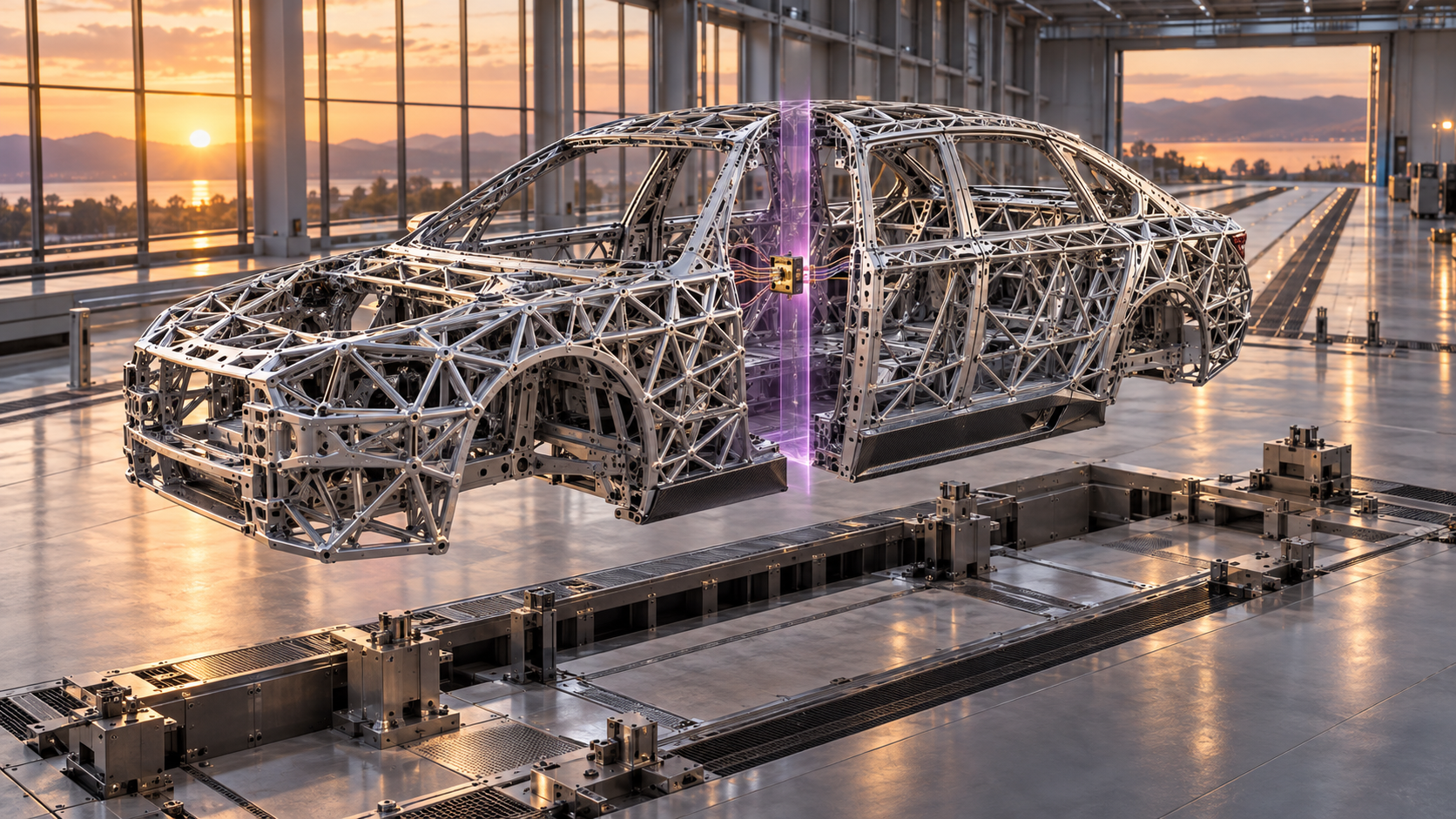
IonQ and Synopsys Put a 36-Qubit Forte Run Inside Ansys LS-DYNA, Cutting Wall-Clock Time by About 12 Percent on Hardware and Up to 14.6 Percent in Simulation, First Place at IEEE Quantum Week 2026
Eight authors from IonQ and Synopsys wired a non-variational quantum optimization routine into Ansys LS-DYNA, ran the first nested-dissection cut on the 36-qubit Forte trapped-ion system, and measured finite element analysis wall-clock time falling by about 12 percent on hardware and up to 14.6 percent for the drill in a simulated 80-qubit experiment, while simulated experiments overall reached 150 qubits only for the jet engine. We read what a faster crash and vibration solver means for survivability and airworthiness work, why the hybrid quantum-classical workflow is dual-use by construction, and what a missing classical ablation and best-case timings leave between an IEEE Quantum Week first-place paper and a program office relying on quantum-accelerated graph partitioning.