IonQ and Synopsys Put a 36-Qubit Forte Run Inside Ansys LS-DYNA, Cutting Wall-Clock Time by About 12 Percent on Hardware and Up to 14.6 Percent in Simulation, First Place at IEEE Quantum Week 2026
Quentir Defense Monitor
Evidence-based insights for quantum defense and security. Published by Quentir Systems LLC · September 18, 2026.
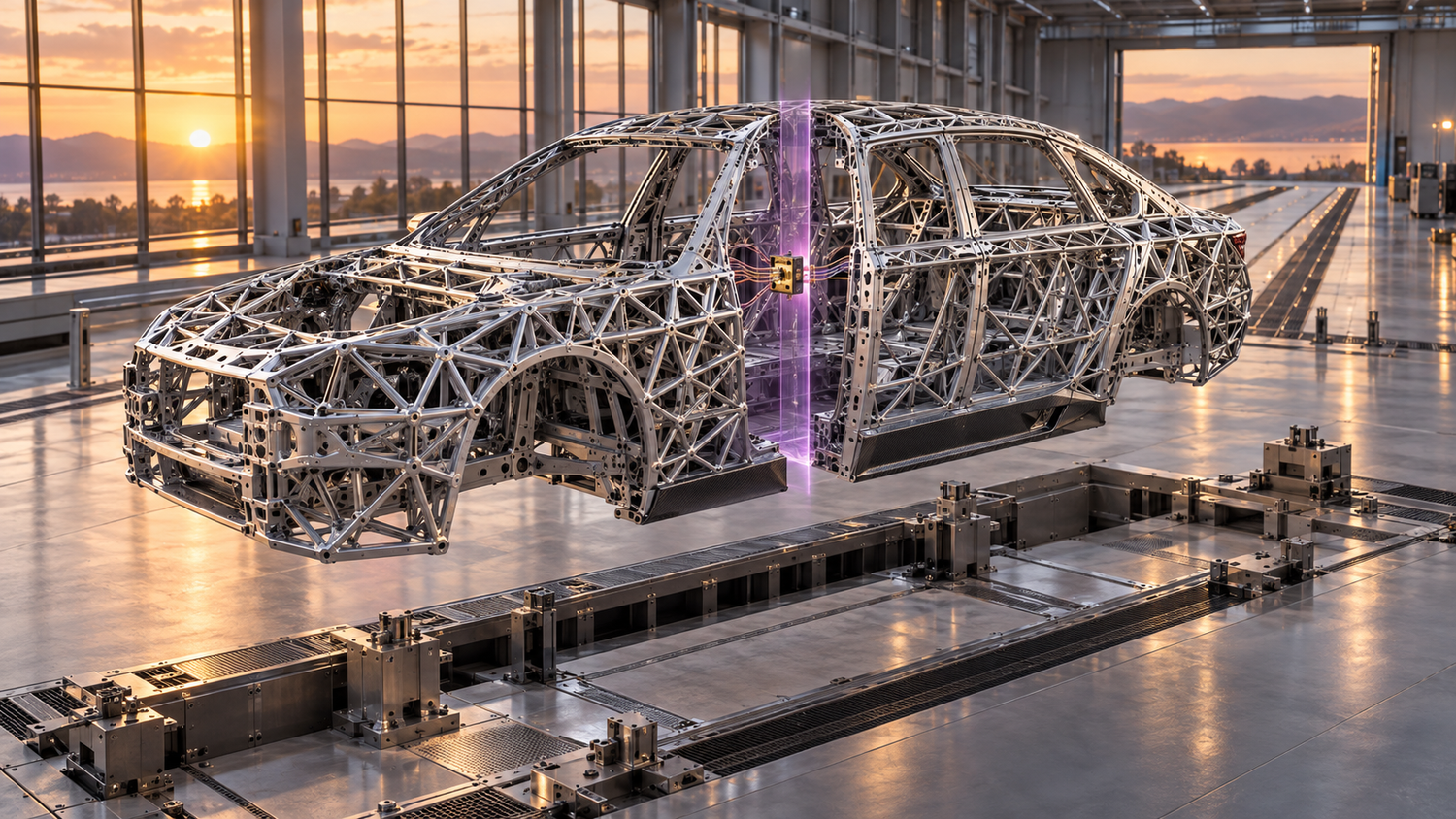
On September 17, 2026, IonQ detailed a paper written with Synopsys in which a trapped-ion quantum processor chooses one step inside Ansys LS-DYNA, the solver that vehicle and aerospace programs use for crash, blast, impact and vibration analysis, and the full simulation then finishes sooner. The paper, by Daiwei Zhu, Miguel Angel Lopez-Ruiz, François-Henry Rouet, Claudio Girotto, Willie Aboumrad, Robert Lucas, Ananth Kaushik and Martin Roetteler, was first posted to arXiv on March 16, 2026, revised on August 25, and took first place in the Quantum End-to-end Hybrid Case Studies track at IEEE Quantum Week in Toronto, where it was presented on September 15. For a defense reader the result is a solver story. The physics engine that tells an engineer whether a hull survives a blast or an airframe resonates at cruise is the same engine here, and the paper measures wall-clock time on that engine, with a quantum computer in the loop.
The bottleneck the paper attacks is old and well understood. Finite element analysis turns a structure into a mesh of millions of elements and a sparse matrix with tens to hundreds of millions of unknowns, and that matrix has to be factorized again and again. Factorization creates new nonzero entries, called fill-in, and the amount of fill-in depends on the order in which rows and columns are eliminated. Production solvers choose that order by nested dissection, which recursively cuts the mesh graph into balanced halves along a small separator. Choosing each cut well is a graph partitioning problem, which is NP-hard, so LS-DYNA relies on a heuristic partitioner called LS-GPart. The paper swaps the quantum processor into the very first cut and leaves everything else to the classical code.
What the eight authors ran: Iterative-QAOA on coarse graphs, 36 qubits on Forte, and four industrial meshes up to 35 million elements
The workflow starts from the full mesh graph, coarsens it to a hardware-matched size of 24 to 150 supernodes by spectral clustering, solves the coarse partitioning problem on the quantum processor, lifts the answer back to full resolution, and hands it to LS-DYNA. The quantum algorithm is Iterative-QAOA, a non-variational variant in which all circuit angles follow a linear ramp set by a single scalar, so no classical optimizer sits in the loop. After each run the measured bitstrings are scored by their cut cost, a Boltzmann-weighted average of the lowest-energy ones biases the next circuit's starting state, and the distribution walks toward good cuts. In practice the low-energy sector converged in fewer than five iterations. A Fiduccia-Mattheyses local search then repairs the lifted partition, and the 20 highest-quality partitions per configuration go into LS-DYNA to be timed.
The arXiv paper reports 63 simulations across four meshes. A sedan body derived from the public NHTSA Honda Accord crash model carries 5.9 million vertices and 55.3 million edges, a Rolls-Royce jet engine assembly 34.9 million vertices and 870.6 million edges, a Rolls-Royce impeller 7.0 million vertices, and a drill component from Predictive Engineering 3.6 million vertices. The sedan and the engine were run as vibrational analysis, the drill and the impeller as transient analysis. Instances of 36 coarse nodes were executed on IonQ's Forte, a 36-qubit trapped-ion system, with 1,980 two-qubit gates per circuit for the drill and impeller and 1,080 for the sedan, plus 5,000 shots and no error mitigation beyond symmetrized circuit realizations averaged across batches. Every instance above 36 nodes ran on a noiseless matrix-product-state simulator on NVIDIA A100 and H100 GPUs, up to 150 qubits and 12,000 two-qubit gates for the engine.
The timings come from LS-DYNA in distributed-memory mode. On Forte hardware with 36-node coarse graphs, the total wall-clock time fell by about 12 percent for the drill, with smaller gains for the impeller and the sedan. On the simulator, the reduction reached 14.6 percent for the drill at 80 nodes and 13.8 percent for the jet engine, while the simulated experiments overall reached 150 nodes only for the jet engine, and every model showed at least 5.9 percent. These are best-case figures, the single strongest of the 20 partitions in each configuration. At 32 to 36 nodes the median partition offered little or no gain over LS-GPart, and for the engine the gains were confined to the top candidates. The runs used shortened workloads, two transient time steps and 20 eigenmodes, on the grounds that the reordering step is done once and the saving repeats across every later solve when severe deformation, contact changes or element deletion do not require a new ordering. The authors put it in production terms: a large transient run of the drill model takes about seven days, and a 14.6 percent reduction, if reproduced on that workload, would return about one day of compute. IonQ's release of September 17 makes the same claim and lists the paper among nine it had accepted at the conference. The conference's best-paper list confirms the first-place ranking in the end-to-end hybrid track, with the IonQ and Kipu Quantum protein-folding paper that Quentir read in its Medicine lane in third place on the same list.
Quantum pillar: computing (optimization and logistics). Use posture: dual-use. Technology readiness: TRL 3 of 9. The quantum step ran on real trapped-ion hardware at 36 qubits inside a production solver and produced measured time savings on shortened workloads, which is an experimental proof of concept, while the larger gains rest on classical simulation and no fielded engineering team yet depends on the method.
Why a faster crash and vibration solver is defense capability, and who gains from it
LS-DYNA is sold by Synopsys as crash simulation software, and its transient solver is the tool of choice wherever a structure meets a sudden load: a vehicle hull under a buried charge, a composite panel taking a fragment, a drop test of an electronics enclosure, a bird strike on an engine inlet. The paper's own finding is that transient analysis is the class where the method pays most, because factorization is nearly the whole runtime there, whereas in vibrational analysis it is about half. That could map onto the work of a survivability or airworthiness office when severe deformation, contact changes or element deletion do not force the solver to recompute the ordering. A conditional 14.6 percent reduction in a seven-day blast run would return about one day to the schedule or allow one more design variant to be tested inside the same compute budget, and the authors note that the asymmetric geometries where the classical heuristic struggles, the drill and the engine, are the ones that gained most. Armored vehicles and airframes are asymmetric objects.
What a force could do with it is therefore modest and concrete: run more survivability iterations per program month, and spend less energy per iteration on a cluster that a ministry already owns, provided the workload permits the ordering to be reused. What it could stop is nothing directly. The posture is dual-use in the plain sense. The identical hybrid workflow serves an automaker meeting a crash standard, a turbine maker checking blade resonance, and a program office qualifying a hull, and any adversary running the same commercial solver could adopt it on the same terms. The quantum step knows nothing about the physics; it sees a weighted graph and returns a cut. That is also why the result generalizes. The outlook section names Ansys Fluent, HFSS, CFX, COMSOL and Abaqus as solvers built on the same sparse linear algebra, which covers electromagnetics for antenna and radar design as well as fluids and structures.
The buyer's reading is that this is a hybrid quantum-classical workflow whose value is bought at the point where a quantum processor's time is amortized over many classical solves. That condition can hold for vibrational analysis and for transient analysis without severe deformation, contact changes or element deletion, and fails for a workflow that must reorder once per solve. It is a narrower claim than "quantum accelerates engineering," and the paper is careful to say so.
What stands between a 36-qubit run on shortened workloads and a program office relying on it
The first limit is the one the authors state most plainly. Hardware validation stops at 36 nodes because each graph node takes one qubit and Forte has 36. Every figure above that, including the 14.6 percent headline, comes from a noiseless matrix-product-state simulation at fixed bond dimension, which is classically tractable by construction. In the authors' words, those results characterize the algorithm's scaling rather than demonstrate a quantum capability, and the paper does not claim quantum advantage. The prospective value lies at graph sizes beyond classical simulability, if the observed growth of the gain with node count persists there. Quentir's earlier reading of a quantum fluid solver measured against exascale hardware drew the same line between a simulated circuit and a quantum result.
The second limit is the missing control. The study compares the full hybrid pipeline against LS-GPart and does not isolate the coarse-graph solver's contribution. An ablation that drops a strong classical partitioner into the same slot, with coarsening, lifting and refinement held fixed, is left to future work, and the authors concede that further classical optimization at the coarse level could narrow the gains. Until that experiment is run, a program office cannot tell how much of the saving belongs to the quantum processor and how much to the coarsen-solve-lift wrapper around it.
The third is the shape of the evidence. Best-case timings from 20 candidate partitions, on two time steps and 20 eigenmodes, on one MPI layout per model, with the stochastic effects of load balancing and network latency that the authors report breaking the link between fill-in and runtime on every multi-rank run. Reproduction needs the modified LS-DYNA build, three proprietary meshes used with permission, and Forte access; only the sedan mesh is public. Nothing here is wrong, and the paper is unusually candid about all of it. It is simply an early measurement.
What the paper establishes is that a non-variational quantum optimization routine can be wired into a production engineering solver, run on real hardware at 36 qubits, and return partitions that shorten a full simulation by a measurable margin on industrial meshes. What it does not establish is that a quantum processor did anything a well-tuned classical partitioner could not, or that the gains survive at production workloads and median partitions. The next results to look for are the ablation, median rather than best-case timings, a hardware run above 36 qubits on IonQ's larger systems, and the same measurement on a second solver. A program that lives on LS-DYNA has a reason to watch this line of work, and no reason yet to change a procurement.
Sources
Primary source: Daiwei Zhu, Miguel Angel Lopez-Ruiz, François-Henry Rouet, Claudio Girotto, Willie Aboumrad, Robert Lucas, Ananth Kaushik and Martin Roetteler, "End-to-end Performance of Quantum-Accelerated Large-Scale Linear Algebra Workflows," arXiv 2603.15515, first posted March 16, 2026, version 4 of August 25, 2026. Other material: IEEE Quantum Week 2026 best-paper list; IonQ's September 17, 2026 press release as carried by HPCwire; IonQ's Forte system page; the Ansys LS-DYNA product page at Synopsys.