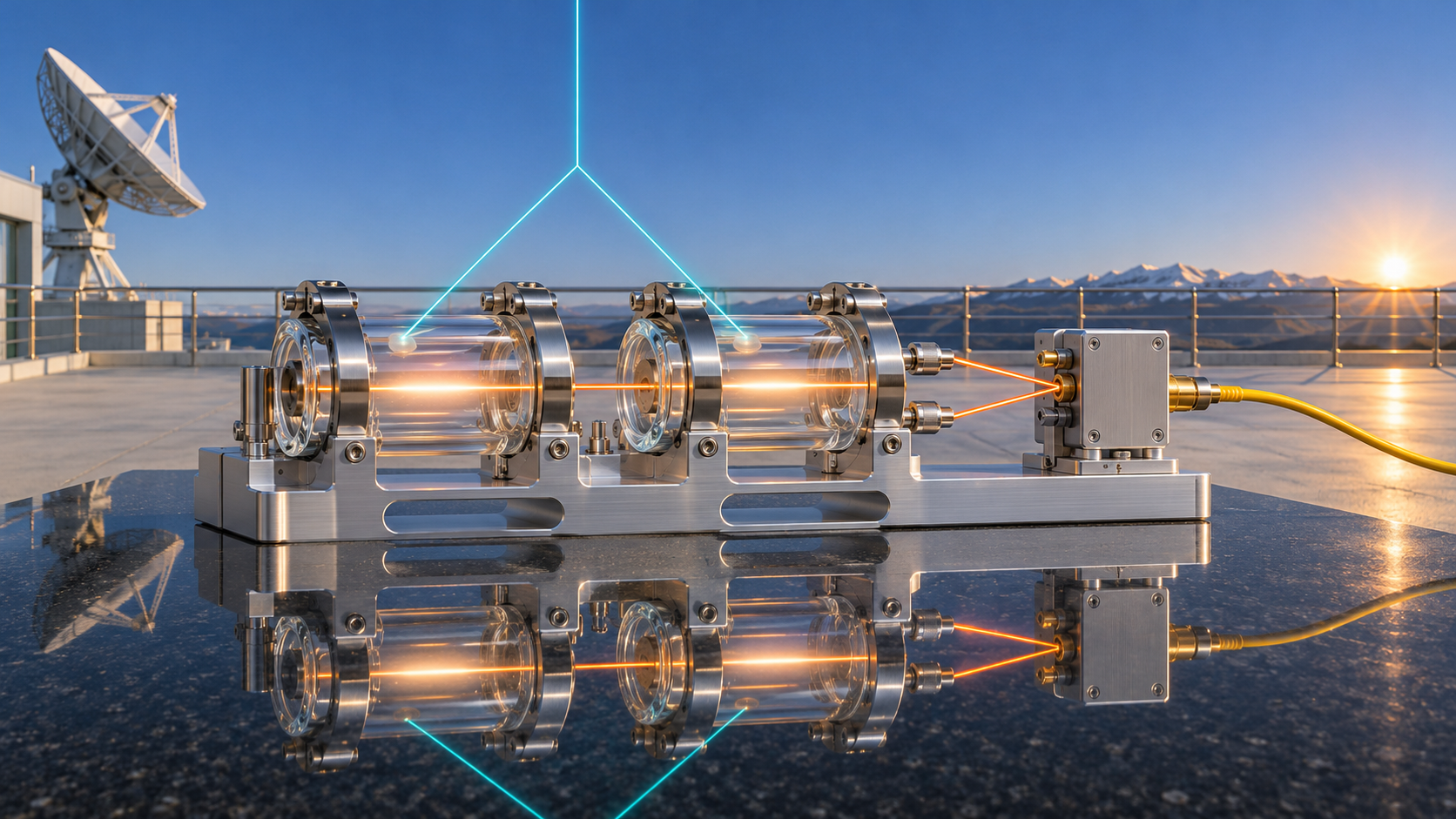
Aalborg University's Mandal, Zhang, Mikkelsen and Shen Model a Two-Cell Differential Rydberg GNSS Receiver: −154.5 dBm Threshold, arXiv 2611.09653, 6 November 2026: TRL 2
A. K. Mandal, F. Zhang, J. H. Mikkelsen and M. Shen of Aalborg University posted to arXiv on 6 November 2026 a closed-form, Monte Carlo-checked model of a two-cell differential Rydberg receiver for weak GPS L1 signals. Local-oscillator phase control steers the satellite signal into the difference between two vapor cells while a shared squeezed reservoir correlates photon shot noise and quantum projection noise for cancellation, giving 2 to 9.5 dB of signal-to-noise gain over one cell and a minimum detectable power of about −154.5 dBm, 8.5 dB below a single-cell Rydberg GNSS receiver and 34.5 dB below a conventional front end. This post reads the paper as dual-use PNT capability in the sensing pillar at TRL 2, sets it beside the GNSS jamming and spoofing environment EASA documents and ESA's NAVISP Rydberg navigation receiver activity, and lists the noise-correlation measurement, the mismatch budget and the L1 acquisition test a navigation office should wait for.