Aalborg University's Mandal, Zhang, Mikkelsen and Shen Model a Two-Cell Differential Rydberg GNSS Receiver: −154.5 dBm Threshold, arXiv 2611.09653, 6 November 2026: TRL 2
Quentir Defense Monitor
Evidence-based insights for quantum defense and security. Published by Quentir Systems LLC · November 9, 2026.
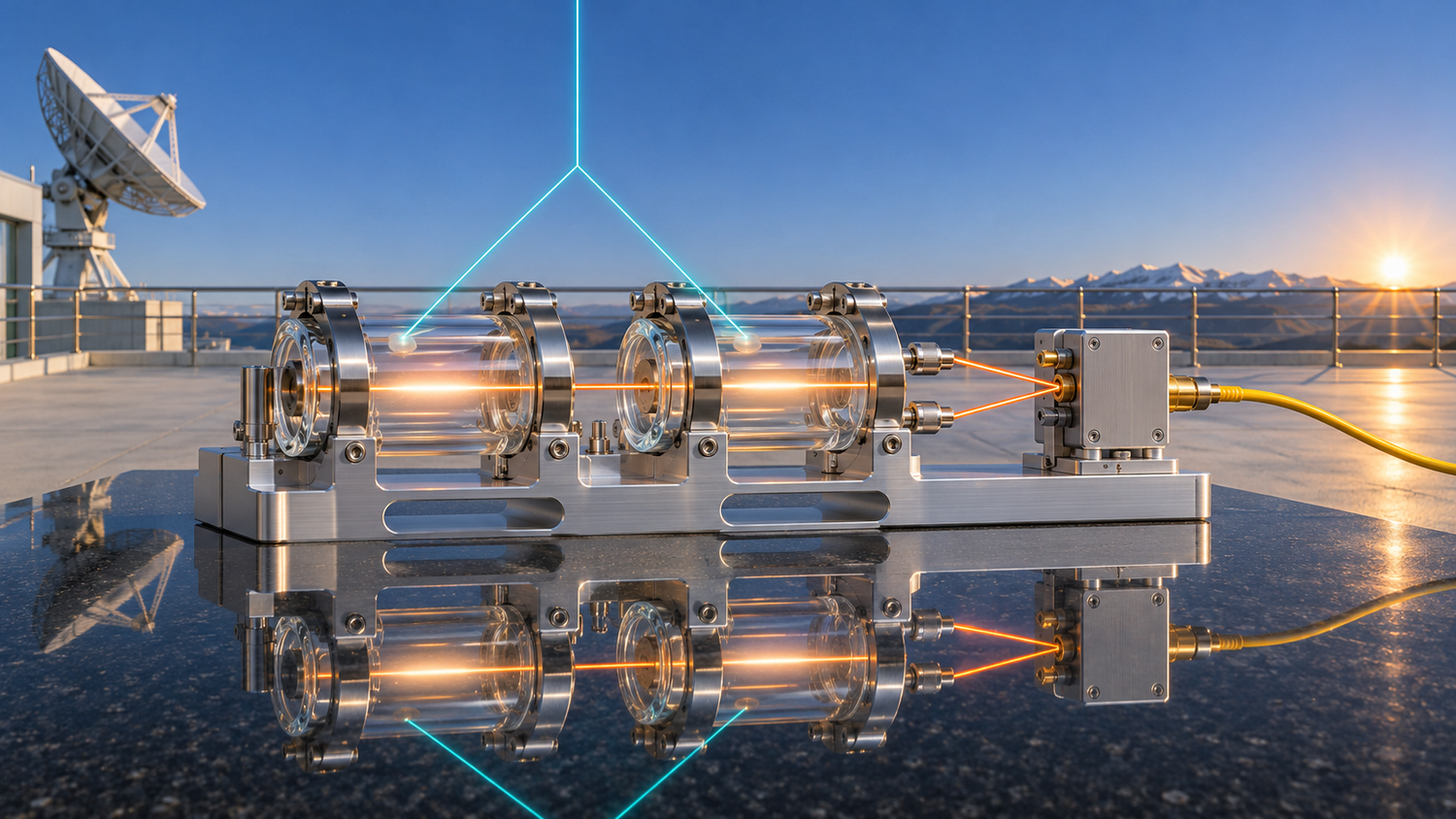
Four researchers in the Department of Electronic Systems at Aalborg University in Denmark have worked out, in equations and Monte Carlo simulation, a modeled detection threshold of about −154.5 dBm under the paper's assumptions for a proposed GNSS receiver using two atomic vapor cells read out as a matched pair. This is not demonstrated GPS acquisition or tracking sensitivity. A. K. Mandal, F. Zhang, J. H. Mikkelsen and M. Shen posted the six-page paper to arXiv on 6 November 2026, and have submitted it to the IEEE International Conference on Communications 2027. The design, which they call a differential Rydberg atomic quantum receiver, steers the wanted satellite signal into the difference between the two cells and arranges for the two dominant quantum noise sources to appear in the sum, where subtraction removes them.
The result sits inside a defense problem that civil aviation now lives with every day. Satellite navigation signals arrive at the ground far below the thermal noise floor, and a jammer a few watts strong can deny them across a region. This post reads the Aalborg paper as a Rydberg GNSS receiver proposal in the sensing pillar, positioning, navigation and timing sub-branch, dual-use in posture, and sets out how far an analytical model with an assumed squeezed-light source stands from a receiver a navigator could trust.
What the paper of 6 November 2026 establishes: two cells, one phase-controlled local oscillator, and quantum noise pushed into the common mode
A Rydberg receiver senses a radio field with atoms rather than with a metal antenna. A probe laser and a coupling laser hold cesium or rubidium atoms in a narrow transparency window, and an incoming microwave or radio field that matches a transition between two highly excited states changes how much probe light gets through. In the superheterodyne arrangement the Aalborg group uses, a strong local oscillator is combined with the faint received field before it reaches the atoms, so the beat between the two rides on the probe light and carries the amplitude and phase of the signal.
The paper adds a second cell and a rule for the local oscillator. Both cells share the same probe and coupling lasers and, because they sit closer together than the 19 centimeter wavelength of the L1 carrier, they see the same satellite field. The phase of the local oscillator fed to each cell is offset so that the two atomic responses to the wanted signal come out with opposite sign. Subtracting the two photodetector outputs then adds the signal and cancels whatever the two cells have in common. The authors call this phase balancing, and the condition reduces to an odd multiple of half a cycle between the two local-oscillator phases, with a correction when the two cells are far enough apart for path delay to matter.
The second idea is what makes the subtraction worth doing. Three noise terms limit a Rydberg receiver in the authors' model: quantum projection noise from the atoms, photon shot noise on the probe light, and intrinsic thermal noise in the electronics. Thermal noise in two separate detector chains is independent and does not cancel. Projection noise and shot noise, however, can be made to correlate between the cells if the two atomic ensembles and the two probe beams are prepared from a shared two-mode squeezed reservoir, which the paper models as a cavity-mediated source coupled to both cells. The correlation coefficients come out in closed form from the squeezing strength, the ratio of reservoir coupling to atomic decoherence, and the optical efficiency. In the paper's curves, projection-noise correlation reaches about 0.90 when the reservoir couples as fast as the atoms decohere, while a weakly squeezed reservoir saturates near 0.46, and at 80 percent optical efficiency the shot-noise correlation runs from 0.38 to 0.97 as the optical squeezing parameter rises from 0.25 to 1.5.
The numbers: 2 to 9.5 dB of SNR gain, −154.5 dBm against −146 dBm for a single cell, and −4 dB average SNR at a bit error rate of one in a thousand
The paper's own Table I puts shot noise at roughly 3.8 times the thermal noise power and more than 18 times the projection noise, so the gain from correlating the light is where the design pays off. Raising the shot-noise correlation from zero to 0.9 lifts the signal-to-noise gain over a single cell from about 2 dB to between 6.5 and 7.4 dB depending on cell temperature and density, and the gain reaches 9.5 dB as the correlation tends to one. Correlating the projection noise adds only tenths of a decibel on top.
The headline figure is minimum detectable power. The authors define it through an outage probability, the chance that a fading channel drops the received signal below a threshold signal-to-noise ratio, and use Chebyshev's inequality to turn that into a required average power. With a 0 dB threshold and 10 percent outage allowed, and a Rician channel whose line-of-sight factor rises from 1.155 to 2.4, the required power falls from about −146 dBm to about −160 dBm, a reminder that propagation statistics decide as much as the receiver does.
The receiver comparison in Figure 4 is the part a program office will quote. At the same 0 dB threshold, the plotted minimum powers are about −120 dBm for the conventional GPS front end the authors cite, −133 dBm for a high-sensitivity GNSS receiver with 20 millisecond coherent integration, −146 dBm for a single-cell Rydberg receiver, and −154.5 dBm for the two-cell differential design. The paper states this as 8.5 dB, roughly seven times less power, against the single cell, and 34.5 dB against the conventional receiver. The bit error analysis points the same way: at a bit error rate near one in a thousand, the differential receiver needs an average signal-to-noise ratio of about −4 dB, against about +5 dB for one cell and +13 to +15 dB for the high-sensitivity receiver. Every analytical point is checked against Monte Carlo simulation with 150,000 runs, and the two agree within 0.005 dB.
Quantum pillar: sensing (inertial navigation and PNT). Use posture: dual-use. Technology readiness: TRL 2 of 9. For the reader this means the two-cell receiver exists as a set of equations and a Monte Carlo simulation, its gain rests on a squeezed-light source and a cell-to-cell noise correlation that nobody has measured, and no atom has yet received a satellite signal through this design.
Why the panel reads sensing (inertial navigation and PNT), dual-use and TRL 2
The pillar is sensing because the device measures an electric field with atoms, and the sub-branch is the one Quentir's capability map reserves for position, navigation and timing where satellite signals are denied or degraded, which is the problem the authors chose as their representative weak signal. The posture is dual-use. A proposed receiver with a modeled detection threshold 34.5 dB below the cited conventional front end could become a navigation aid for ships, aircraft and vehicles, and that is defensive; GPS acquisition, tracking and jammer tolerance remain untested. The same two-cell architecture is proposed for weak narrowband signals, which the paper makes explicit by evaluating square M-QAM constellations rather than the binary phase modulation GPS actually uses, and a weak-signal receiver serves a signals collector as readily as a navigator. The readiness level is 2. The shared ladder places simulation of hardware that does not exist at level 2, and this is a simulation of a receiver whose shared squeezed reservoir, matched cells and phase-locked local oscillators have not been assembled. The closed-form expressions are checked against a numerical simulation, which is the internal check level 2 work should carry.
What a force would need tested: holding a satellite fix through jamming that EASA now reports from the Baltic to the Arctic
The operational need is on the public record. The European Union Aviation Safety Agency's page on GNSS outages and alterations points operators to Safety Information Bulletin 2022-02R4, issued on 3 July 2026, and describes interference concentrated in regions surrounding conflict zones and other sensitive areas, which it lists as the Mediterranean, Black Sea, Middle East, Baltic Sea and the Arctic. It separates jamming, which stops a receiver locking to the signal, from spoofing, which broadcasts counterfeit satellite signals to deceive it, and it tells crews to verify position by means other than GNSS when either occurs and to report every spoofing event. A military navigator faces the same spectrum, with the difference that the interference is aimed.
Lower receiver noise does not by itself establish tolerance to external interference, and jammer tolerance remains untested. Demonstrating it requires interference-specific acquisition and tracking results; the differential subtraction may reinforce an interfering field alongside the wanted signal. The GPS L1 C/A signal is a spread-spectrum code at 1575.42 megahertz clocked at 1.023 million chips per second, as ESA's Navipedia signal plan sets out, and a receiver recovers it by correlating against a known code. The Aalborg proposal places the Rydberg cells in the front end, and its modeled noise gain does not demonstrate GPS despreading, acquisition or tracking performance.
That a navigation customer is already looking at atomic receivers is also public. The European Space Agency's NAVISP program lists activity EL1-102, Quantum Receiver for Navigation Applications, with PA Consulting of the United Kingdom as prime contractor, started on 7 October 2025 for 12 months and still ongoing, with the aim of showing navigation-relevant features such as angle-of-arrival measurement and enhanced sensitivity on PA's existing Rydberg testbed, including the use of signals of opportunity. The Aalborg paper arrives as a design argument for the sensitivity half of that brief, and its single-cell benchmark rests on a cavity-coupled receiver that has already received a geostationary satellite beacon at a field sensitivity of 21 nanovolts per centimeter per root hertz, the measured starting point the two-cell idea proposes to improve on.
For a force, the capability on offer is a proposed GNSS front end whose modeled sensitivity is set by atomic physics and by how well two cells can be made to share their noise. It belongs to the same family of modeling work as the single-local-oscillator wideband Rydberg receiver that Surrey, Queen Mary and Southeast University published on 4 November 2026, which addressed bandwidth where this paper addresses the noise floor; both treat the atoms as a front end a modem must be designed around.
What stands between the simulation and a program office relying on it: a squeezed reservoir nobody has built, matched cells, phase errors and a real L1 signal
Five items separate the paper from a requirement. The first is the shared squeezed reservoir. All of the gain beyond about 2 dB comes from correlating photon shot noise and projection noise between two cells through a two-mode squeezed source, and the authors say plainly that the benefits depend on the assumed inter-cell covariances and that measuring those covariances is future work. Until a bench shows two vapor cells sharing squeezed noise at the correlations the curves assume, the −154.5 dBm figure is a design target. The second is cell matching. The subtraction only cancels what the cells have in common, and the model assumes identical fading on both cells, perfect knowledge of the channel and perfect phase balance; the authors list phase errors, cell mismatch and implementation losses as the effects they intend to assess next. The third is the signal itself. The analysis evaluates square M-QAM with hard-decision detection, while GPS L1 C/A is binary phase-shift keyed and recovered by despreading, so a demonstration should run on a real or faithfully emulated L1 waveform and report acquisition and tracking. The fourth is the operating environment. The gain assumes a far-field plane wave, narrowband fading and a 300 kelvin, 5.5 dBi antenna reference, and a receiver meant for a moving platform under deliberate interference will have to show what happens when a strong in-band jammer sits beside a weak signal, which the weak-signal approximation does not address. The fifth is measurement by someone other than the authors, on hardware, against a high-sensitivity receiver chosen by the evaluator.
What the sources support is this. An Aalborg University team has published a closed-form, simulation-checked model of a two-cell differential Rydberg receiver in which local-oscillator phase control steers the wanted signal into the difference mode and a shared squeezed reservoir correlates the two dominant quantum noise terms for cancellation, giving 2 to 9.5 dB of signal-to-noise gain over one cell and a modeled detection threshold of about −154.5 dBm under the paper's assumptions for a proposed GNSS receiver, at a 0 dB threshold and 10 percent outage. That number is not demonstrated GPS acquisition or tracking sensitivity. EASA documents the GNSS jamming and spoofing environment that gives the work its purpose, and ESA has a Rydberg navigation receiver activity under way with a UK contractor. A measurement of inter-cell noise correlation on real cells, a phase-error and mismatch budget, and an acquisition test on an L1 waveform are the next three pieces of evidence to wait for.
Sources
Primary source: A. K. Mandal, F. Zhang, J. H. Mikkelsen and M. Shen (Department of Electronic Systems, The Technical Faculty of IT and Design, Aalborg University, Aalborg Øst, Denmark), "A Phase-Balanced Differential Rydberg-Atom Quantum Receiver for Weak GNSS Signal Detection," arXiv 2611.09653, submitted 6 November 2026, 6 pages, 10 figures, submitted to IEEE ICC 2027. Other material: the EASA page on GNSS outages and alterations and Safety Information Bulletin 2022-02R4 of 3 July 2026; ESA Navipedia, GPS Signal Plan; the ESA NAVISP project page for activity EL1-102, Quantum Receiver for Navigation Applications (PA Consulting, started 7 October 2025). Lei and Shi, IEEE Transactions on Quantum Engineering 2026, and Ren and Petovello, IEEE Transactions on Aerospace and Electronic Systems 2017, are cited through the paper. The capability reading, the posture argument, the readiness placement and the buyer items are Quentir analysis.