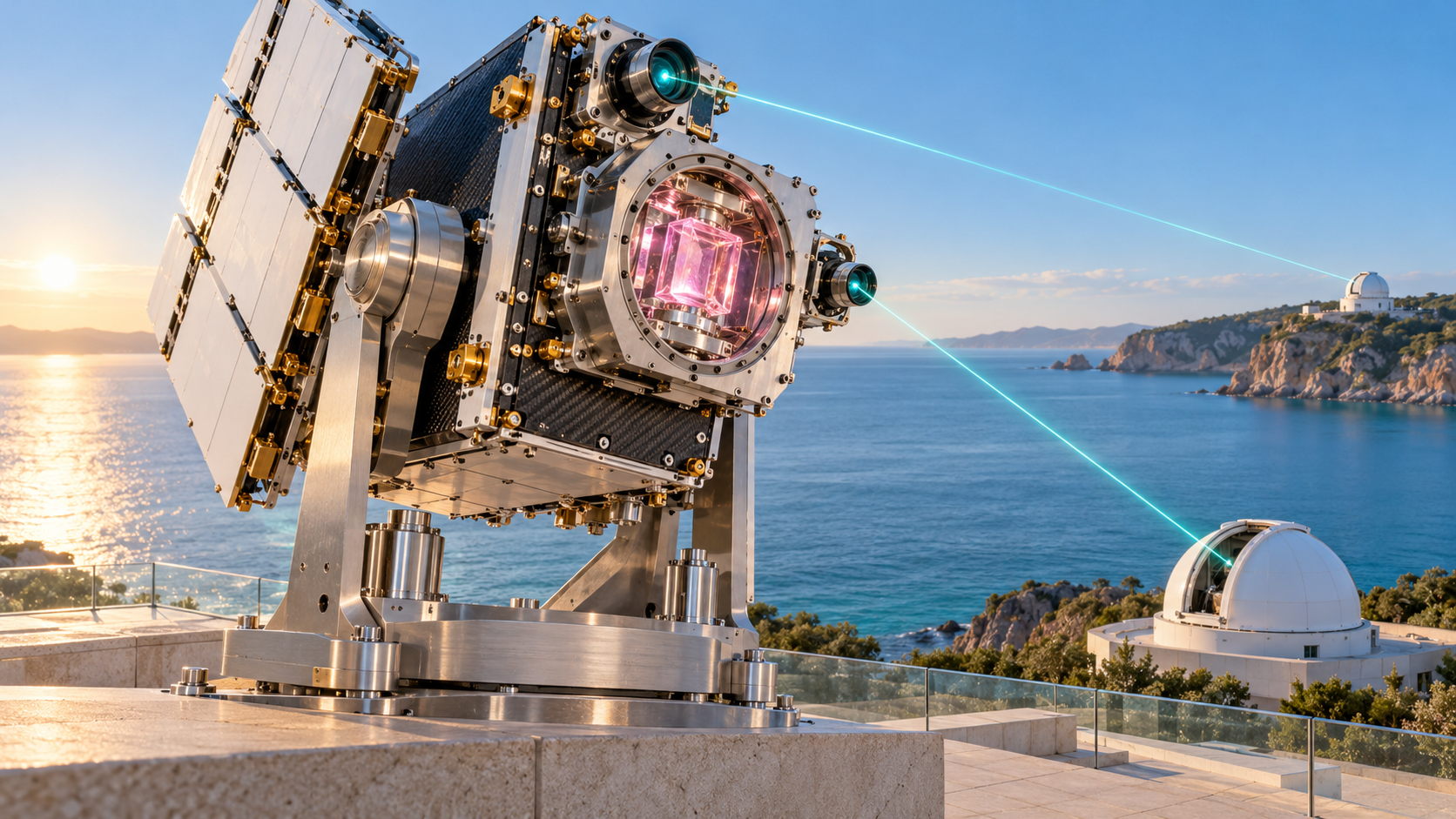
University of Luxembourg SnT Posts QNETSIM, an ESA-Backed Simulator for Satellite and Hybrid Quantum Networks, arXiv 2610.37204, 27 October 2026: 19,502 Entangled Pairs in One Paris-Vienna Pass, TRL 3
Seven researchers in the SIGCOM group of SnT at the University of Luxembourg posted arXiv 2610.37204 on 27 October 2026, describing QNETSIM, an ESA-backed discrete-event simulator that joins orbital geometry, turbulent free-space optical links, three platform-specific quantum memory models and a software-defined control plane to design satellite and hybrid space-ground quantum networks: 19,502 entangled pairs in one modeled Paris-Vienna pass, a 3.35 times yield gain from longer memory coherence when ground stations sit 500 kilometers apart, and a ground repeater whose qualified yield stops improving past 60 seconds of coherence. This post reads the paper as a dual-use satellite quantum key distribution design capability under the networking pillar, weighs what quantum memory coherence time buys a constellation designer, and sets out the validation, statistics and key-manager coupling a program office would need before relying on a space-ground quantum network simulator.

A 24 August Proof Shows an Unbounded Quantum Memory Advantage in Online Sequence Classification
A new proof by Ng, Li, Gu and Thompson shows that for constructed stream-classification tasks, quantum memory stays bounded where any exact classical watcher needs memory that grows without limit, and that for each classical agent below the threshold there exists a suitable input distribution under which its performance approaches guessing. We read the result as the mathematical skeleton of machine learning for ISR, weigh what it would let an edge platform notice on a fixed power budget, and walk the honest distance between a first proof and anything a program office could field.