University of Luxembourg SnT Posts QNETSIM, an ESA-Backed Simulator for Satellite and Hybrid Quantum Networks, arXiv 2610.37204, 27 October 2026: 19,502 Entangled Pairs in One Paris-Vienna Pass, TRL 3
Quentir Defense Monitor
Evidence-based insights for quantum defense and security. Published by Quentir Systems LLC · October 29, 2026.
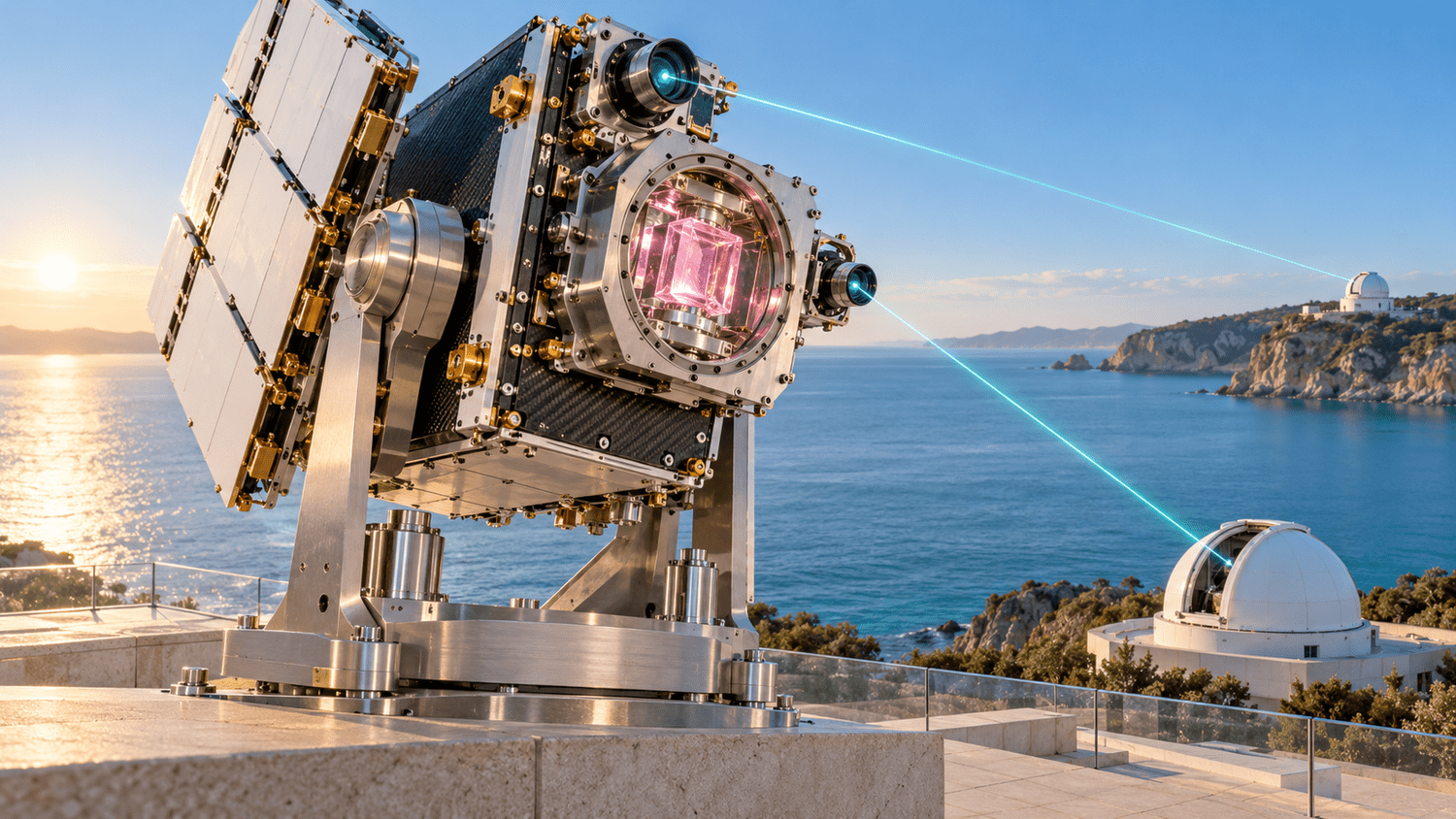
Seven researchers in the SIGCOM group of SnT, the University of Luxembourg's security and trust research center, posted a paper on 27 October 2026 describing QNETSIM, a discrete-event simulator built to design satellite and hybrid space-ground quantum networks before the satellites exist. The paper, arXiv 2610.37204, carries Seid Koudia as corresponding author with Symeon Chatzinotas, who heads the group, as senior author, and it states that the work was carried out under a European Space Agency contract for a project of the same name.
The subject matters to a defense reader for a plain reason. A quantum key distribution link over fiber faces a rate-distance trade-off as losses increase: twin-field QKD has been demonstrated over 1,002 kilometers of fiber under experimental conditions, but achievable key rates depend on the protocol and operating conditions, and a ship, an overseas base or a deployed headquarters may have no fiber at all. Space offers a way to carry quantum keys across those distances without a chain of trusted relays that each hold the key in the clear, depending on the protocol and trust assumptions, and Europe is about to try it: the European Space Agency's Eagle-1 satellite, led by SES with more than twenty European companies, will spend three years in orbit validation once launched. This post reads what the Luxembourg simulator establishes about satellite quantum key distribution design, what it leaves open, and what a program office would still need before it relied on the tool.
What QNETSIM models: orbits, turbulent optical links, three kinds of quantum memory and a software-defined control plane
A satellite quantum network is a timing problem as much as a physics problem. The satellite sees one ground station for a few minutes and the second a few minutes later, so the photons that would join the two must either be sent to both at once or held somewhere in between. QNETSIM treats the whole chain as a sequence of events on one global clock: orbital geometry decides who can see whom, a channel model decides how many photons survive, a memory model decides how long a stored photon keeps its state, and a control plane decides when to generate, store and swap entanglement.
The channel model is the part a space engineer will inspect first. The free-space link uses Gaussian beam spreading with finite apertures and pointing error, a Hufnagel-Valley turbulence profile and a Gamma-Gamma description of scintillation. The default optical set is an 810 nanometer wavelength, a 0.15 meter transmitter, a 0.50 meter receiver and 12 microradian divergence, with detectors at 60 percent efficiency, 50 picosecond jitter and a 50 nanosecond dead time.
The memory models are what separate this simulator from the tools it compares itself against. The paper's own table lists QuNetSim, NetSquid, QNET, SeQUeNCe and QuISP, and positions QNETSIM as the one with platform-specific memory physics rather than an abstract storage element. Three platforms are written out with explicit decoherence laws: a cold-atom memory, a rare-earth-ion-doped crystal of the praseodymium-in-yttrium-orthosilicate type with a spin-wave storage protocol, and a trapped-ion interface described by cooperativity. Memory capacity is finite and counted in modes, which is what lets the simulator report when a ground station's memory bank fills up.
What the four scenarios returned: a 3.35 times gain from longer memory, a Paris-Vienna pass and a ground repeater that stops improving past 60 seconds
The first scenario puts the Bell-state measurement on the satellite, at 500 kilometers altitude, with two optical ground stations below. When the two stations sit together, memory coherence time hardly matters: integrated pairs rise from 27,201 to 27,571 as the coherence time goes from 30 to 300 seconds, a 1.4 percent gain, because the photons arrive together and nothing waits. When the stations are 500 kilometers apart and the pass runs across the line between them, the same change lifts the yield from 4,750 to 15,922 pairs, a factor of 3.35. The paper's reading is the one a buyer should keep: quantum memory coherence time buys most of its value when the geometry forces one photon to wait for the other, which is exactly the geometry of two distant national sites. Turbulence was a smaller lever: raising the Rytov variance from 0.02 to 0.5 cut the co-located yield by 5.9 percent.
The second part of that scenario is a specific pass. A circular 360 kilometer orbit on 25 September 2026 at 17:00 UTC gives Paris and Vienna 312.7 seconds of shared visibility above a 10 degree mask. The run delivered 19,502 entangled pairs, 62.4 per second of shared visibility with a peak of 116.5 per second, at a per-arm loss near 31 decibels and a success-weighted fidelity of 0.855. The Vienna memory bank reached its 256-mode capacity during the pass. That last number is the kind of result a design tool exists to produce: a memory sized for a balanced test can be under-provisioned for a real pass whose two arms fill at different times.
Quantum pillar: networking (satellite QKD). Use posture: dual-use. Technology readiness: TRL 3 of 9. The Luxembourg team built working simulation software and exercised it on four synthetic satellite-network scenarios with physically motivated parameters, which is working software on stand-in data; the tool has not been checked against another simulator or against a flown link, and no hardware of its own exists, so it sits at an experimental proof of concept rather than a validated design instrument.
Where the simulator sits in the capability map, who gains, and why the posture reads as dual-use
The capability map Quentir uses for the Defense Monitor files space-segment key distribution and inter-satellite links under the networking pillar as satellite QKD, and the paper belongs there even though its deliverable is software. Every scenario in it is a space-ground key or entanglement distribution architecture, and the stated next step is coupling the simulator to a key management system. The ETSI industry specification group on QKD published GS QKD 020 in June 2026 as the protocol and data format for an interoperable key management API, and the paper names that family of specifications as its integration target.
What would a force gain if the tool matured? A sizing instrument. A program office deciding how many satellites, how much onboard memory and which ground stations to buy can already use models to test those choices against orbital geometry and atmospheric statistics; QNETSIM brings those models together with platform-specific memory physics and a software-defined control plane. The third scenario shows the shape of the answer. A ground-based repeater at Windhof, west of Luxembourg City, sits between an 810 nanometer satellite downlink and a 16.14 kilometer fiber to Kirchberg. Across a near-zenith pass of about 760 seconds, counting only pairs above a fidelity of 0.8, a memory with a 0.6 second coherence time yields almost nothing, 6 seconds yields about 2,000 pairs, 60 seconds yields about 7,900, and 600 seconds yields the same 7,900. Past one minute of coherence, increasing coherence time buys no further yield on that pass under the scenario's fixed configuration, and a buyer reading that curve knows which memory specification to write.
The second scenario runs a low Earth orbit constellation serving Luxembourg to Singapore through time-varying three-hop and four-hop routes and holds delivered quality near 0.78 across the plotted windows, the first published shape of a hybrid space-ground quantum network service timeline from this group and the scenario closest to what a national authority with overseas sites would ask for.
The posture is dual-use in the map's sense. The same simulator serves the civil European Quantum Communication Infrastructure, which the European Commission describes as spanning all 27 member states with 19 cross-border terrestrial projects and a space segment built with ESA, and it serves a defense ministry sizing a sovereign key service for forces beyond fiber reach. The Commission's EuroQCI page places the infrastructure inside IRIS², the EU's secure connectivity system, and puts the Eagle-1 launch in late 2027, later than the ESA page's late 2026 or early 2027. In a trusted-relay QKD architecture, the satellite must be trusted with key material; in entanglement-based QKD with trusted endpoint devices and appropriate protocol security checks, the ground stations can generate keys without trusting the satellite with them. Ownership alone does not confer those keys; the design tool takes no side. Quentir read the hardware end of the same European effort when DAS Photonics' faint pulse source passed space qualification for ESA's QKDSat: one story is a flight component, the other is the model that decides how many such components a constellation needs.
What stands between the paper and a program office: validation, confidence intervals, calibrated hardware and a real key manager
The first gap is validation, and the authors do not hide it. The paper offers comparative context against five other simulators and against the Micius dual-downlink attenuation of 64 to 82 decibels that Yin and colleagues measured in 2017. There is no head-to-head run showing QNETSIM and NetSquid or SeQUeNCe agreeing on one scenario, and no run reproducing a flown link. Until one exists, every number above is a statement about the model's internal consistency.
The second gap is statistics. The ground-repeater results present one counting realization and an across-realization mean with no confidence interval or replication count. A buyer wants error bars before writing a requirement from a curve.
The third gap is hardware. The three memory models are explicit, which is the paper's strength, yet the authors state that space-qualified hardware, spectral conversion and heralded loading require platform-specific calibration. The direct-distribution scenario between Matera in Italy and Helmos in Greece shows how sensitive that calibration is: at a target fidelity of 0.90 the optimized operating point yields about 1.14 million genuine coincidences per second at 810 nanometers against about 400,000 at 1550 nanometers, and one field-stop setting costs 0.5 decibels under a favorable turbulence profile and 5.17 decibels at surface conditions.
The fourth gap is the control plane. The paper exposes an HTTP and JSON event-action interface so that a real orchestration controller can drive simulated satellite links, and it proposes coupling to a production key management system through ETSI GS QKD 014 for key delivery, QKD 015 for the SDN controller interface and QKD 020 for horizontal key transfer. Operation with physical testbed devices, clock synchronization and security controls are listed as separate integration work. Quentir read the policy end of that question in the UK-Singapore financial dialogue joint statement of 20 October 2026, where QKD appears beside post-quantum cryptography in the two governments' financial-sector language; a simulator that speaks the ETSI key-delivery interfaces is what would let a satellite key service plug into the key managers those agencies already run.
The practical reading for a buyer is this. The Luxembourg paper establishes that a space-ground quantum network simulator with platform-specific memory physics now exists, runs on realistic orbits and specific passes, and returns the trade-offs a constellation designer needs: memory coherence against station separation, memory capacity against pass asymmetry, and wavelength against loss. It does not establish that its numbers match a flown link or another tool. A program office with a satellite key distribution interest should file this as a design instrument worth a validation request, and should expect the next evidence to come from a cross-simulator comparison on a shared scenario, from Eagle-1 pass data once the satellite flies, and from a demonstration of the key-manager coupling the authors propose.
Sources
Primary source: Seid Koudia, Francesco Vista, Heyang Peng, Ilora Maity, Intidhar Bedhief, Juan Carlos Hernandez Hernandez and Symeon Chatzinotas (SIGCOM group, SnT, University of Luxembourg), "QNETSIM for memory assisted design of satellite and hybrid quantum networks," arXiv 2610.37204, posted 27 October 2026, carried out under the European Space Agency project Quantum information NETworks SIMulator. Other material: European Space Agency, Eagle-1 project page; European Commission, European Quantum Communication Infrastructure policy page; ETSI, Industry Specification Group on Quantum Key Distribution. The capability reading, the posture argument and the buyer milestones are Quentir analysis.