A Korean Pharma Webinar Names the Quantum Workload
Quentir Medicine Monitor
Evidence-based insights for quantum medicine. Published by Quentir Systems LLC · August 11, 2026.
A drug program can spend years eliminating molecules that looked promising in an earlier model. Each filter, from target binding through toxicity and metabolism, asks a different computational or biological question. The losses are expensive, but they also protect patients from weak candidates reaching trials.
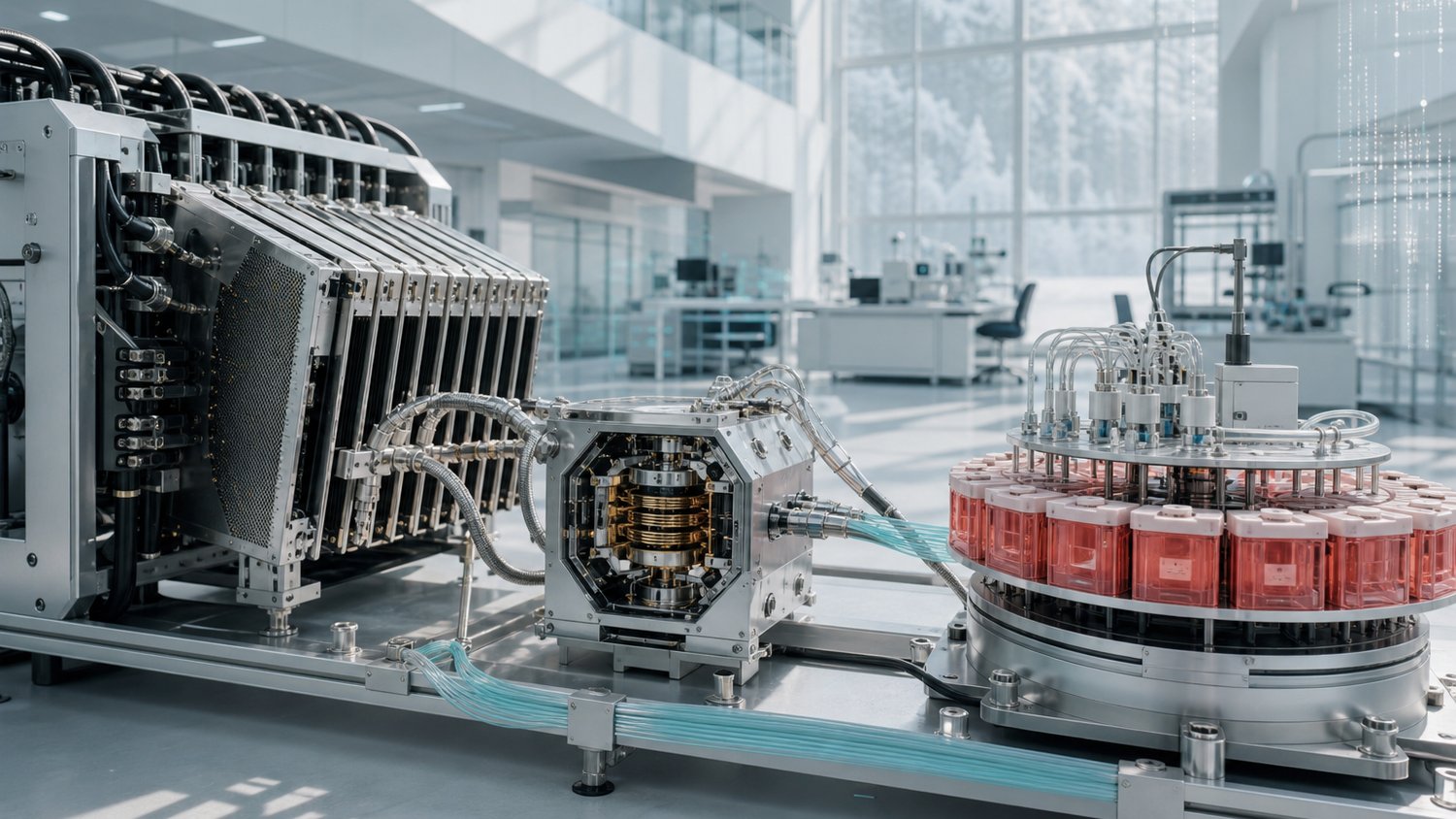
SDT is putting quantum computing beside those filters. On August 11, Tech42 reported that the company would present a hybrid quantum computing stack at the Korea Pharmaceutical and Bio-Pharma Manufacturers Association's first AI drug-discovery webinar on August 13. SDT's planned environment joins CPUs, GPUs, simulators, and quantum processors. Its proposed uses include molecular simulation, candidate search, and ADMET prediction.
That list carries a useful discipline. A drug-discovery workload has to be named before anyone can judge whether a quantum processor helps. The event preview gives the proposed work a useful outline while leaving performance for a later experiment.
Practical takeaway. SDT has described the test environment; KPBMA supplies the convening point for pharmaceutical researchers. The next useful result will be a comparison on one defined task, using the same data and acceptance criteria across classical and quantum backends.
SDT owns the platform; KPBMA convenes the room
Tech42's August 11 account establishes what is scheduled. KPBMA will host an online webinar titled “The Current State of Quantum Computing Applied to Drug Discovery R&D.” The announced participants include Dutch superconducting-QPU developer QuantWare, Quantum Intelligence and its QUEST drug-discovery platform, the Korea Research Institute of Bioscience and Biotechnology, and SDT.
SDT says it will demonstrate QuREKA, its quantum-computing-as-a-service platform. The article describes access to the company's own superconducting machine, IonQ trapped-ion systems, high-performance simulators, and a CUDA-Q application environment. It also says researchers can select resources according to the problem and algorithm.
The ownership line is simple. QuREKA belongs to SDT. KPBMA hosts the webinar, and the other named organizations arrive as participants. This is an event preview built largely on company statements, so it establishes the schedule and participants. It also describes the architecture and proposed uses. Performance remains open.
One environment can make the comparison fairer
A hybrid platform matters because useful drug discovery already depends on different kinds of computation. Classical molecular dynamics and docking answer some questions. Machine learning and laboratory assays answer others. A quantum subroutine would enter that chain at a specific step. It would not replace the chain.
The CUDA-Q documentation describes a development model that can target CPUs, GPUs, and multiple quantum backends from one environment. Portability does not prove performance. It does make controlled comparison more practical: the same problem definition can move between a simulator and available processors while the surrounding classical code remains visible.
For pharmaceutical teams, that may be the architecture's most immediate contribution. A spectacular result on one proprietary setup can be hard to reproduce. A workload that runs through a common interface can be compared for runtime and accuracy. Resource use matters too, as do stability and sensitivity to hardware noise. The quantum component then has to earn its place beside established methods.
Quantum pillar: computing. Technology readiness: not applicable. The public record describes an announced pharmaceutical application plan and platform architecture, with no reported drug-discovery experiment or benchmark result to place on the ladder.
ADMET is where broad language meets a difficult endpoint
ADMET asks how a drug is absorbed and distributed, how it is metabolized and excreted, and whether it is toxic. These properties help determine whether a molecule that binds well in a model can survive the rest of the journey toward a medicine. They are not one calculation. Each property brings its own data and assays. The uncertainty and cost of failure differ too.
SDT's announcement names ADMET prediction as a possible use without identifying a dataset, target property, model, baseline, or metric. Those choices belong to the experiment that would follow. They will determine whether the quantum layer improves prediction, reduces compute cost, or simply provides another backend for an exploratory model.
A credible follow-on could be modest: one public dataset, one prespecified endpoint, and classical baselines that already perform well. Repeated runs would expose variance. A held-out test set would check generalization. The useful result could be negative. Learning that a quantum route adds cost without improving the answer would save laboratories from pursuing the wrong branch.
The convening may matter more than the first demo
KPBMA's role brings the demand side into the room. Hardware companies know the limits of processors. Pharmaceutical scientists know which approximations or bottlenecks consume time and which errors can kill a program. Research institutes can connect algorithm design to biochemical practice. These groups often meet only after a technology claim has already hardened into a sales story.
The institutional mix is therefore more interesting than a generic promise of faster discovery. It creates a place where a pharma team can ask whether a candidate task is data-limited, compute-limited, or assay-limited. A QPU helps only with the middle category, and even there only when an algorithm plus the available hardware can beat a strong alternative on the measure that matters.
The humane stake sits several stages downstream. Better early filters can reduce wasted experiments and steer scarce research effort toward candidates with a stronger chance of helping patients. Poor filters do the opposite. They can discard a useful molecule or advance a fragile one. Quantum medicine earns trust when it improves that choice under comparison, not when it decorates the pipeline.
How Quentir Reads It
This event is best read as the introduction of a testing surface. SDT's announced stack links classical and quantum resources, while KPBMA's webinar links technology suppliers to pharmaceutical users. Together they can turn a broad claim about drug discovery into a workload that another group could inspect.
The original connection is between portability and scientific restraint. Multi-backend access is usually sold as convenience. In quantum medicine, it can also serve as a check on overclaim. If the same task can move between simulator, GPU, and QPU, the quantum contribution becomes easier to isolate. Hardware noise, preprocessing, classical optimization, and post-processing remain part of the record instead of disappearing behind one final score.
Quentir records two separate developments: SDT has described a multi-backend architecture, and KPBMA has created a pharmaceutical forum for it. Their value will converge when a named workload produces a result that can be compared.
The first useful answer may be a boundary
The next milestone is smaller than a new drug. It is one workload for which SDT and participating researchers can say exactly what ran on the QPU, what stayed classical, which baseline was used, and how the result changed across repeated runs. That answer would locate the boundary between a capable hybrid laboratory and a quantum advantage claim.
Drug discovery has room for tools that clarify where they fail. A well-designed comparison can reveal that a quantum method works only at a toy scale, only under a favorable encoding, or only before the cost of data preparation is counted. It can also reveal a narrow task worth pursuing. Either outcome would give pharmaceutical researchers something more durable than an August webinar: a result that tells them where the QPU belongs on the workbench.
Sources
Primary source: no first-party SDT or KPBMA event notice was located in the public record inspected. Lead media source: Jeong Jae-yeop, Tech42, August 11, 2026, reporting SDT's announcement. Corroborating secondary event account: Startup Recipe, August 11, 2026. Technical context: NVIDIA CUDA-Q documentation, accessed August 11, 2026.