Quantum Foundry Copenhagen Plans a 5,300-Square-Meter Quantum Chip Factory for 2027: What the Novo Nordisk Foundation Announced on 4 September 2026
Quentir Medicine Monitor
Evidence-based insights for quantum medicine. Published by Quentir Systems LLC · September 4, 2026.
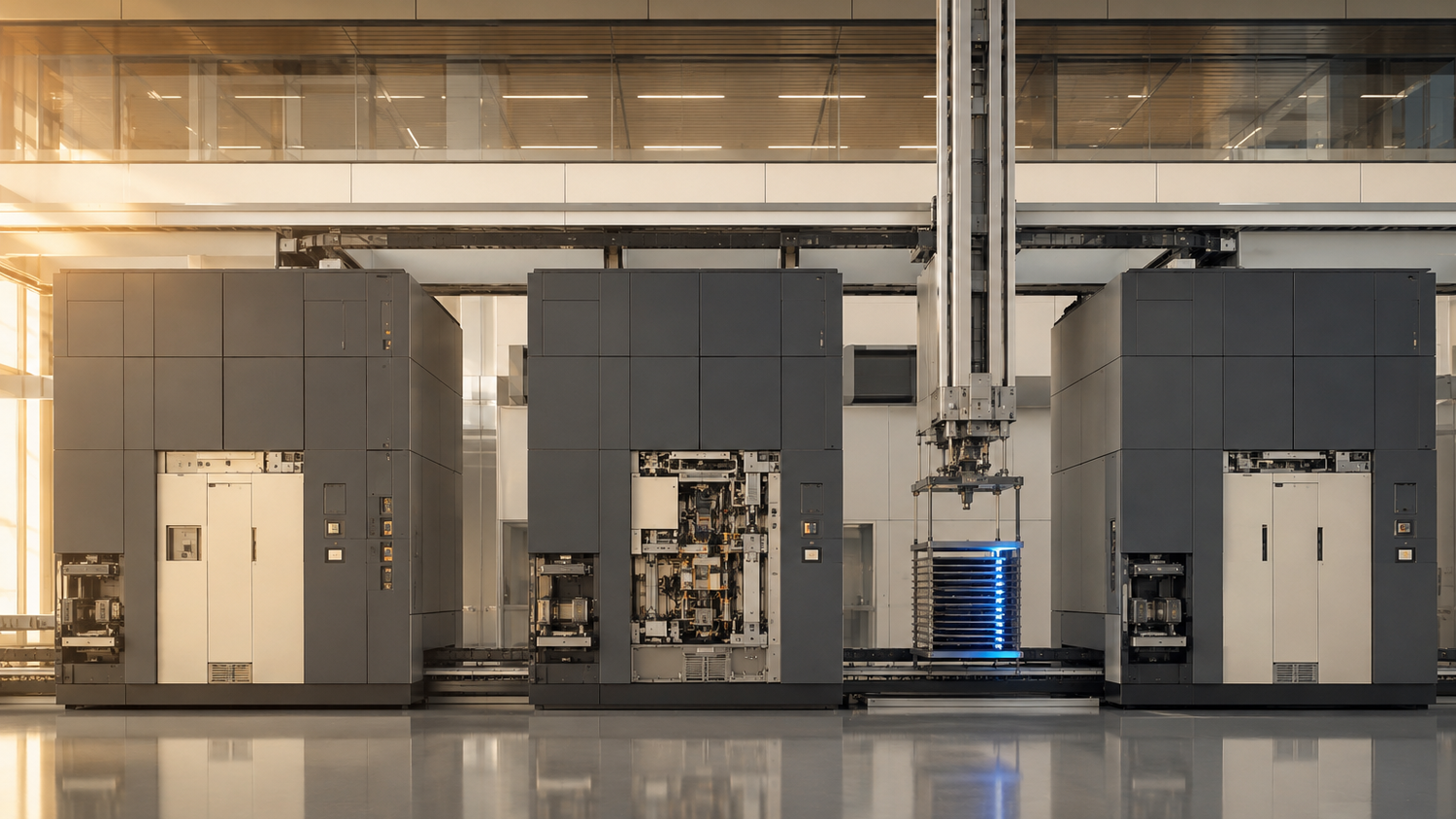
A health foundation announcing a chip plant is unusual enough to state plainly. On 4 September 2026 the Novo Nordisk Foundation and Quantum Foundry Copenhagen, the company the foundation started in 2023 and owns, said they will build a 5,300-square-meter quantum chip fabrication facility in Copenhagen, with an opening expected in 2027. The plant is to combine nanofabrication of quantum materials, characterization, testing, chip assembly and packaging, and it is to sell wafer fabrication to quantum technology vendors elsewhere in the world on commercial terms.
The foundation's own Danish announcement puts faster development of new medicine among the reasons for spending the money. Its total commitment to quantum technology now exceeds DKK 2.9 billion, about EUR 390 million, and the factory is the manufacturing end of it. Two days earlier the engineering firm Ramboll handed over the Copenhagen building that will house Magne, the machine the foundation co-owns through QuNorth. Both projects run toward the same declared destination, a fault-tolerant quantum computer in Denmark before 2034, and a clinician reading the announcement is entitled to ask what any of it does for a patient in the meantime.
What Quantum Foundry Copenhagen and the Novo Nordisk Foundation Announced on 4 September 2026
The announcement published by the foundation in Danish, and its English counterpart issued the same morning over GlobeNewswire, describe one building and four functions. The facility is 5,300 square meters. It will hold laboratory space for nanofabrication of quantum materials, equipment for advanced characterization and testing, a line for chip assembly and packaging, and ultra-high-vacuum manufacturing capability. The company's stated purpose is to develop and scale the manufacturing equipment that next-generation quantum chips need, and then to run wafers for other vendors commercially. Opening is expected in 2027.
Quantum Foundry Copenhagen was founded by the foundation in 2023 and develops its own tools, materials and processes for quantum chip manufacturing. Its chief executive is Peter Krogstrup, who states the ambition plainly: the company means to supply Europe with "advanced, next-generation quantum computing processors" and to let quantum companies scale production. Mads Krogsgaard Thomsen, chief executive of the Novo Nordisk Foundation, frames the plant as the link between research money already spent and the industrial capacity that would turn it into products. Lene Oddershede, the foundation's chief scientific officer, compares quantum technology to semiconductors and the internet as a platform other things get built on. Henna Virkkunen, the European Commission's executive vice-president for technological sovereignty, security and democracy, and Martin Lidegaard, Denmark's minister of business and competitiveness, both appear in the release, which places the project inside Europe's argument about converting science into factories rather than inside a health portfolio.
One figure sits outside the release. Bloomberg reported on the same day, from an interview with Krogstrup, that the foundation will put roughly DKK 400 million, about USD 62 million, into building the research and development organization and preparing the facility, that the production line itself will need further money, and that production could start about two years out. The foundation's own materials do not carry that number, so it should be read as the chief executive's account to a reporter rather than as a committed figure in a published instrument. The distinction matters for anyone modeling when European wafer capacity actually exists.
Quantum pillar: computing. Technology readiness: TRL 4 of 9, as a provisional estimate by this Monitor rather than a rating the parties publish. Rung four means validated in the laboratory, and the announcement establishes tool, material and process development since 2023 without describing a documented validation run, so the placement rests on what the company says it has built and on the fact that the plant to qualify it does not exist yet. The company is now building the plant in which those processes would be qualified at production scale; the building opens in 2027, the production line still needs funding, and the reviewed materials report no qualified production-scale run. For a hospital or pharmaceutical buyer this is several steps before a purchasable quantum processor and many steps before any clinical or discovery workload runs on chips made here.
Why a Chip Factory Is the Slow Part of the Medicine Argument
The foundation's Danish text says quantum technology could help develop new medicine faster. That claim is reasonable in direction and very early in degree, and the honest way to size it is to look at what quantum chemistry did for a drug target in the same week. On 1 September 2026 QC Ware and IonQ reported chemical accuracy on an enzyme active-site model presented as a drug-discovery workflow, and the calculation, as this Monitor read it when QC Ware and IonQ mapped four orbitals of a cytochrome P450nor active site onto eight qubits of IonQ Forte, covered four orbitals on eight qubits inside a larger classical treatment. That is a genuine result and a very small quantum region. Cytochrome P450nor is a fungal nitric oxide reductase rather than one of the human monooxygenases that carry most drug metabolism, so it stands here as a tractable test system for the method, not as a drug target. The gap between four orbitals and an active site of the size a real program would need is where the whole industrial argument lives. Hardware is one binding constraint there, and better algorithms alone do not bridge the demonstrated scale gap; error correction and the choice of active space bind alongside it.
This is what makes the foundry decision coherent rather than eccentric. If qubit count, qubit quality and the yield of the chips that carry them are among the binding limits on quantum chemistry for pharmacology, then a health funder that wants the medical payoff has to buy into fabrication, because nobody reaches useful chemistry by writing better software against processors that do not exist. Buying that capacity means accepting a decade of lead time and a plant whose customers, for years, will mostly be other quantum companies rather than pharmaceutical ones. The foundation appears to have accepted exactly that trade.
Where the DKK 2.9 Billion Has Gone: the Niels Bohr Institute Program, QuNorth and Magne
The chip factory is the third visible layer of a stack the foundation has been assembling. The first is research: the Novo Nordisk Foundation Quantum Computing Program at the Niels Bohr Institute, University of Copenhagen, whose stated aim is Denmark's first fully functional fault-tolerant quantum computer before 2034. The second is a machine to use in the meantime. In 2025 the foundation and EIFO, Denmark's export and investment fund, each put in about EUR 40 million to establish QuNorth and acquire Magne, specified at 50 logical qubits over more than 1,200 physical neutral-atom qubits, with hardware from Atom Computing and software from Microsoft, and 100 percent Danish ownership.
Magne moved this week too. Ramboll completed the Copenhagen facilities on 2 September 2026, including the computer room, server room and airlock together with ventilation, power, cooling and fire suppression, which lets QuNorth begin installing the system; full operation is expected in spring 2027. Hans Kragh, Ramboll's senior chief project manager, described the requirement in terms a hospital estates department would recognize, a precision environment controlling vibration, dust, magnetic fields, static electricity, temperature and humidity. Ebba Carbonnier, QuNorth's chief executive, has framed Magne as capacity that accelerates the development of new solutions for Nordic researchers and companies.
Two of those three layers therefore arrive in 2027: Magne in the spring, and the factory at some point in the same year. That is a compressed schedule for a program whose scientific destination is 2034, and it is a different funding shape from the state-led programs this field usually reports. Where Korea, for instance, placed two quantum deliverables inside a KRW 200 trillion national research strategy, Denmark's largest quantum commitments come from an independent Danish enterprise foundation with philanthropic objectives, which answers to its own board and can hold a position across a decade without an election intervening. Virkkunen's line about converting scientific expertise into industrial capacity is the European version of the same problem, and a foundation balance sheet is one of the few instruments in Europe that can hold a position that long.
What a Hospital or Pharmaceutical Buyer Should Watch Between Now and the 2027 Opening
Four things are checkable and will resolve on their own schedule. Whether the production line is funded, since the DKK 400 million Krogstrup described covers the organization and the facility rather than the line itself. Whether the foundry's first customers become public, since a wafer service selling to quantum vendors on commercial terms may name them or may keep them confidential, and either choice tells a reader something about the order book. Whether Magne, once operational in spring 2027, gets a published allocation for chemistry and life-science workloads rather than general Nordic research access. And whether the Niels Bohr Institute program states the qubit count and error rate it thinks a pharmacologically useful active-site calculation requires, which would let anyone compare the 2034 target against the four-orbital demonstrations being published now. This Monitor will read each of those when it lands.
Sources
Primary source: the Novo Nordisk Foundation and Quantum Foundry Copenhagen, "Ny fabrik i København skal styrke Europas kapacitet til fremstilling af kvanteteknologi," announcement of 4 September 2026, and its English counterpart "New Copenhagen facility to strengthen Europe's quantum manufacturing capabilities" issued the same day over GlobeNewswire, for the 5,300 square meters, the four functions of the plant, the 2027 opening, the commercial wafer service, the founding of Quantum Foundry Copenhagen in 2023, the DKK 2.9 billion total, the 2034 fault-tolerant target at the Niels Bohr Institute, and the quotations from Peter Krogstrup, Mads Krogsgaard Thomsen, Lene Oddershede, Henna Virkkunen and Martin Lidegaard. Bloomberg's report of 4 September 2026 is the sole source for the DKK 400 million, about USD 62 million, and for Krogstrup's statement that the production line needs further funding and that production could begin about two years out; the foundation's own materials do not carry those figures. The Quantum Insider, 4 September 2026, corroborates the facility description, and its report of 2 September 2026 supplies the Ramboll handover, the rooms and building systems, the spring 2027 operating date and the quotations from Hans Kragh and Ebba Carbonnier. The Novo Nordisk Foundation's own release on the acquisition of Magne supplies the EUR 80 million total, the roughly EUR 40 million each from the foundation and EIFO, the 50 logical qubits and the count of more than 1,200 physical neutral-atom qubits, and the roles of Atom Computing and Microsoft. The QC Ware and IonQ result and the Korean research strategy are cited through this site's earlier posts, which carry their own primary sources. The judgments are this Monitor's own: the TRL 4 placement of the manufacturing capability, the reading of the four-orbital demonstration as the size of the medicine gap, and the four items a buyer can check.