A Village Health Kiosk, 70 Kilometers of Fiber, and 12.7 Bits a Second
Quentir Medicine Monitor
Evidence-based insights for quantum medicine. Published by Quentir Systems LLC · August 20, 2026.
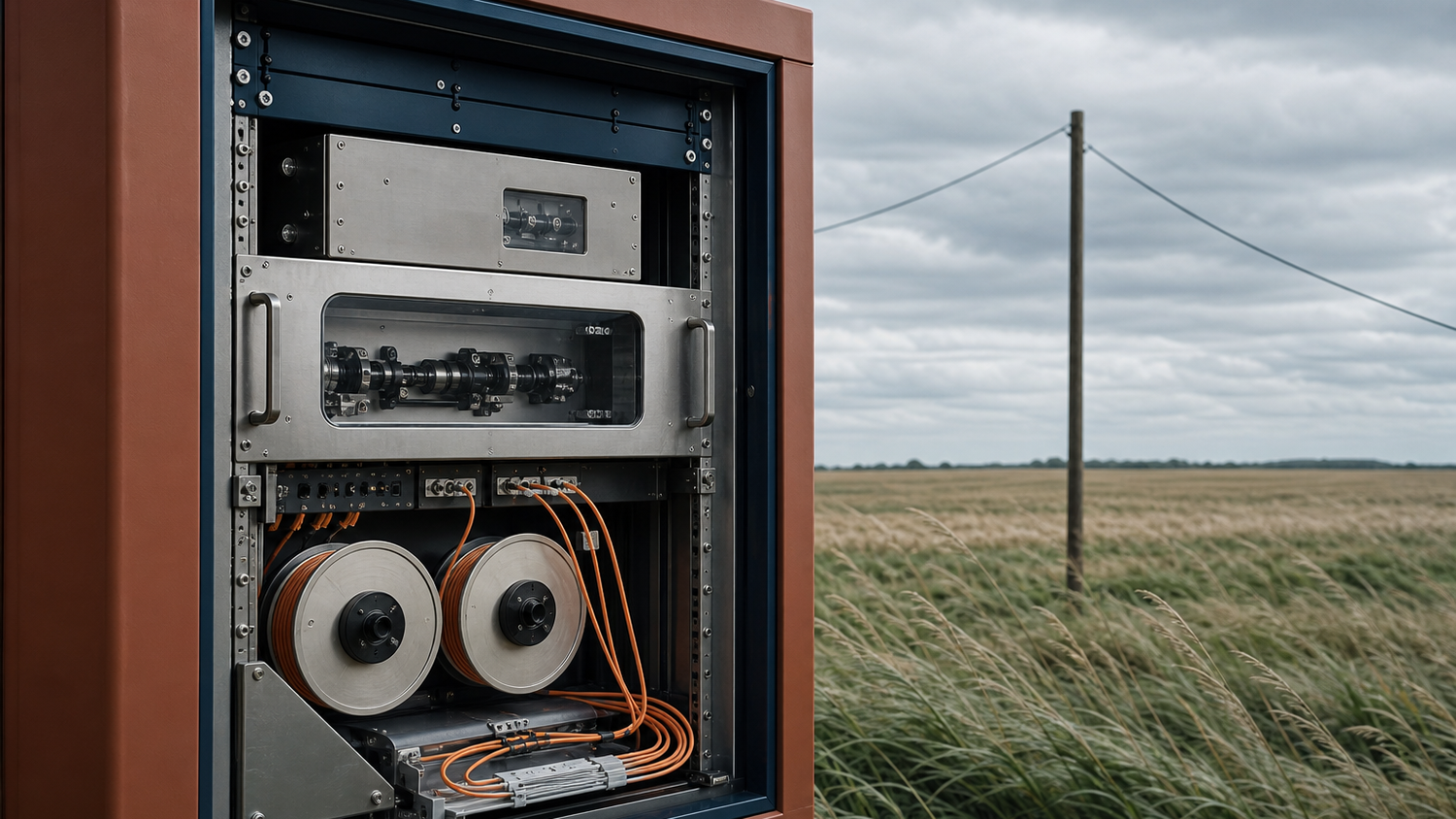
In a health kiosk in the Thuringian village of Sundhausen, a participant sat down for a fifteen-minute consultation with a physician at the university hospital in Jena. Audio and video ran for the full session without interruption or perceptible delay. The keys protecting that traffic had been generated from polarization-entangled photon pairs sent down installed telecommunications fiber, much of it strung between poles across open farmland.
A German research team has now published its field report on that network, and the numbers in it are more interesting than the demonstration. The deployment pairs entanglement-based quantum key distribution using the BBM92 protocol with end-to-end post-quantum cryptography, running the sntrup761 and ML-KEM-768 key exchanges above it. The engineering choice worth a hospital reader's attention is that the quantum keys were pushed straight into standard Linux VPN tunnels between adjacent nodes, with no dedicated key management system in between, and the existing medical systems were left unmodified.
Practical takeaway. Read this as two separately operated links rather than one continuous quantum-protected clinical channel. The aerial-heavy link to the village delivered roughly half the key rate of the buried one at twice the error rate, the final hop into the hospital ran on stored keys, and the teleconsultation itself was a fifteen-minute simulation.
Two links, two very different sets of numbers
The network the paper measures spans about 140 kilometers of installed fiber in total, arranged as two links through a trusted node at Erfurt. The Sundhausen to Erfurt link covers 70 kilometers, of which 51 kilometers hang in the air and 19 run underground. The Jena to Erfurt link covers 69 kilometers, almost all of it buried, with roughly 4 kilometers aerial.
Those construction details show up directly in the measurements. On the aerial-heavy Sundhausen link the secure key rate averaged 12.7 bits per second with a standard deviation of 10.3, at a quantum bit error rate of 13.3 percent with a deviation of 9.6. On the mostly buried Jena link the same system produced 22.2 bits per second with a deviation of 4.7, at an error rate of 6.1 percent with a deviation of 0.8. Nearly twice the key rate on the buried link, less than half the error rate, and an error-rate spread of 0.8 points against 9.6.
The two links were also operated separately, for 22 days and 2 days respectively, so no measurement in the paper describes both halves of the path running at once. The 22-day figure that headlines the abstract belongs to the village link alone. On the last segment, from the Jena institute to the university hospital, the demonstration used previously generated keys from a local keystore, which the authors attribute to hardware-availability constraints. The consultation was therefore protected end to end, though not by live quantum keys along every meter of it.
The integration choice is the part a hospital can use
Hospital IT departments rarely have the freedom to re-platform. Clinical information systems, imaging archives and telemedicine endpoints are procured on long cycles, validated against regulatory obligations, and connected to one another by arrangements nobody wants to disturb. A security technology that requires the clinical stack to be rewritten around it will wait a very long time for a purchase order.
By feeding quantum-derived keys into a conventional VPN between neighboring nodes, the team kept the change inside the network layer, and the telemedicine application above it went on behaving like a telemedicine application. That also explains why a key rate in the low tens of bits per second is workable here. The quantum layer supplies rekeying material for tunnels rather than carrying the consultation itself, so the relevant question is how often a tunnel can refresh its key, not whether video fits down the quantum channel.
Quantum pillar: networking and post-quantum cryptography. Technology readiness: TRL 5 of 9. The system was tested on the real fiber and with the kind of clinical session it is meant to protect, though the two links ran in separate campaigns, the last hop into the hospital used stored keys, and the consultation was a fifteen-minute simulation rather than clinical service.
Wind speed showed up in the error rate
The authors are candid about the limitation a press release would have been tempted to leave out. The predominantly aerial link behaved markedly worse than the buried one, and its error-rate variation correlated most strongly with wind speed. The standard deviation on the village link tells the same story from another direction: a mean of 12.7 bits per second carrying a deviation of 10.3 describes a supply that sometimes nearly stops.
Aerial fiber moves. A span between poles stretches, twists and vibrates as the weather changes, and polarization-encoded quantum states are sensitive to exactly that. Active polarization stabilization and dispersion compensation held the entanglement together well enough for 22 days of unattended operation, which is the strongest result in the paper. The weather dependence sits underneath that endurance rather than being cancelled by it.
This is the question a procurement officer would ask next. What key rate survives a storm, and what does the tunnel do when the key supply runs thin? The account establishes that the system keeps running autonomously for weeks on ugly fiber. It does not yet establish a service level anyone could sign.
Where the quantum layer stops
Trusted nodes are the structural caveat. In a trusted-node chain, keys are agreed between each pair of neighboring nodes in turn, and the plaintext key exists at every intermediate node, Erfurt included. Four European cybersecurity agencies made this point plainly in their joint position paper on quantum key distribution, written by Germany's BSI with France's ANSSI, the Netherlands National Communications Security Agency and the Swedish National Communications Security Authority. Commercial systems typically reach about one hundred kilometers, they write, so longer distances require trusted nodes, and "end-to-end security cannot be achieved over long distances using fibre-based QKD."
Their conclusion goes further. Quantum key distribution "can however currently only be used in practice in some niche use cases," and is "not yet sufficiently mature from a security perspective." The agencies place the clear priority on migration to post-quantum cryptography in hybrid solutions with symmetric keying.
Read the Thuringian architecture against that and the two accounts agree more than they conflict. The quantum layer secures each hop. Confidentiality across the whole path from kiosk to hospital rests on ML-KEM-768 and sntrup761, which is precisely the layer the agencies say deserves priority. A hospital buying this would be buying a hardened regional link, with standardized post-quantum cryptography still doing the load-bearing work end to end.
Quantum entropy without the fiber
Discussions of deployments like this one usually settle into quantum key distribution versus post-quantum cryptography. Both camps depend on a third element that draws far less attention: the randomness the keys are made from. ML-KEM-768 is exactly as strong as the key material fed into it, and an adversary who can model the generator behind that material bypasses the mathematics entirely. The Thuringian network manufactures unpredictability with entangled photons and delivers it at 12.7 bits per second across 140 kilometers of fiber and a trusted node. A quantum random number generator on silicon manufactures it at the endpoint itself.
Chip-scale generators are on the market now. Quantum eMotion, a Canadian company, builds one around electron tunneling in a solid-state junction and reports 1.8 gigabits per second of measured quantum noise in a package small enough to embed in microelectronics, with FIPS 140-3 validation in progress. The healthcare reference exists already: the company's Sentry-Q platform runs with GreyBox Solutions and Becton Dickinson in remote patient monitoring networks in Canada and the United States. Those are the company's own figures and deserve to be read as such, and the comparison they invite is still instructive. The photonic link supplies shared secrets between two fixed sites and detects tampering along the way. The chip supplies raw quantum entropy wherever the silicon sits, in a monitoring device, a kiosk terminal or a hospital security module, and leaves key agreement to the standardized post-quantum algorithms the four agencies already recommend.
A hospital following the agencies' advice will run hybrid post-quantum key exchanges either way, and every node in a network like Q-net-Q needs local entropy of its own before the first photon is measured. Seeding those algorithms from measured quantum noise hardens the one layer the agencies say carries end-to-end confidentiality, at device scale, with no dedicated fiber, no weather exposure and no intermediate node to trust. Quantum-grade keys and quantum key distribution are separable purchases, and for most clinical endpoints the chip is the purchase that fits the installed base.
How Quentir Reads It
The deployment belongs to the Q-net-Q consortium, whose closing results were announced on 26 February 2026 by the Fraunhofer Institute for Applied Optics and Precision Engineering. Nordhausen University of Applied Sciences led it, with 11.8 million euros from the German federal research ministry and the European Regional Development Fund, and with Fraunhofer HHI, two technical universities, Friedrich-Alexander University Erlangen-Nuremberg, Jena University Hospital, the internet exchange operator DE-CIX and Quantum Optics Jena as partners. The eHealth station in the kiosk came from MEYTEC, and Dr. Albrecht Günther, a senior physician at Jena University Hospital, read the incoming vital parameters on a tablet.
Public money built a hardened link for exactly the kind of traffic that leaves small communities, and that placement is the civic argument. A kiosk that lets someone have vital signs read by a hospital specialist without a long journey widens access, and the confidentiality of that traffic sensibly belongs to regional infrastructure rather than to each village's own budget.
Set that against where health data is actually lost, and the scopes need keeping apart. Verizon's 2026 breach report, summarized for the healthcare sector on 20 May 2026, counted 1,492 healthcare incidents with 1,438 confirmed data disclosures, most of them ransomware-driven intrusions, and put vulnerability exploitation at 20 percent of healthcare intrusions, ahead of phishing at 14 percent and stolen credentials at 11 percent. Separately, and across all sectors rather than healthcare alone, the same report found only 26 percent of critical vulnerabilities fully remediated, with the median time to resolution stretching to 43 days.
A quantum-secured tunnel defends the segment between two endpoints. The healthcare breach record describes attackers walking in through the endpoints themselves. Both readings hold at once, and the deployment addresses a real threat model, since traffic captured today can be stored and decrypted once a capable machine exists. A buyer who lets the two collapse into one story will spend a capital budget on the wrong layer.
What would move the readiness level upward is specific and testable. Run both links in one campaign. Supply the hospital hop from live keys rather than a keystore. Publish key rate against measured wind speed, with the tunnel's behavior when the supply falls. Then carry real clinical traffic for a season and report what happened, including the boring parts. The 22 days of unattended operation on a 70 kilometer link with 51 of those kilometers hanging in the wind is the finding that earns the next experiment.
Sources
Primary source: Vasile-Laurentiu Dosan, Paul Spooren, Sebastian Moeckel, Alessandro Zannotti, Alek Lagarrigue, Pablo Vazquez and colleagues, arXiv preprint, submitted 19 August 2026, read with the Fraunhofer IOF announcement of the Q-net-Q results of 26 February 2026, the 2024 joint agency position paper on quantum key distribution, and HIPAA Journal's healthcare summary of the Verizon 2026 breach report.