Sagutxoa Grows Neurons From Donated Milk Teeth in Alicante and Plans a Quantum Analysis on IBM's Quantum System Two in San Sebastián (El País, 18 September 2026)
Quentir Medicine Monitor
Evidence-based insights for quantum medicine. Published by Quentir Systems LLC · September 20, 2026.
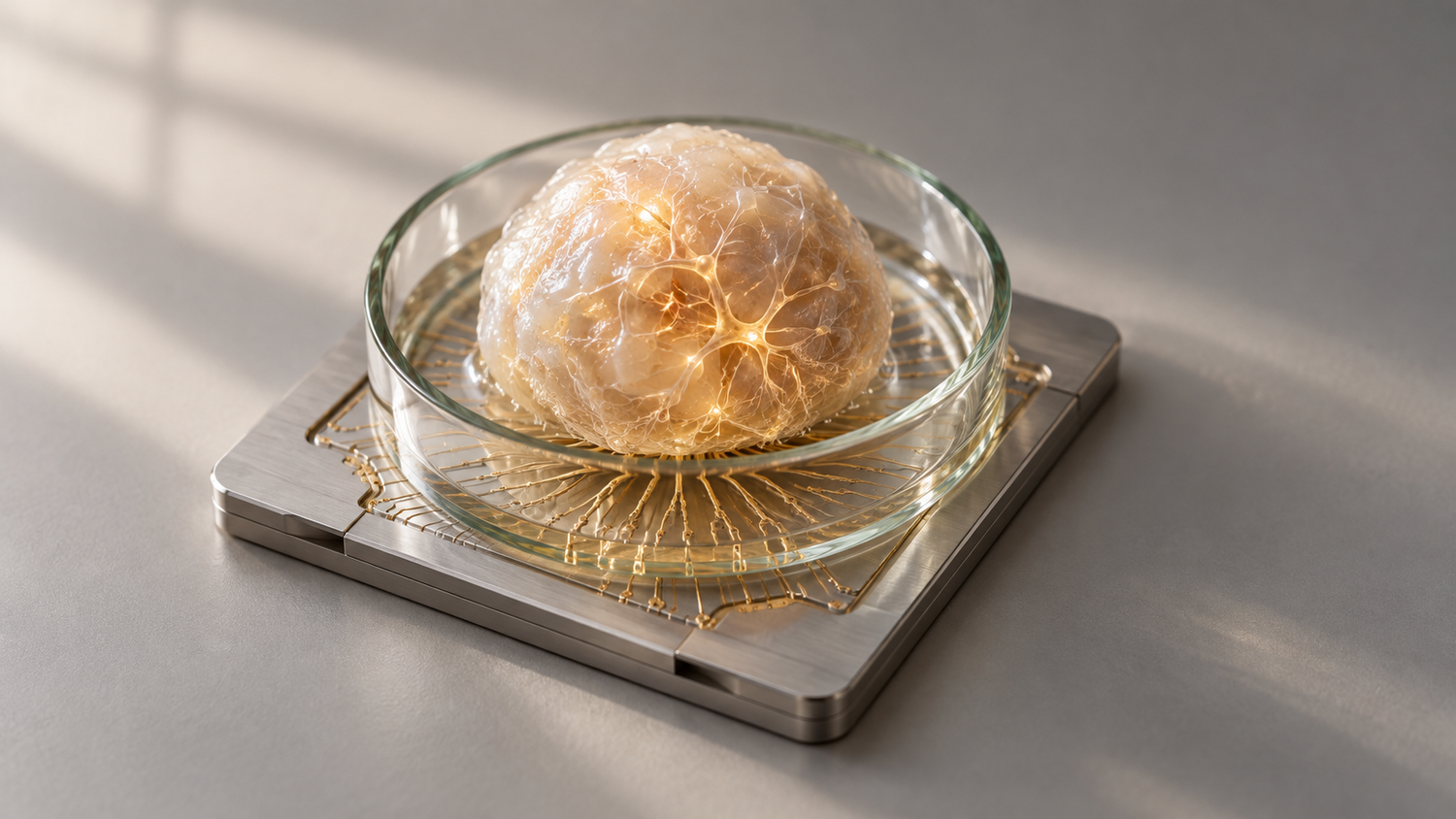
On 18 September 2026 El País reported from the Basque Country on Sagutxoa, a research project that grows human neurons from the milk teeth of children with rare neurological diseases and intends to send the measurements taken on those neurons to a quantum computer. The neuroscience half of the project has produced something concrete: a public biobank of more than 50 frozen neuronal lines. The quantum half is a plan with access to the machine through a public regional program; the reports describe no quantum hardware result.
The project is led by Salvador Martínez, professor at the Universidad Miguel Hernández and researcher at the Instituto de Neurociencias in Alicante, and is financed by the Bilbao foundation The Walk On Project with an initial budget of 120,000 euros. Its raw material is milk teeth donated by children with rare neurodegenerative diseases; the dental pulp contains neural crest progenitors that become neurons without genetic modification. The computing partner is LKS Next of the Mondragón group, which expects to use the IBM Quantum System Two installed in San Sebastián through the Basque Government's Basque Quantum infrastructure.
For a hospital neurologist or a rare-disease foundation the interesting part is the biology, which is further along than the headline suggests, and the honest part is the timeline: the foundation's president says the phase now under way should reach its first conclusions in about a year, and warns against raising false expectations.
What the Alicante team has built since the first donated teeth: a biobank of more than 50 neuronal lines and 300 further donors
Martínez told El País that the first task was to establish whether the pulp of a shed milk tooth contains neural crest progenitors, and that the answer was yes. The stem cells in the pulp turn into neurons naturally, without any genetic reprogramming, which is the point of difference from induced pluripotent stem cell models that rewrite a skin or blood cell's program first. In culture, he says, the neurons behave as neurons do: they form circuits, connect to one another and develop synapses, which produces very large volumes of electrophysiological, proteomic and transcriptomic data.
The group now holds a public biobank with more than 50 frozen neuronal lines and has another 300 children willing to donate a tooth. The first phase concentrates on two rare conditions, adrenoleukodystrophy, a progressive genetic disorder of the nervous system, and congenital epilepsy. The study design is a comparison: neurons from children without a neurodegenerative condition against neurons from affected children, across the same measurements. Martínez calls the human-cell model a qualitative leap because the comparison happens in human neurons, with no animal step in between.
The funder, The Walk On Project, was created by Mikel Renteria after his son Jon was diagnosed with a severe neurodegenerative condition; El País puts its age at sixteen years and the money it has put into research so far at 1.5 million euros, raised through concerts, sports events and a rubber-duck race on the Bilbao estuary. Sagutxoa means little mouse in Basque; the Ratoncito Pérez of Spanish childhood, who collects milk teeth, gives the project its name.
What LKS Next and Aitor Moreno say the quantum computer will do with the electrophysiology data
The neurocomputation stage is led by Aitor Moreno of LKS Next, a technology consultancy inside the Mondragón corporation. The cooperative's own magazine, TU Lankide, described the collaboration on 9 September 2026, nine days before El País, and confirms the 120,000-euro initial budget and the partnership between the foundation, LKS Next and the CSIC institute in Alicante.
Moreno's description of the method, as quoted by El País, is that quantum computing allows the team to analyze and evaluate large volumes of electrophysiological data by parallelism, and that by brute force it can analyze what happens with the molecules involved, which will make it easier to find hidden patterns in the diseases under study. The machine he intends to use is the IBM Quantum System Two that the Basque Government and IBM inaugurated in San Sebastián on 14 October 2025 at the IBM-Euskadi Quantum Computational Center in the Ikerbasque building, under a partnership that began in 2023 within the BasQ initiative. Access comes through Basque Quantum and, for the Bizkaia side, the provincial council's Biqain strategy.
Quantum pillar: computing. Technology readiness: TRL 2 of 9. The quantum analysis is a stated concept with reported access to the San Sebastián machine; the cited reports describe no algorithm run on the neuronal data and no hardware result, and the neurons themselves are a laboratory disease model several steps before any patient study.
Why brute-force parallelism is the wrong picture of a 2026 quantum processor, and what a Basque run has actually looked like
The phrase parallelism by brute force describes how a classical cluster works, and it is the standard misreading of a quantum computer. A gate-based processor does hold a superposition over many states, and each measurement returns a single bit string drawn from the resulting distribution; a useful algorithm is one whose gates arrange constructive interference on the desired outcomes and destructive interference elsewhere, so that repeated measurements concentrate on the answer with acceptable statistics. Present hardware adds two constraints. A Heron-class processor of the kind installed in San Sebastián runs circuits of limited depth before noise takes over, and classical data has to be encoded into qubit states before any circuit can act on it; IBM's own course material on data encoding sets out the basis, angle and amplitude encodings and the overhead each carries. Data-loading costs must be included in any claimed advantage, and the reports provide no encoding or resource estimate for the Sagutxoa data. An earlier medical run on the Basque IBM backend shows the scale at which such work currently happens. In the Tecnun study this Monitor examined earlier, synthetic myelodysplastic-syndrome patients were seven-bit samples drawn from ibm_basquecountry, the 156-qubit Heron r2 processor of the San Sebastián system; the underlying paper by Olatz Sanz Larrarte and colleagues, arXiv:2608.28168, describes seven binary variables per patient and training subsamples of 100 to 400 patients, a proof that the workflow runs, at a scale far below any pattern search across a biobank.
None of this makes Sagutxoa's plan unreasonable. The cited reports do not specify the quantum algorithm or experimental design; a realistic version, in this Monitor's reading, would be a hybrid pipeline: classical feature extraction from the recordings, a compact variational or kernel model on a small number of qubits, and a classical benchmark run alongside so that any quantum contribution is measured against it. Martínez's own framing, that quantum algorithms will yield biomarkers and that results will become evident once ten diseases have been analyzed, sets a broader research ambition without a timetable; Renteria's one-year estimate refers to the phase now under way, with a caution attached, and neither man gives the quantum result a date.
What a clinician or a rare-disease foundation can take from Sagutxoa today
The transferable asset is the neuronal model. A public biobank of patient-derived neurons from adrenoleukodystrophy and congenital epilepsy, grown without genetic reprogramming, is valuable to any group working on those conditions whether or not a quantum processor is ever involved, and the 300 pending donors suggest the collection will grow. The initial budget of 120,000 euros and the access route through Basque Quantum are the only funding facts the reports give. The claim to hold to a standard is the analytical one: when LKS Next reports a result from the San Sebastián machine, the questions are how many qubits carried the data, what the classical baseline was, and whether the reported pattern survived on neuronal lines the model had not seen.
How Quentir Reads It
Sagutxoa is a strong neuroscience story with a quantum step attached to its end, and the reports describe no test of that step. The biology is at the laboratory-model stage, which is real progress for two rare pediatric conditions; the quantum analysis is a stated intention with reported computer access, which places it at the concept rung. The overstatement in the public account is the brute-force parallelism description of the machine, which will not be how any successful run works. The Evidence Register will carry the project as a laboratory model with a planned quantum analysis, and will move it up only when a result appears with a classical baseline beside it.
Sources
Primary source: El País, País Vasco edition, "Un ensayo aplica la computación cuántica a las neuronas obtenidas de dientes de leche," 18 September 2026, reporting interviews with Salvador Martínez (Universidad Miguel Hernández and Instituto de Neurociencias, Alicante), Aitor Moreno (LKS Next) and Mikel Renteria (The Walk On Project). Also drawn on: The Walk On Project's own site for the foundation's history; TU Lankide of 9 September 2026 on LKS Next's participation; the Basque Quantum announcement of 14 October 2025 on the IBM Quantum System Two in San Sebastián; IBM's quantum machine learning course page on data encoding; the Tecnun preprint arXiv:2608.28168 and earlier Quentir coverage of it. The readiness placement and the reading of the parallelism claim are this Monitor's own.