A Diamond Magnetometer Closes the Distance to Biomagnetism
A smaller gap between sensor and signal
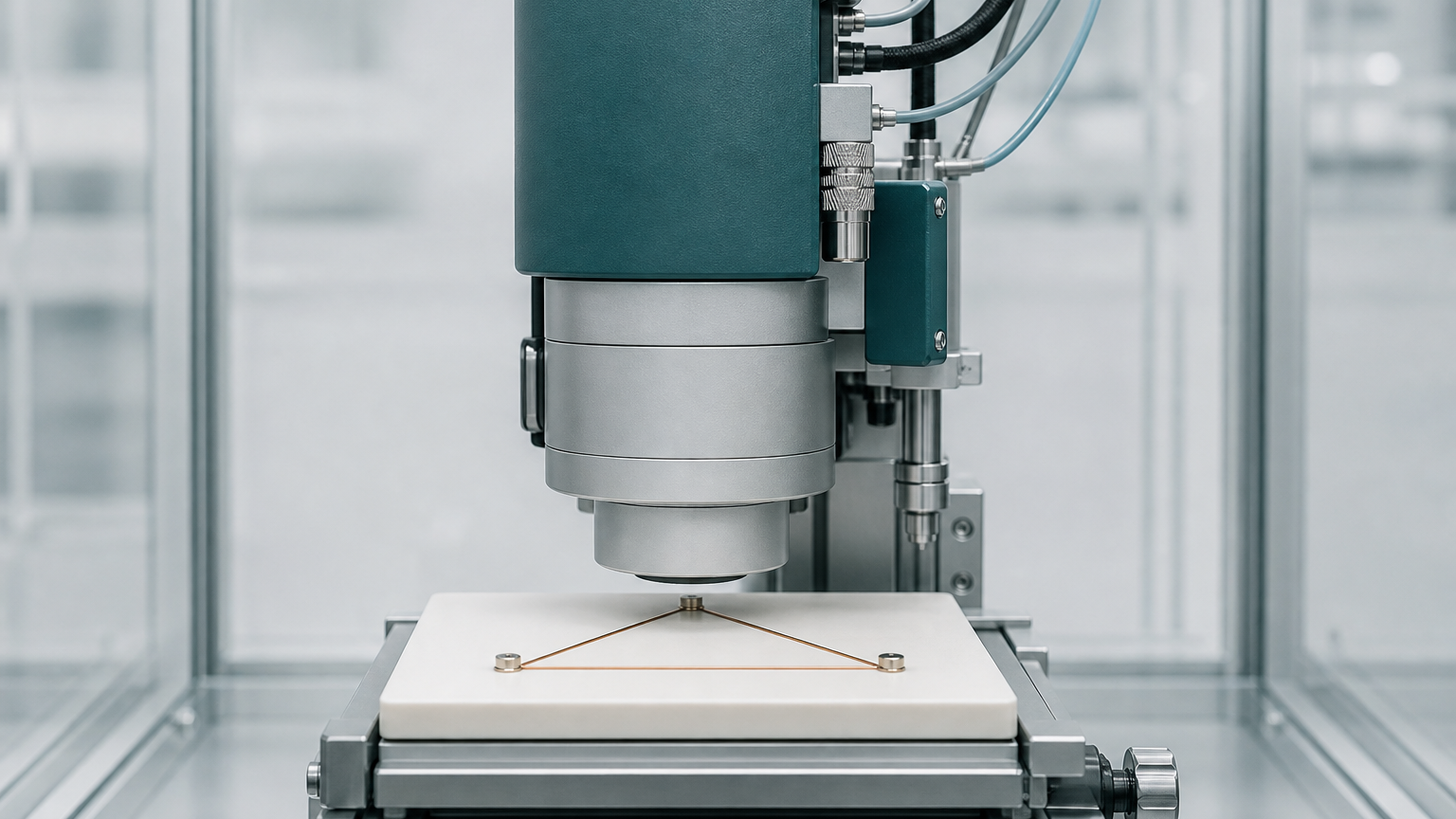
Biomagnetic fields weaken sharply with distance, so the physical gap between a detector and the body is part of the sensitivity budget. Yuta Araki and colleagues have built a diamond NV magnetometer whose sensing head can sit about 2.0 millimeters from a sample. A compact microwave antenna helps set that geometry, while a light-trapping diamond waveguide makes more efficient use of the green laser that initializes and reads the sensor's nitrogen-vacancy centers. The integrated device addresses the heat and bulk that have limited high-sensitivity Ramsey measurements near biological samples.
What the laboratory result establishes
The peer-reviewed paper reports 2.93 picotesla per square-root hertz sensitivity across 100 to 400 hertz at 210 milliwatts of laser power. The measured temperature increase was approximately 13 kelvin. In a controlled test, the sensor detected a 77.7-picotesla field from a dry brain-field phantom at a 2.5-millimeter standoff, without signal averaging and with a signal-to-noise ratio of approximately 4.3. Quentir assesses the assembled system at TRL 4 of 9: a quantum sensing device validated in the laboratory on a phantom that imitates a brain-field pattern.
The clinical distance remains
The phantom does not reproduce movement, anatomy, variable spacing or the environmental interference of a living-subject recording. The authors also state that sub-picotesla brain signals will require further accumulation and improved sensitivity. A future magnetoencephalography or magnetocardiography instrument would need stable arrays, calibration and clinical comparisons as well. The current paper supplies no human dataset, workflow study, regulatory record or manufacturing claim. Those absences keep the result at the laboratory-instrument stage even though its geometry addresses a genuine near-body constraint. Quentir reads the paper as a bounded hardware advance. It joins optical efficiency to a short sensor-to-sample distance, reports each operating constraint quantitatively, and makes the next test easy to name: a living-subject measurement with a defined physiological signal and an established comparator.