A Diamond Magnetometer Closes the Distance to Biomagnetism
Quentir Medicine Monitor
Evidence-based insights for quantum medicine. Published by Quentir Systems LLC · August 18, 2026.
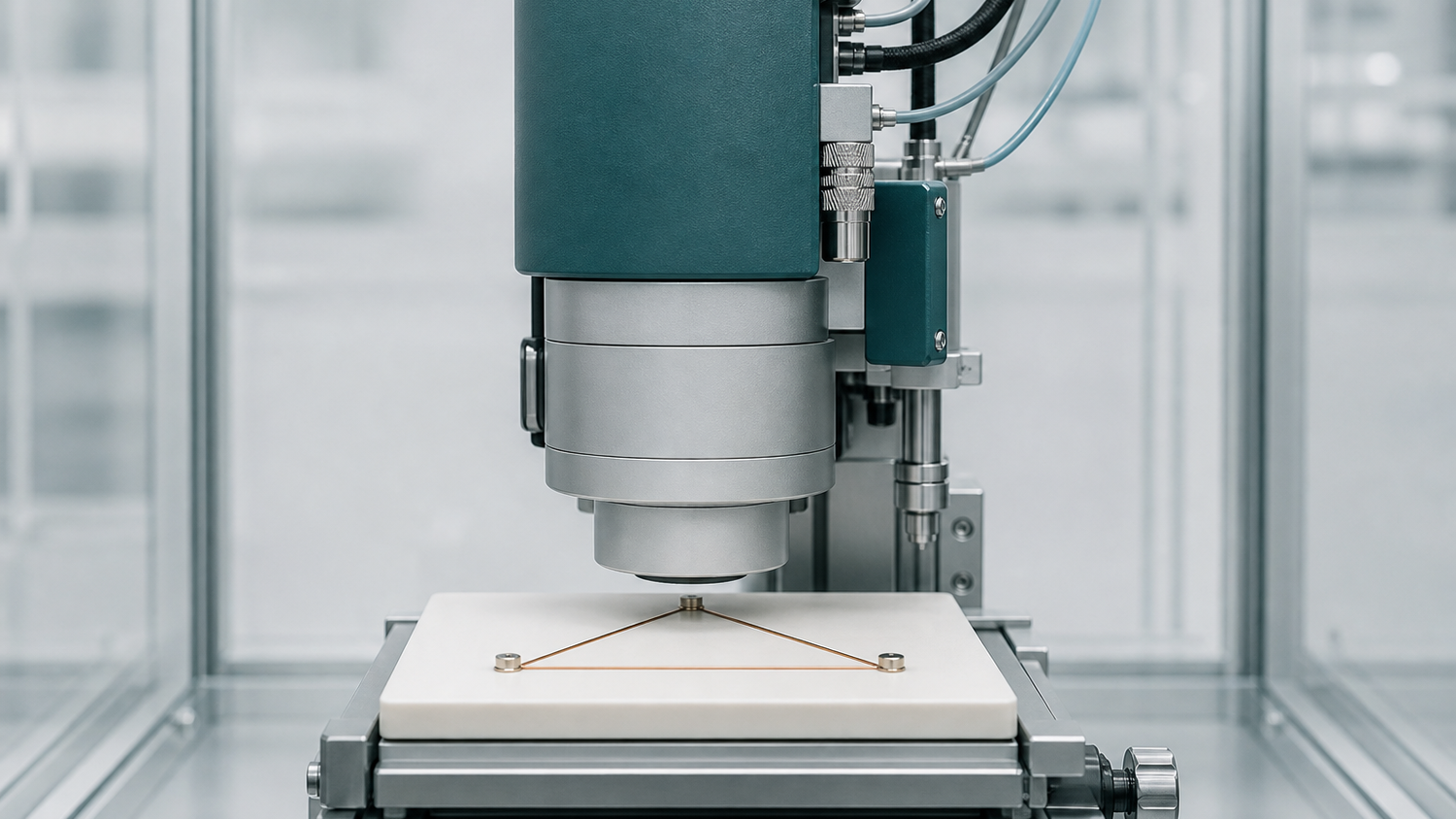
Biomagnetism poses an unforgiving engineering problem: the signal fades sharply with distance, while the sensor itself adds heat and bulk. A new diamond NV magnetometer brings its sensing head within 2.0 millimeters of a sample and runs its laser at 210 milliwatts, turning two physical constraints into one compact laboratory result.
Yuta Araki and colleagues at the Institute of Science Tokyo, Japan's National Institute for Materials Science, the National Institutes for Quantum Science and Technology, and Denso report the device in Applied Physics Letters. Their short sensor-to-sample distance matters because magnetic fields from the brain and heart weaken rapidly before they reach a detector. Their light-trapping diamond waveguide also cuts the optical power needed for Ramsey interferometry, holding the reported temperature rise to about 13 kelvin.
The team then tested a dry brain-field phantom at a 2.5-millimeter standoff. The sensor detected a 77.7-picotesla field without signal averaging, with a signal-to-noise ratio of approximately 4.3. That is a measured phantom result. It is still some distance from recording the much weaker magnetic activity of a living brain.
Practical takeaway. The paper solves a meaningful piece of the biomagnetic instrument problem by combining lower optical power with a shorter measurement distance. It validates a laboratory sensor on a dry phantom, not a clinical magnetoencephalography system.
Distance is part of the sensitivity budget
Magnetoencephalography records magnetic fields generated by coordinated electrical activity in the brain. Those fields are extremely weak. The apparatus has to separate them from environmental noise while preserving where the signal came from. A detector that can sit closer to the scalp receives more of the local field and can support finer spatial inference, provided the rest of the system remains stable.
The new paper makes that geometry explicit. Its compact microwave antenna and dielectric mirror set a minimum sensor-to-sample distance of about 2.0 millimeters. A JST-affiliated account published on August 17 reports that this is more than three times shorter than earlier Ramsey-based arrangements used by the team. The engineering gain is therefore partly optical and partly mechanical. Sensitivity on a specification sheet can miss the value of moving the detector closer to the field source.
This is also why the dry phantom is useful. The phantom supplies a controlled magnetic pattern that resembles the spatial distribution of a brain signal without adding movement, anatomy, or patient variability. It lets the researchers ask whether their sensor can recover a weak field at the intended standoff. The answer was yes for 77.7 picotesla. The paper also says sub-picotesla brain signals will need further accumulation and improvement.
A waveguide turns laser power into usable fluorescence
Diamond nitrogen-vacancy centers are atomic-scale defects whose spin states respond to magnetic fields. Green laser light initializes and reads those states, while microwaves control the spin sequence. In ensemble sensors, more useful fluorescence usually helps sensitivity. High laser power, however, can heat a device that is supposed to work close to living tissue.
The researchers used a light-trapping diamond waveguide so the 532-nanometer beam reflects repeatedly inside the diamond. More of the light interacts with the NV centers before leaving the sensor. The peer-reviewed article, published July 20, 2026, reports an optical power conversion efficiency of 9.5 percent. At 210 milliwatts, the device reached a magnetic sensitivity of 2.93 picotesla per square-root hertz across 100 to 400 hertz. The reported temperature increase was approximately 13 kelvin.
Those numbers belong together. A biomagnetic sensor that reaches an attractive sensitivity by pouring several watts of laser power into a near-body assembly has traded one constraint for another. Here the waveguide, microwave antenna and Ramsey sequence operate as an integrated design. The result suggests a path toward smaller room-temperature sensing heads, although it does not establish comfort, biocompatibility, long-duration stability, or performance on a person.
Quantum pillar: sensing. Technology readiness: TRL 4 of 9. Quentir assesses the assembled quantum magnetometer at this level because it was validated in a laboratory on a dry phantom, before testing on living subjects or use in a clinical diagnostic workflow.
The phantom result draws a clear boundary
A dry phantom is a strong choice for instrument validation because it fixes the target field and geometry. It is a weak substitute for biology. A human measurement introduces motion, variable sensor spacing, tissue contours, ambient fields and the problem of separating a physiological signal from competing sources. The sensor also has to operate for clinically useful periods without thermal drift or calibration loss.
The authors identify several next improvements. Better diamond crystal quality could extend spin coherence. More control over the charge state of NV centers could preserve the population that contributes to sensing. Lower reference-light noise could improve the readout. The system also needs greater tolerance to temperature-driven shifts in resonance frequency if it is to remain stable over long recordings.
For hospital buyers, that list explains why Quentir assesses the paper at TRL 4. The device exists, its parts have been assembled, and the team measured a relevant phantom under laboratory conditions. There is no living-subject dataset, clinical comparison, regulatory clearance, workflow study, or manufacturing record. The target applications, magnetoencephalography and magnetocardiography, are credible because both depend on tiny magnetic fields. They remain targets.
Room temperature changes the instrument architecture
The complete instrument matters more than any one favorable component. Cooling burden is one cost, but magnetic shielding, calibration, channel count, sensor placement and analysis software also shape a usable system. A room-temperature sensor changes which engineering compromises are available. It does not by itself establish a portable or inexpensive scanner.
Denso's presence among the authors is worth noticing for the same reason. The paper has an industrial co-author with experience in compact sensing and manufacturing. That does not turn the prototype into a product. It suggests that the work is being shaped by concerns that extend beyond a physics bench: packaging, heat, distance and repeatable hardware.
How Quentir Reads It
Quentir reads this paper as a hardware result with unusually legible constraints. The team did not lead with a broad promise about quantum diagnostics. It reports a sensitivity band, laser power, optical conversion efficiency, temperature rise, sample distance and phantom field. Each number answers a different reason why an NV magnetometer might fail near the body.
The most interesting connection is between metrology and anatomy. Better field sensitivity has medical value only when the detector can approach the source safely and preserve spatial information. The 2.0-millimeter mechanical distance is therefore as consequential as the 2.93-picotesla sensitivity figure. It connects the quantum defect inside the diamond to the geometry of a future examination.
The next decisive record would come from living-subject measurement with a defined physiological target and a comparator. Until then, the device is best understood as a compact laboratory magnetometer that has crossed a dry phantom threshold. It brings diamond quantum sensing closer to biomagnetism by closing the physical gap first.
Sources
Primary source: Yuta Araki, Takeharu Sekiguchi, Yuji Hatano, Naota Sekiguchi and colleagues, “A highly sensitive diamond NV magnetometer using Ramsey interferometry with a short sensor-to-sample distance,” Applied Physics Letters 129(3), published July 20, 2026. Public research account: JST’s Objective Japan, August 17, 2026.